
Patio Decor Ideas That Turn Your Outdoor Space Into a Real Room
The summer I finally got my patio right, I didn’t buy anything new. I rearranged what I had, added one outdoor lantern, and strung lights from the eaves to the fence post. That was it. And suddenly, instead of walking past that back door and feeling vaguely guilty about the neglected chairs sitting out there, I started actually going outside.
That’s the thing nobody tells you about patio decor. The problem is almost never a lack of things. It’s a lack of intention. Most patios suffer not from emptiness but from being treated like leftover space — a parking lot for chairs that didn’t fit inside, pots that are only half-alive, a grill pushed into the corner. The patios that make you stop scrolling are designed with the same logic as any room in your house: one focal point, furniture arranged with purpose, lighting that carries you from afternoon into evening, and plants that do the heavy lifting between “built” and “natural.”
I’ve spent the last few weeks looking at patio spaces across every style, budget, and square footage. What I found surprised me. The best ones weren’t the biggest. They weren’t the most expensive. They were the most decided. Every single one of them had made a clear choice about what it wanted to be. Here’s what they taught me.
The Farmhouse Dining Setup That Actually Works Outside
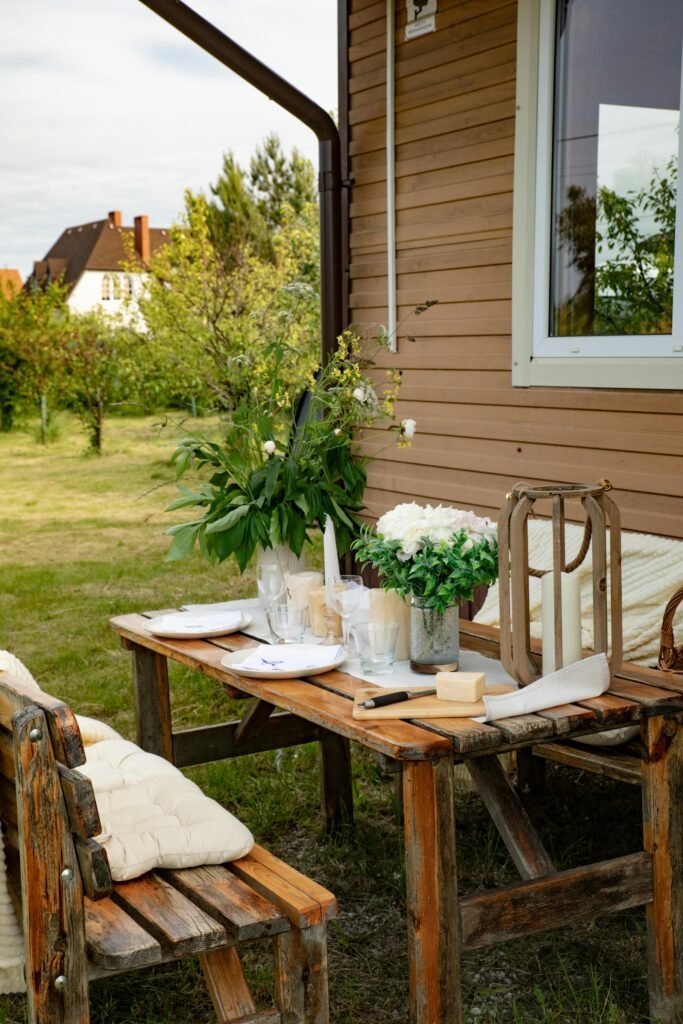
I keep coming back to this image because it does something so simple and so difficult at the same time: it makes the outdoors feel genuinely domestic. Not like a restaurant, not like a camping setup — like someone’s home, just without a ceiling.
The bones here are a reclaimed wood trestle table and matching bench, the kind you can find at farm markets or antique stores for $80–$200 depending on condition. What elevates it completely is the styling. White quilted seat cushions (roughly $25–$40 each) soften the rough wood. Fresh peonies and loose greenery are gathered into a simple white ceramic vase — not a formal arrangement, just garden clippings dumped in water. A wooden lantern sits at the end of the table the way a candle holder might sit on a dining room sideboard.
There’s a lesson here that applies everywhere in patio decorating: the transition objects matter. The things that signal “this was thought about” — the folded napkins, the small candles, the one vase — do more work than the furniture itself. The table says farmhouse. The accessories say home.
This kind of setup pairs naturally with a spring tablescape philosophy: keep the color palette anchored in white and natural green, let fresh flowers and foliage do the decorating work rather than purchasing a collection of outdoor accessories.
What to Do With a Fence You Can’t Change
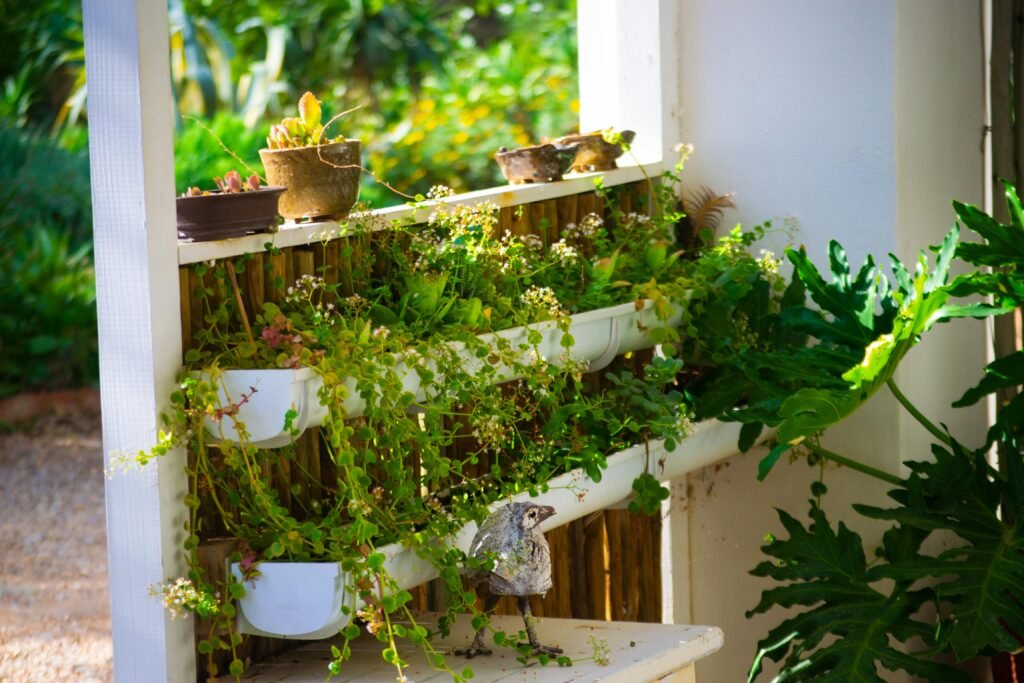
Most rental patios — and plenty of owned ones — come with a fence that’s ugly, or a wall that’s blank, or a boundary that draws the eye in all the wrong ways. The answer is almost always plants, but vertical plants specifically, because they turn the problem boundary into the focal point.
What’s happening here is genuinely clever: white rain gutters have been repurposed as horizontal planters and mounted in tiers along a bamboo privacy screen. The trailing plants — creeping jenny, string of pearls, baby’s tears — spill down between the levels, so the entire structure looks like a living waterfall. Terracotta pots on the top tier hold upright succulents. The small bird figurine at the base is the kind of whimsical detail that makes people lean in and look.
The cost to build something like this yourself is remarkably low. Standard vinyl rain gutters run about $5–$8 per 10-foot section at any hardware store. You’ll need end caps ($1–$2 each) to hold soil, and drainage holes drilled every 6 inches. The whole planter system can be done for under $40 — the plants will cost more than the gutters.
Trailing plants for this purpose: sweet potato vine, bacopa, million bells, creeping thyme, or any of the Plectranthus varieties. Mix textures and scale for maximum effect. Whatever you do, don’t plant a single species — the visual interest comes from the contrast between fine-textured trailers and bolder foliage.
Why Evening Lighting Changes Everything
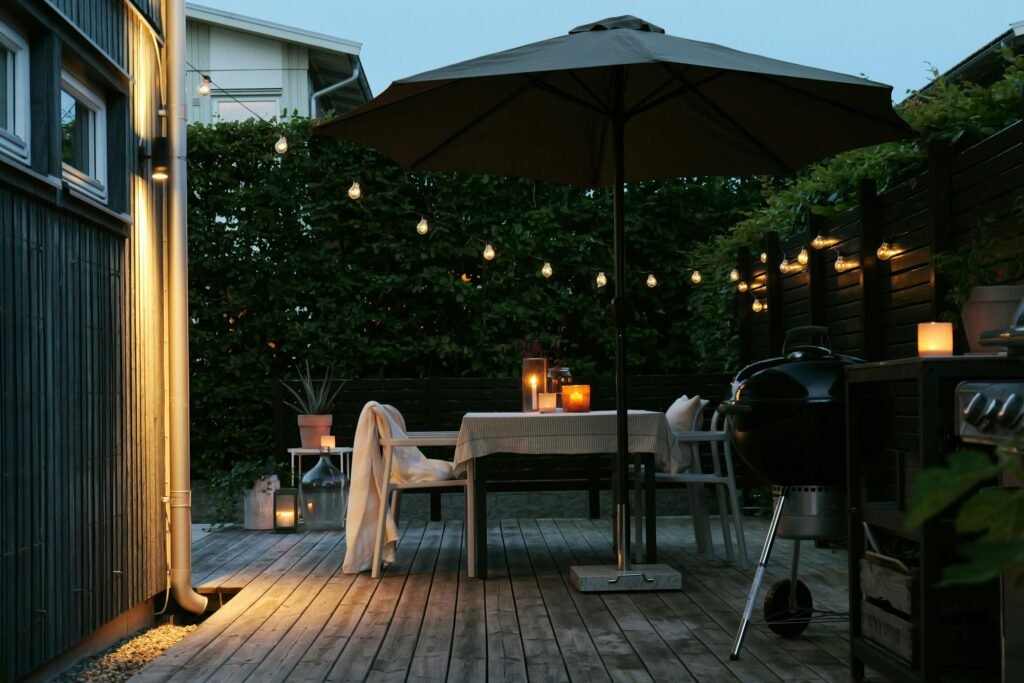
I want you to look at this patio in full daylight and imagine it without the lights. It’s fine. It’s a wooden deck with some chairs, a grill, and a hedge. Nothing wrong with it. Nothing special either.
Now look at it at dusk with the Edison bulb string lights strung overhead and the candles lit on the table. It’s completely different. It’s atmospheric and warm and the kind of place where you’d want to stay for hours after dinner.
This is the single most underrated thing you can do for any outdoor space: add string lights. Not fairy lights, not solar twinkle lights — proper café-style Edison string lights with globe bulbs, mounted at a height that creates a canopy over the seating area. The warm glow at roughly 2,700K color temperature makes people look better and feel calmer. That’s just physics.
Outdoor string lights run $20–$60 for a 25-foot strand depending on bulb quality and weatherproofing. You’ll want commercial-grade wire (not the cheap green stuff) if you’re leaving them up year-round. Mount them with screw hooks on fence posts or pergola beams, and run them in a loose zigzag rather than straight parallel lines — the overlap creates more density of light.
The candle lanterns on the table do the second layer of work. Layered lighting outdoors — overhead strings plus table level candlelight — operates the same way layered lighting does inside. It creates depth, warmth, and the sense that the space was designed, not assembled. If you’re just starting your patio refresh, start here.
The Case for One Statement Chair
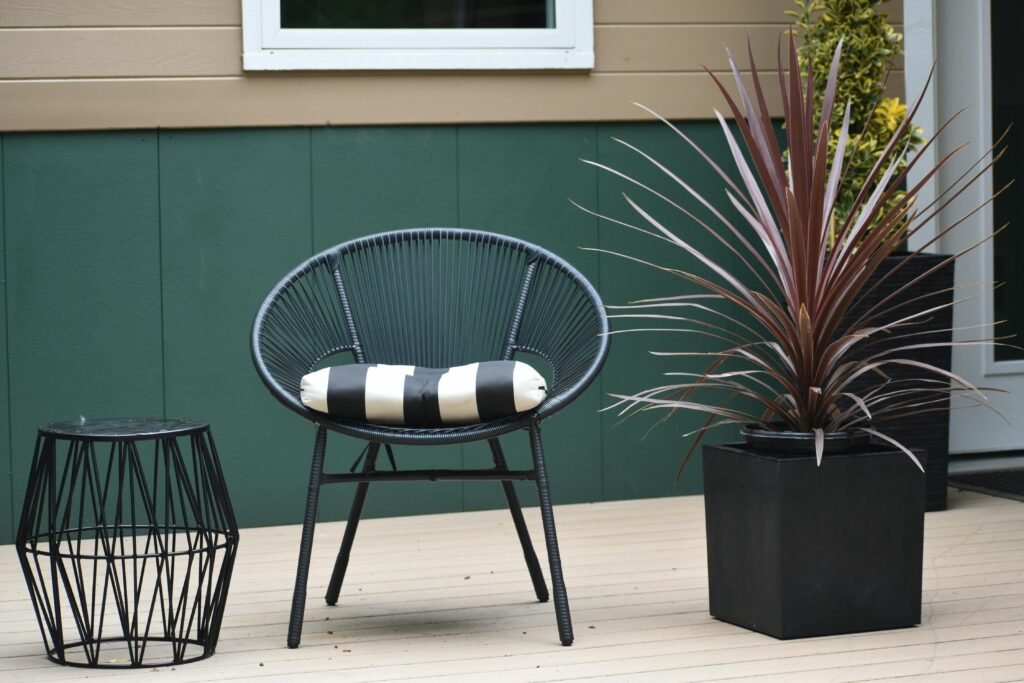
There’s a patio decorating mistake I see constantly: buying a matching set of four chairs and a table, arranging them symmetrically, and wondering why it feels like a waiting room. The answer is that patios with too many equal-weight pieces don’t have a focal point. They have furniture.
This image is the antidote. One Acapulco-style rope chair — the round, woven kind that’s been everywhere for the last five years — in all-black, paired with a simple black geometric wire side table, and flanked by one large black square planter holding a Cordyline ‘Red Star’ whose burgundy-red spikes arc outward dramatically. The house behind it is painted deep hunter green and warm olive, which makes the black graphic furniture pop.
The lesson: one great chair does more for a small patio than three average chairs. The Acapulco chair runs $150–$350 depending on brand and UV resistance of the cord. The Cordyline ‘Red Star’ is widely available at garden centers for $25–$60 for a three-gallon pot, and it’s remarkably hardy in USDA zones 7–11. The black planter gives it weight and permanence.
If you’re working with a small deck or a patio that doesn’t need to seat a crowd, resist the impulse to fill it. One chair, one side table, one dramatic plant, and a clear view from the doorway. That’s enough. That’s a vignette, not a room — and vignettes on patios are deeply underutilized.
The Pergola-and-Curtains Combination
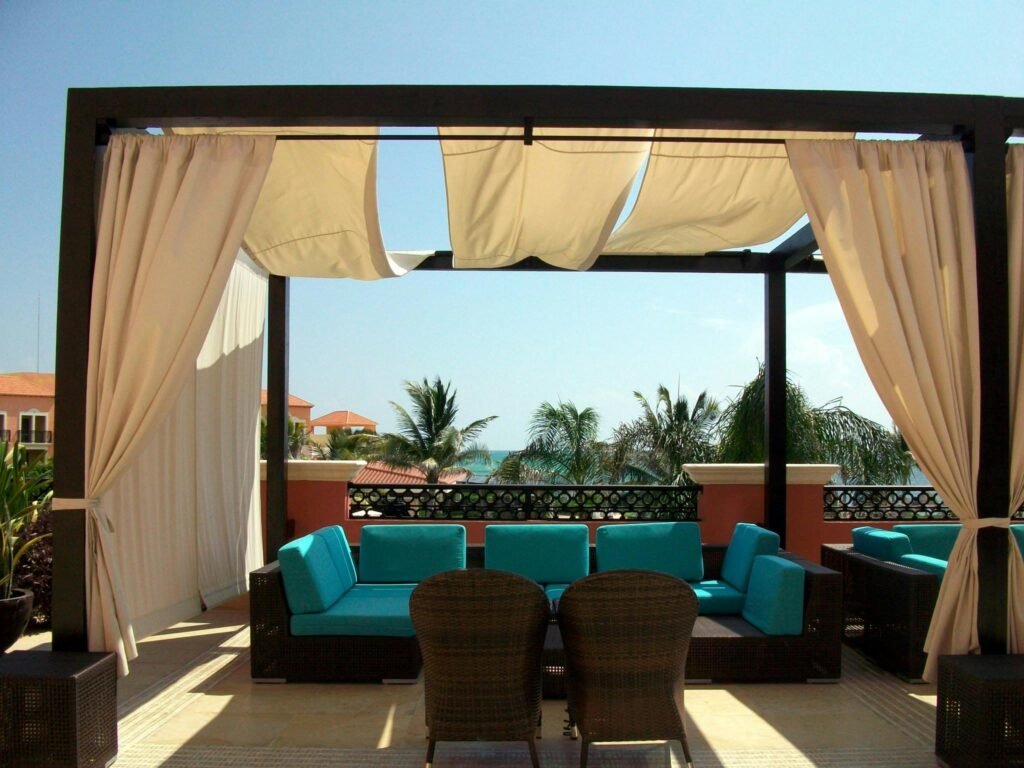
A pergola alone is structural. Add curtains, and it becomes a room.
This image is resort-level in execution, but the principle scales down to any backyard pergola. The dark wood or powder-coated steel frame creates the architectural bones. The cream canvas panels draped across the top break the direct sun without blocking light entirely — this is different from a solid roof and creates a much softer, more romantic quality of shade. The linen curtains on the sides can be pulled or tied back to open the space, or closed for privacy and to block afternoon glare.
What makes the color palette work is the tension between neutral and vivid. The frame is dark, the fabrics are cream and natural, the cushions are Cozumel turquoise. The furniture underneath is dark woven wicker, which grounds the bright cushions without competing with them. This is the contemporary coastal living room principle applied outdoors — one saturated accent color against a base of neutrals.
Budget reality: a freestanding 10×10 wood pergola kit runs $400–$1,200 depending on materials. Adding a fabric canopy costs roughly $80–$200 for outdoor-rated canvas. Outdoor curtain panels (UV and moisture resistant) run about $30–$60 per pair. The transformation from bare pergola to draped outdoor room: significant. If you already have a pergola and haven’t added curtains yet, this is the weekend project that will actually get you outside.
When the Patio Becomes the Living Room
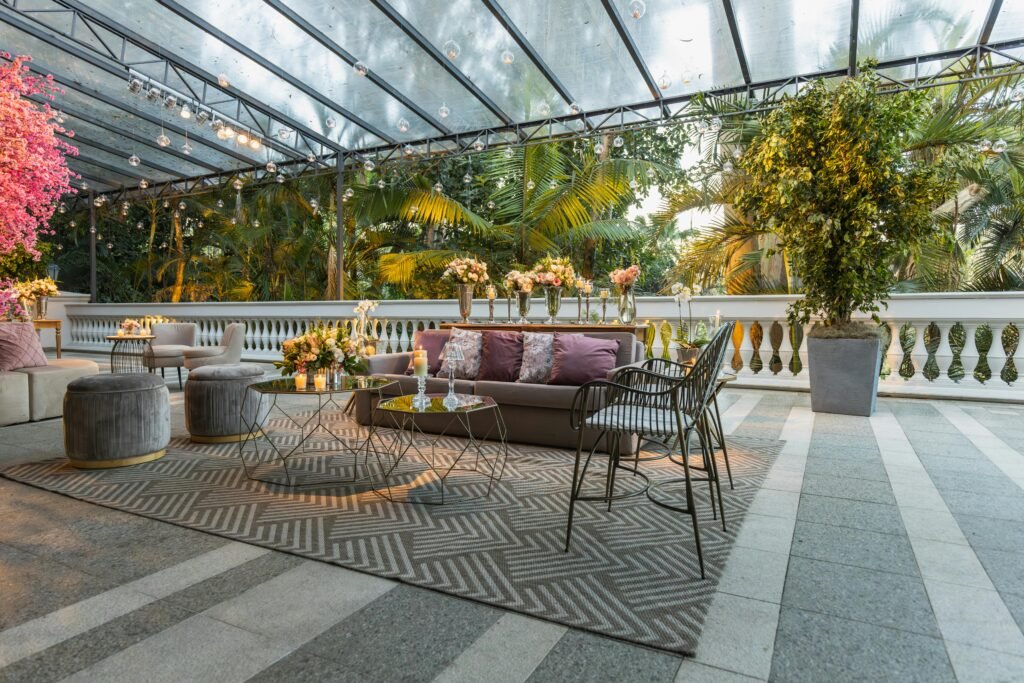
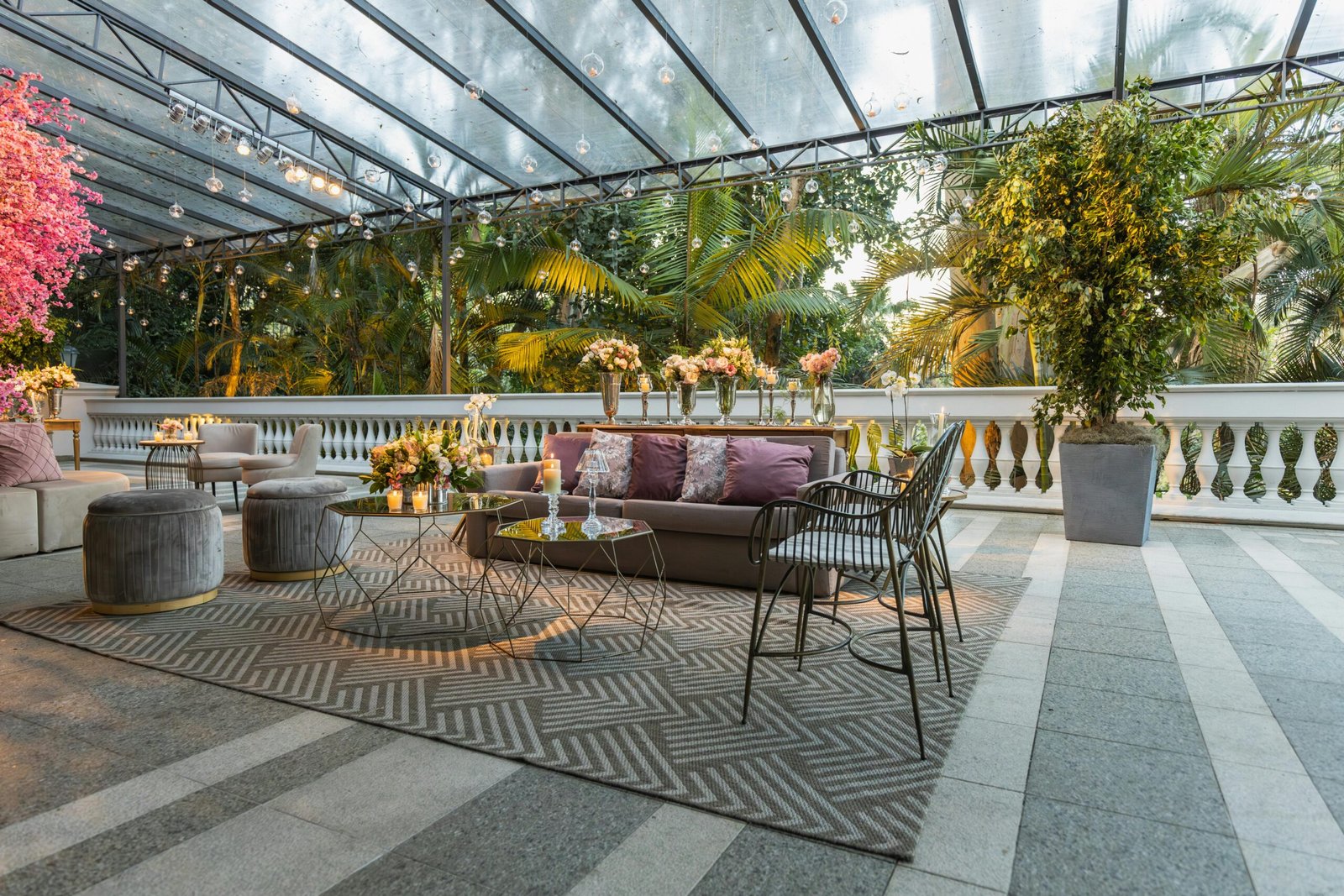
This space sits on the far end of the spectrum from everything else in this article — it’s clearly a professionally designed event space or resort conservatory, not a backyard weekend project. But I’m including it because it makes the argument better than anything else could: the patio can be the most beautiful room in the house.
Look at what it’s doing. The glass roof creates enclosure and protection while keeping the sky visible — the same move a greenhouse makes, but applied to a social space. The structural steel frames are left exposed and painted black, which reads as industrial rather than unfinished. The plants are monumental: mature palms, a full bougainvillea in deep pink, hanging tropical climbers. The lighting is a string of clear glass globe pendants hung from the ceiling structure, creating the same warm glow-above-the-eye effect as outdoor string lights.
The furniture is indoor-quality in its upholstery and scale — a full sofa with deep cushions, velvet ottomans, an area rug with a graphic chevron pattern — but chosen in materials that tolerate humidity and shade. This is the key insight: if your patio is covered and protected from direct rain, you have far more furniture options than you think. You don’t need to buy the standard teak-and-weather-resistant-wicker outdoor set. You can buy an indoor-style deep seating arrangement in performance fabrics (Sunbrella and similar run $15–$25 per yard) and treat your covered patio like an actual interior room.
If you’re looking at 2026 home decor trends, the indoor-outdoor blurring has been one of the most prominent — and this space represents where that trend goes at its most committed.
The Fire Pit That Makes a Patio Feel Complete
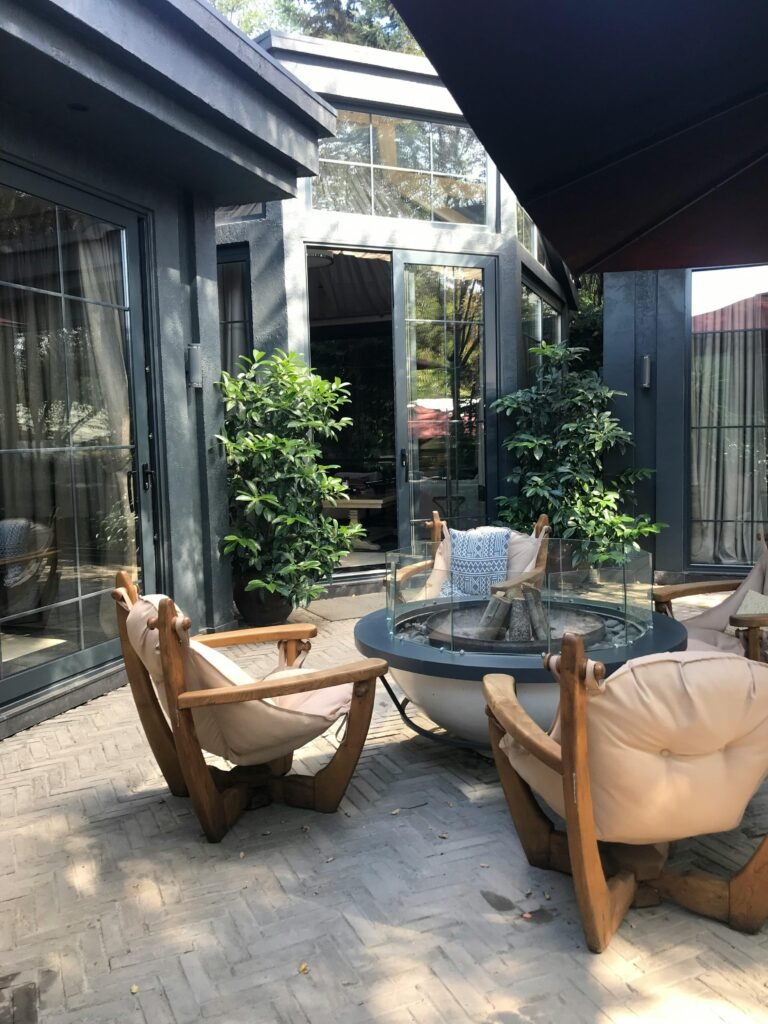
Every time someone asks me what a patio is “missing,” my first question is: is there a fire? Not necessarily a fireplace — those are their own conversation — but some kind of fire element. Because fire does something nothing else in exterior design can do: it gives you a reason to stay outside after dark, and it gives your eyes somewhere to rest.
This patio has figured it out. The round concrete fire bowl with a glass wind guard sits at the center of a loose seating arrangement, flanked on all sides by teak chairs that are somewhere between a safari chair and a lounge chair — deep seat, angled back, the kind of thing you sink into. The floor is herringbone-patterned brick, which adds texture at ground level without competing with anything above it. The architecture is dark charcoal-painted wood and glass, so the warm tones of the fire and the teak furniture do all the warming work.
A concrete or steel round fire pit like this runs $300–$800. The glass wind guard is sold separately for most models ($60–$150) and is worth it if you live anywhere that gets a breeze. Teak outdoor chairs at this quality — with the angled slat back and canvas cushion — run $200–$450 each.
The most important thing this patio gets right is the relationship between the fire pit and the seating radius. Chairs are close enough to feel the warmth and see faces across the fire, but not so close that you’re craning your neck. The magic radius is roughly 5–7 feet from the edge of the fire pit to the front of the seating. Less than that and it feels crowded and hot. More than that and the fire becomes scenery rather than experience.
Lanterns, Plants, and the Layered Deck
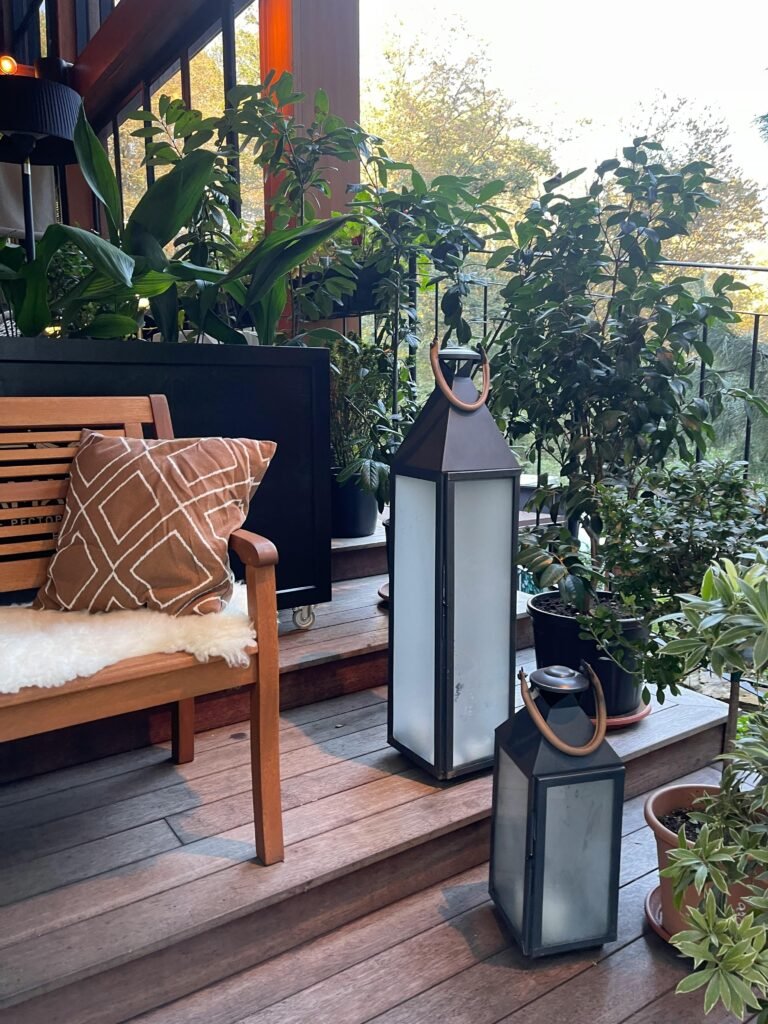
This image is a masterclass in layering a small deck without overwhelming it. Nothing here is expensive. Everything here is intentional.
Start with the bench — a simple slatted teak or eucalyptus outdoor bench, around $150–$250. On it: a terracotta-toned geometric throw pillow ($20–$35) and a white faux sheepskin throw ($30–$60). Those two additions take a garden bench from “somewhere to sit briefly” to “somewhere to curl up and stay.” The softness of the sheepskin against the rough wood grain is exactly the kind of textural contrast that makes a space feel layered rather than flat.
The lanterns are the real stars. Two black metal lanterns — one tall at roughly 28 inches, one shorter at about 16 inches — with frosted glass panels and leather handle loops. They’re lit by pillar candles inside, not plug-in LEDs, which gives the light a warmth that solar or battery options can’t match. Pairing two lanterns of different heights is one of those simple tricks that reads as very deliberate. A single lantern looks forgotten. Two at different scales look styled.
Then the plants. Dozens of them, in black nursery pots, black metal containers, and warm terracotta. Large tropical leaves alternate with smaller-scaled foliage. The variety of container color — all in the black and terracotta range — creates cohesion without rigidity. This plant density is the equivalent of a spring home decor refresh translated into an outdoor permanent installation. Get the containers consistent in color family even if the plants differ, and the collection will always look curated rather than chaotic.
The Rooftop Pergola Problem Nobody Mentions
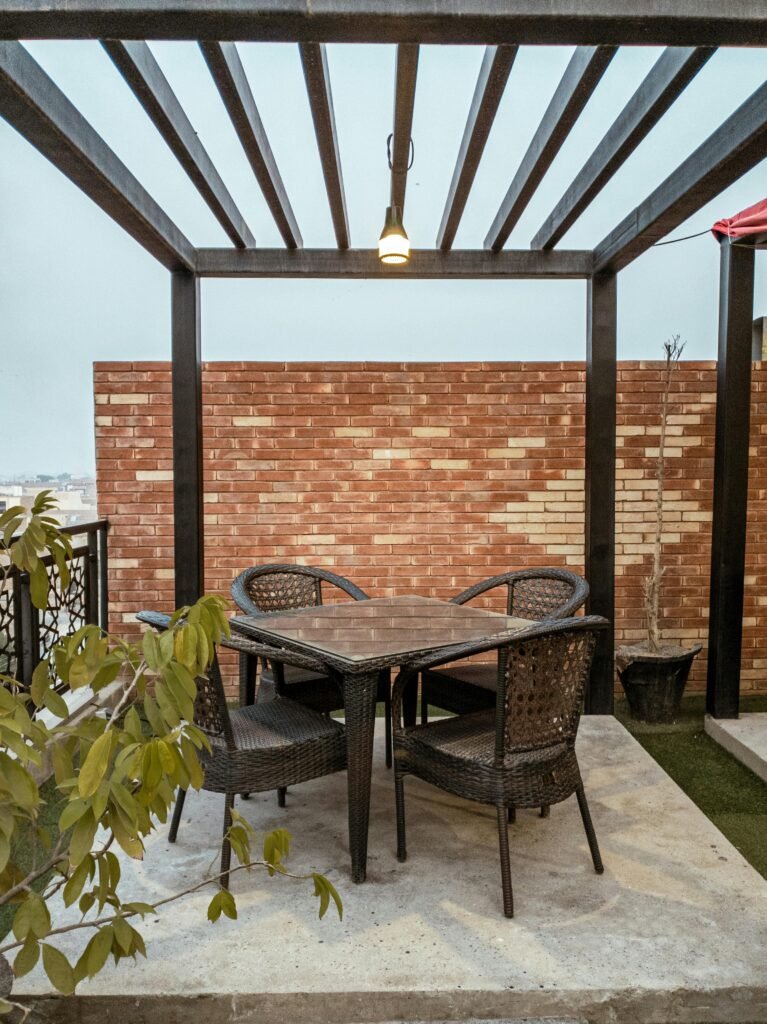
Rooftop patios have a structural problem that ground-level patios don’t: they’re exposed. Too much sun, too much wind, no natural enclosure on any side. Furniture on an unshaded rooftop either bakes in summer or blows around in a storm. This is why pergolas were invented, and why a steel-framed pergola on a rooftop almost always makes sense as the first investment.
This rooftop setup is modest and honest about its constraints. The dark steel pergola frame overhead creates definition and a mounting point for the single pendant light — a warm-toned globe pendant hung from the center beam. Below it: a woven rattan dining set, four chairs around a glass-top table. The exposed brick wall behind reads as a design feature rather than an unfinished boundary, its red and cream tones warming a space that might otherwise feel cold and industrial.
There’s a practical lesson here: on a rooftop, the wall or parapet you can’t remove becomes the backdrop. Work with its color and texture rather than trying to hide it. This brick wall would look worse with a row of planters in front of it trying to camouflage it; it looks right as the deliberate backdrop to a simple dining set.
A freestanding steel pergola rated for wind load (necessary on rooftops) starts around $600–$1,500 for a 10×10 structure. Rattan dining sets that weather rooftop conditions cost $400–$1,200. Add an all-weather pendant light with an outdoor-rated cord, and the total investment for a rooftop that actually functions is $1,200–$3,000 — less than most people spend on a single interior furniture piece.
The Urban Sectional with a View
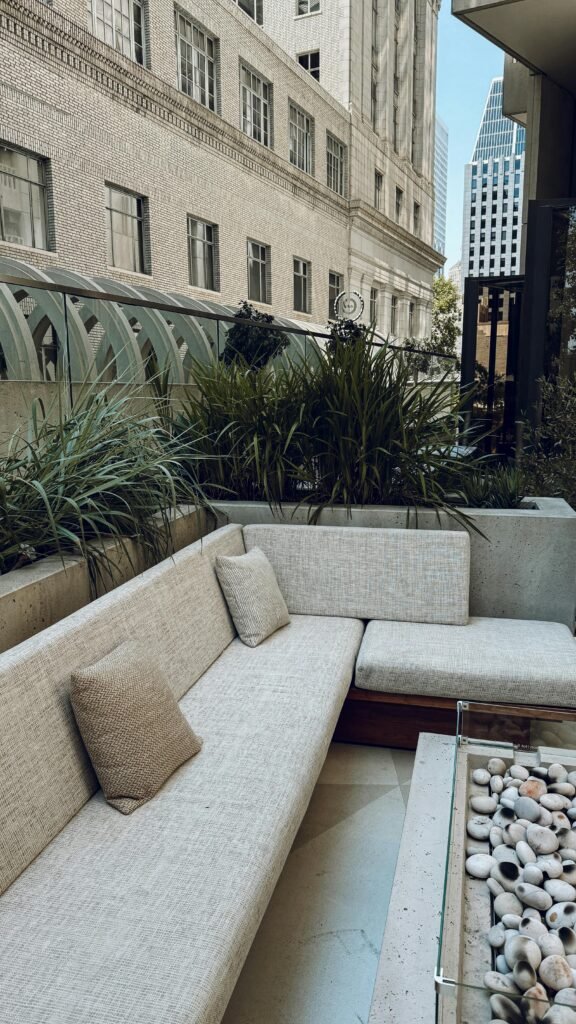
This is what a city patio can be when it stops apologizing for not being a garden. There are no flowers here. No vines, no color, nothing that tries to bring the countryside to the city. Instead: an outdoor sectional in linen-toned performance fabric, concrete planter boxes at built-in-bench height filled with architectural ornamental grasses, and a rectangular fire table with a glass top and river-rock base.
The color story is strictly monochromatic — cream, linen, warm grey, concrete — with the only contrast coming from the dark grasses and the city skyline beyond the glass balustrade. This restraint is what makes it feel considered rather than cold. One pop of bright cushion color here would ruin everything.
The outdoor sectional is the investment piece. A performance-fabric sectional at this size and quality — weather-resistant, UV-stable, quick-dry foam cushions — runs $1,800–$4,500 depending on brand. West Elm, Pottery Barn Outdoor, and Restoration Hardware all carry versions of this profile. The concrete planters at this scale (roughly 18 inches high, 36 inches long) run $150–$400 each, and they’re worth the weight because they read as architecture, not accessory.
The fire table ($400–$1,200 for a propane model this size) anchors the seating without requiring a permanent installation — important on any rooftop where you don’t own the structure. If you’re thinking about 2026 paint color trends and how they apply outdoors, this palette of warm whites and natural linen is where the market is moving: away from all-grey cool minimalism, toward warmer neutrals with texture.
The Boho Patio That Refuses to Be Serious
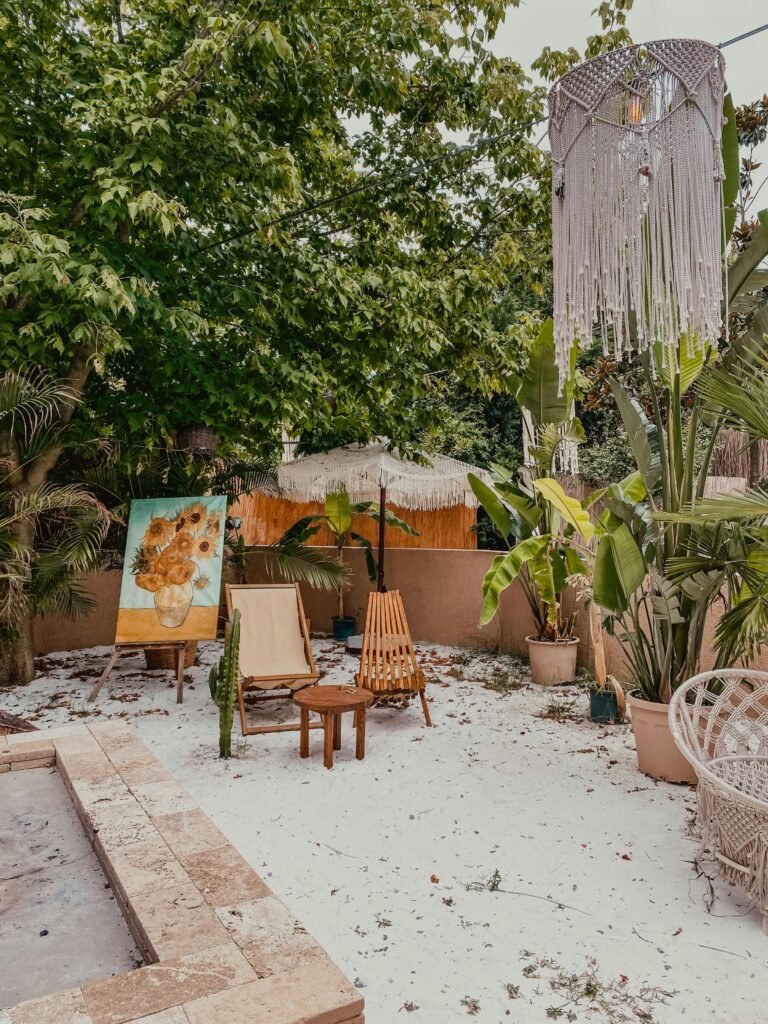
Every other space in this article has been about structure. This one is about the opposite.
What I love about this bohemian outdoor setup is that it has made peace with the fact that a backyard can be weird and personal and joyful in a way that an interior room rarely gets to be. There’s a Van Gogh sunflower painting on an easel in the corner. A macramé chandelier — roughly three feet in diameter — hangs from a tree branch. A fringe market umbrella shades a wooden canvas sling chair and a low wooden slatted chair arranged around a round side table. The ground is painted white, which bounces light and creates the effect of sand or bleached earth without being either.
None of this is expensive. Canvas sling chairs: $40–$120. A wooden low chair of this style: $60–$150. A large macramé chandelier: $80–$200 on Etsy, or make your own with cotton rope from any craft store. Painting the ground white with exterior floor paint: $30–$50 in materials. The boho patio budget is often radically lower than people expect because it rewards handmade, secondhand, and found objects over designer pieces.
The plants here are the structural element — large banana leaf plants, cactus, tropical climbers — and they’re doing the work that walls would do in an interior space. They create enclosure, privacy, and a sense that you’re inside something, even outdoors.
If this aesthetic connects with you indoors, check out boho bedroom ideas — the same principles of macramé, natural materials, and layered textiles translate beautifully between spaces.
The Tiny Balcony That Does Everything Right
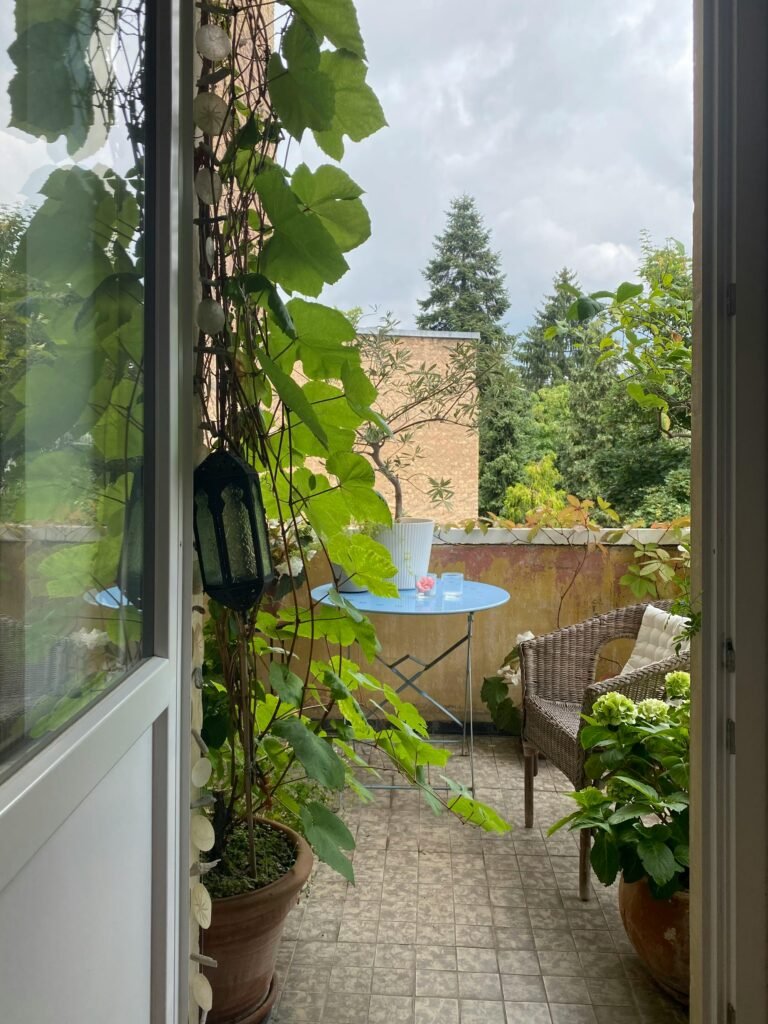
I’ve saved this for last on purpose, because I think it’s the most instructive image in the entire article. This is not a sprawling backyard. It’s a small apartment balcony — maybe 6 feet deep by 8 feet wide — and it is genuinely lovely.
Here’s what makes it work. First, the bistro table in pale powder-coat blue is exactly the right scale. Bistro tables (typically 24 inches in diameter) are the patio furniture equivalent of a wall-mounted bedside table in a small bedroom — they give you a surface without claiming floor space. This one costs roughly $60–$120 at most home goods stores. The wicker armchair beside it has a white seat cushion that doesn’t match the table in material but harmonizes in lightness. Good enough.
The climbing vine on the trellis beside the door is doing double duty: it provides a living privacy screen from the neighboring building while also softening the glass door frame and making the transition from interior to exterior feel intentional rather than abrupt. This is the move that entryway decor does inside — framing the threshold, making the transition feel welcoming. A trellis panel runs $20–$50; a vigorous annual vine like black-eyed Susan vine, morning glory, or sweet potato vine will fill it in a single season.
Terracotta pots with hydrangeas at the base ($15–$30 for blooming hydrangeas in spring), a black lantern hanging from the rail, and the view of deep green trees beyond the low wall complete the scene. The budget for this entire transformation: under $200 if you’re starting from nothing, under $50 if you already have the chair.
The small patio asks one question: what do you actually need? Not what could you fit, not what would look good in a larger space — what do you need? A place to drink coffee and look at trees in the morning. A surface for a glass of wine in the evening. That’s it. Everything else is noise. When you edit your patio down to exactly what you need, it almost always looks better.
What Your Patio Needs to Feel Like a Room
Here’s what I’ve taken from every space in this article. A patio becomes a room when it has a focal point — fire pit, planted wall, statement chair, candlelit table, it doesn’t matter what, but there needs to be something your eye moves toward when you walk out the door. It needs furniture that faces something rather than just occupying space. It needs lighting that works at night, because a patio that goes dark at dusk is a patio that gets used for roughly four hours a day. And it needs at least one layer of plants — potted, vertical, hung, or planted in the ground — that makes the line between architecture and nature soft and uncertain.
You don’t need to do all of this at once. Pick the one that feels most absent in your space right now and start there. Add one lantern. Buy one good chair. String one strand of lights. Come outside tomorrow evening and see if it feels different. It almost always does.
— Emily
Which of these patio styles is calling to you? Drop your biggest outdoor decorating challenge in the comments — I’d love to help you figure out the next right move.
FAQ: Patio Decor Ideas
How do I decorate a small patio on a budget? The most effective small patio moves are also the least expensive: a bistro table and one good chair ($60–$150 combined), a string of outdoor Edison lights ($20–$60), and potted plants in consistent container colors ($15–$30 per pot). Prioritize lighting first — it does the most work for the least money, especially in the evenings when you actually want to be outside.
What’s the best outdoor furniture material for durability? For maximum durability with minimum maintenance, powder-coated aluminum and resin wicker (polyethylene over an aluminum frame) are the best all-around choices. Teak is the most beautiful and also the most expensive; it weathers gracefully if left untreated, or can be oiled annually to maintain its warm color. Avoid cheap wrought iron (it rusts) and standard wicker (it deteriorates in UV and moisture).
How do I make my patio feel more private? Three approaches: tall planters with ornamental grasses or bamboo create natural screens ($50–$150 per planter, filled); pergola curtains give you adjustable privacy that you can open or close depending on sun and neighbors ($30–$60 per panel); and a vertical garden or trellis with climbing plants creates a living wall that grows denser each season. Combination approaches — curtains on a pergola plus planted containers at the perimeter — give you layered privacy without feeling closed in.
Do I need a pergola to add outdoor curtains? No. Outdoor curtains can be hung from a simple tension wire strung between two posts, from a ceiling-mounted curtain track if you have a covered porch ceiling, or from a cable system strung between anchor points on a fence or wall. The curtain itself just needs something to hang from — it doesn’t have to be a pergola.
What plants work best for a small patio? For small patios, prioritize plants with scale interest rather than spreading habit. Tall ornamental grasses in containers (Pennisetum, Calamagrostis) add height without width. Trailing plants (sweet potato vine, bacopa) in hanging baskets use vertical space rather than floor space. One bold specimen plant — a Cordyline, a large-leafed tropical, or a trained standard rose — acts as a focal point. Avoid spreading groundcovers and sprawling shrubs; they’re designed for beds, not pots.
How do I keep my outdoor cushions from fading? Buy cushions in Sunbrella or similar solution-dyed acrylic fabrics — the color is baked into the fiber rather than applied to the surface, which means UV can’t strip it the way it does standard outdoor fabric. Store cushions in a deck box or bring them inside during off-season. Spot-clean with mild soap and water; Sunbrella fabric can even be cleaned with a bleach solution for tough stains without damage to the color.
