Contemporary Coastal Living Room Ideas: What Actually Works (and What Looks Like a Beach Gift Shop)
My friend bought a house three blocks from the water and spent six months trying to make the living room feel like the beach. She bought anchor throw pillows. A rope mirror. Three pieces of driftwood art from Etsy. Shells in a glass jar on the coffee table. By the time she finished, the room didn’t feel like a coastal retreat — it felt like a souvenir shop.
This is the trap that coastal decorating falls into constantly. The idea is right — you want a room that feels like how it feels to sit near water: light, easy, unhurried, a little unfinished in the best way. The execution goes wrong when it becomes literal. Anchors and rope and shells are the things you’d find at a beach, not the feeling of being at one.
Contemporary coastal decor is about capturing the atmosphere, not the props. Here’s what that actually looks like.
The Color Palette — Start Here and Stay Restrained
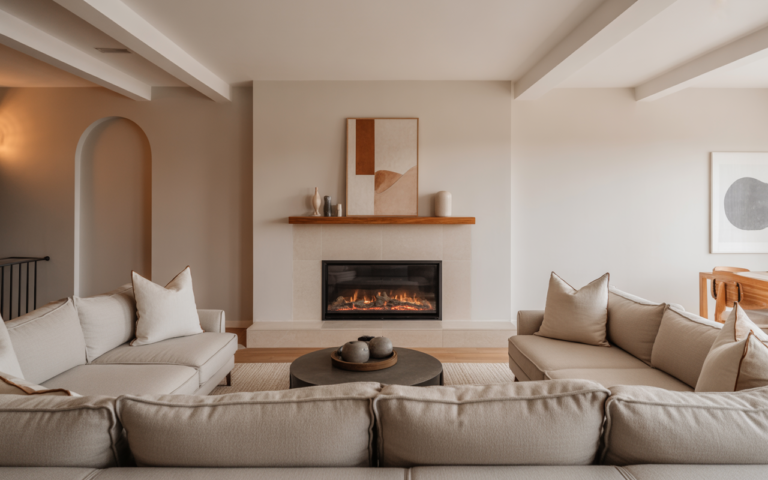
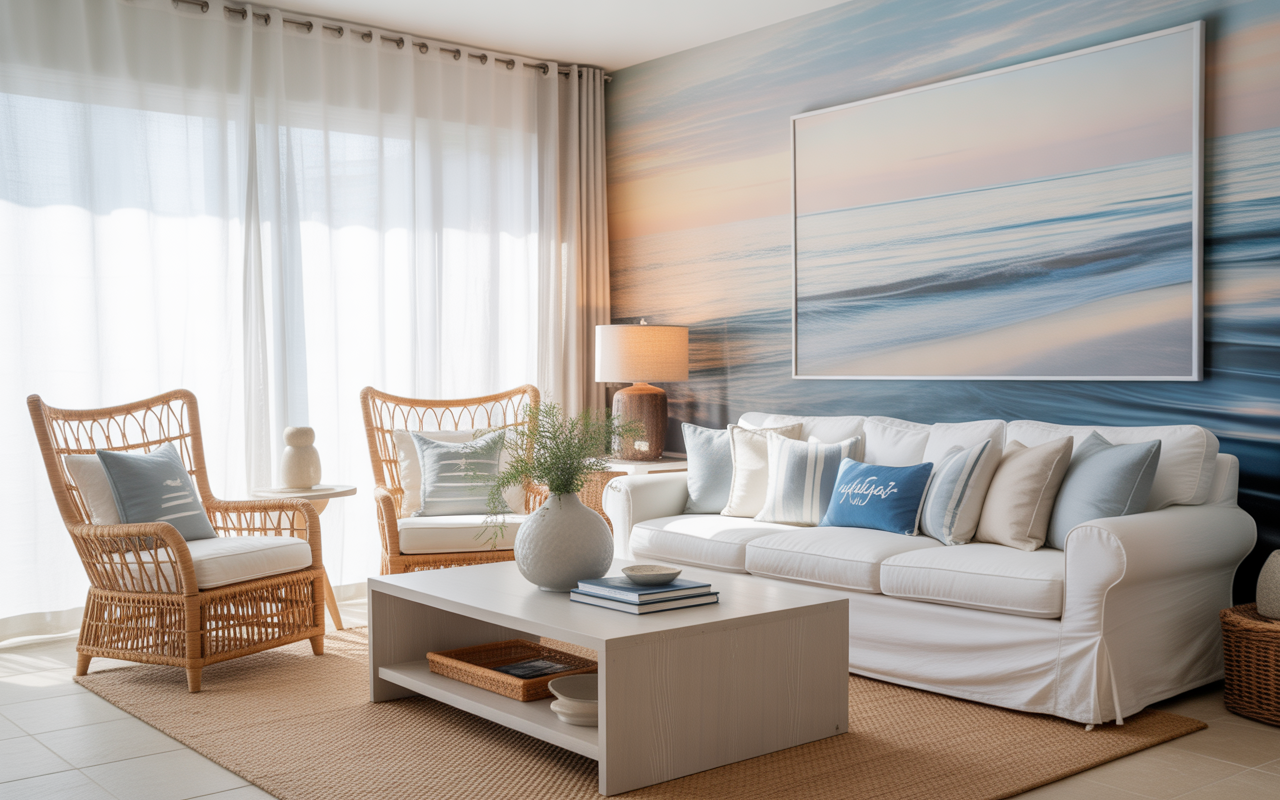
The contemporary coastal palette is soft white, warm sand, and one or two muted blues or greens. That’s it. The instinct to add coral, turquoise, navy, and seafoam all at once is how a living room starts to look like a beach umbrella rental stand.
The version that works: walls in a warm white (Benjamin Moore’s White Dove or Simply White, not a stark cool white), a sofa in natural linen or oatmeal, and one color accent — either a dusty blue or a sage green, not both — introduced through a rug or throw pillows. The accent color should show up two or three times in the room so it reads as intentional, not accidental.
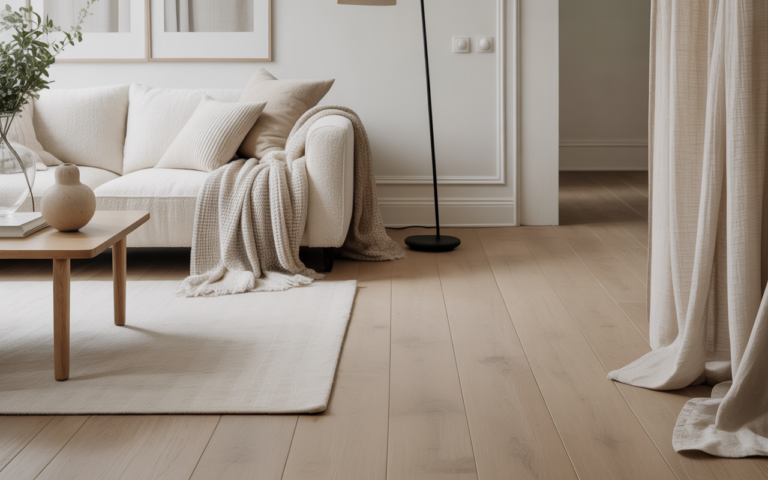
What makes this palette feel coastal rather than just pale: the textures. A flat, smooth, white room feels clinical. The same white room with a woven jute rug, linen cushions, and a rattan chair feels like somewhere you’d actually want to spend a long afternoon. The color alone is the foundation; the textures are what make it feel lived-in.
One thing worth spending money on: good white paint. The difference between a $25 gallon and a premium paint in the right tone is significant. A yellow-toned white in coastal light looks dingy; a warm but not yellow white looks like the sun came in and stayed.
Natural Textures — The Whole Point
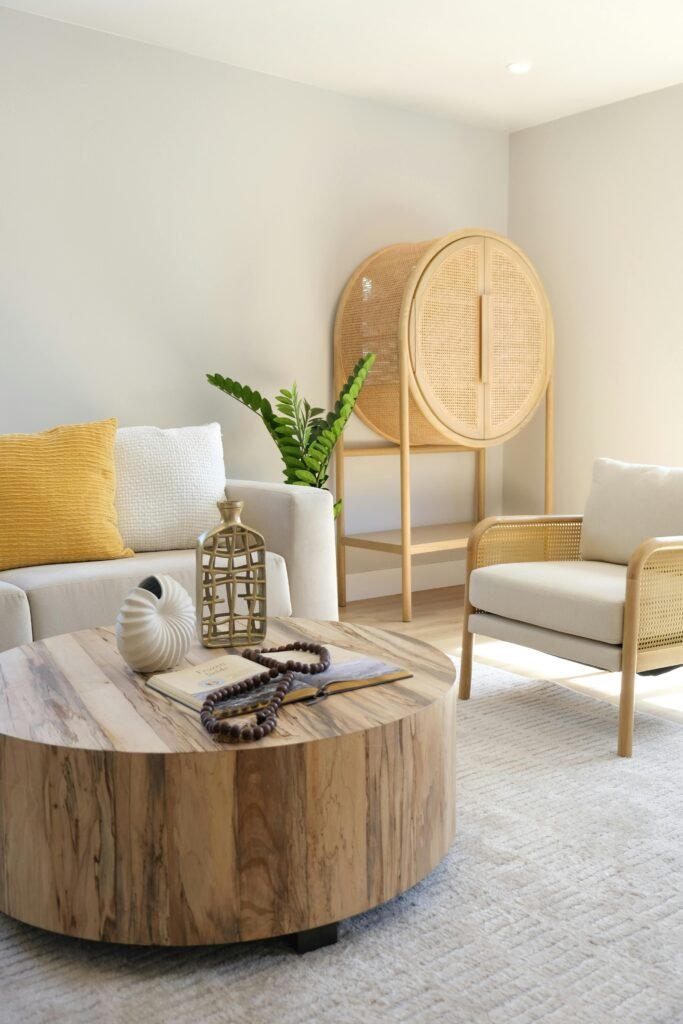
If you took away all the color and all the objects from a well-done coastal living room, you’d still be able to feel what it was going for from the texture alone. Jute and seagrass underfoot. Linen or cotton canvas on the sofa. Rattan or cane on at least one chair or side table. Unfinished or lightly weathered wood on the coffee table. These materials are what coastal living actually feels like.
The layering approach that works: one major textured piece (a jute or seagrass area rug, $80–200 for a quality 8×10) as the foundation, then a sofa with soft, textured upholstery (not a smooth microfiber — linen, cotton twill, or a boucle in a warm neutral), then one rattan or cane element (a chair, a side table, a pendant light — even one is enough), and then throw pillows and blankets in a mix of textures: something chunky-knit, something linen, something waffle-weave.
The materials to avoid in a coastal room: polyester, shiny synthetics, and very smooth lacquered surfaces. They look wrong here, not because they’re inherently bad materials but because they don’t participate in the atmosphere you’re trying to build. Coastal interiors feel organic. Synthetic materials feel manufactured in a way that breaks the spell.
Practical note: linen and cotton upholstery in light colors will show dirt more than dark smooth fabrics. Get performance linen or Crypton-treated fabric for anything the dog or kids touch. The texture still reads as natural; the maintenance is manageable.
Lighting — This Is the Variable That Changes Everything
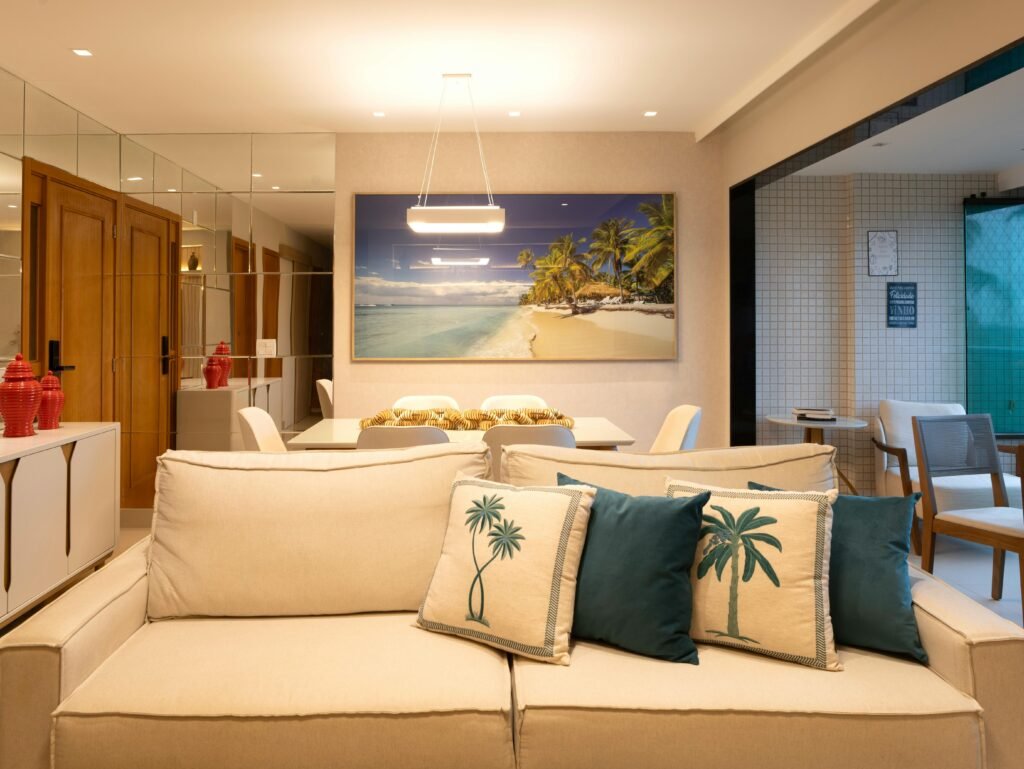
Light is the most important element in a coastal living room, and it’s the one most people get exactly backwards. They want the room to feel bright and airy, so they turn on the overhead fixture. The overhead fixture in almost any residential living room is a bad light — too bright, too flat, in the wrong position to make anything look good — and it’s especially wrong in a room that’s trying to feel warm and inviting.
The contemporary coastal approach to lighting: maximize natural light during the day, and replace it with layered warm artificial light in the evening.
For natural light: sheer linen curtains that let sunlight diffuse through rather than blocking it entirely. If privacy isn’t a concern, skip window treatments in the main living area entirely. If you have large windows or glass doors, keep the sightlines clear — don’t put tall furniture in front of them.
For evening: three or four warm light sources at different heights, none of them overhead. A floor lamp in one corner ($60–120 for a quality one with a warm shade). Two table lamps on either side of the sofa or on console tables ($40–80 each). Possibly a wall sconce or two. All of them on warm bulbs (2700K). The overhead light, if used at all, on a dimmer set to the lowest useful setting.
The specific purchase that changes a coastal living room most: a rattan or wicker pendant light hung where the overhead fixture was. It casts beautiful dappled light, looks organic and coastal in the right way, and immediately makes the room feel like somewhere rather than something. They range from $60 for a basic rattan pendant to $300+ for a quality one. The Serena & Lily wicker pendants are beautiful; similar-quality options exist at Pottery Barn and World Market at lower price points.
Furniture — Casual, Comfortable, and Low to the Ground
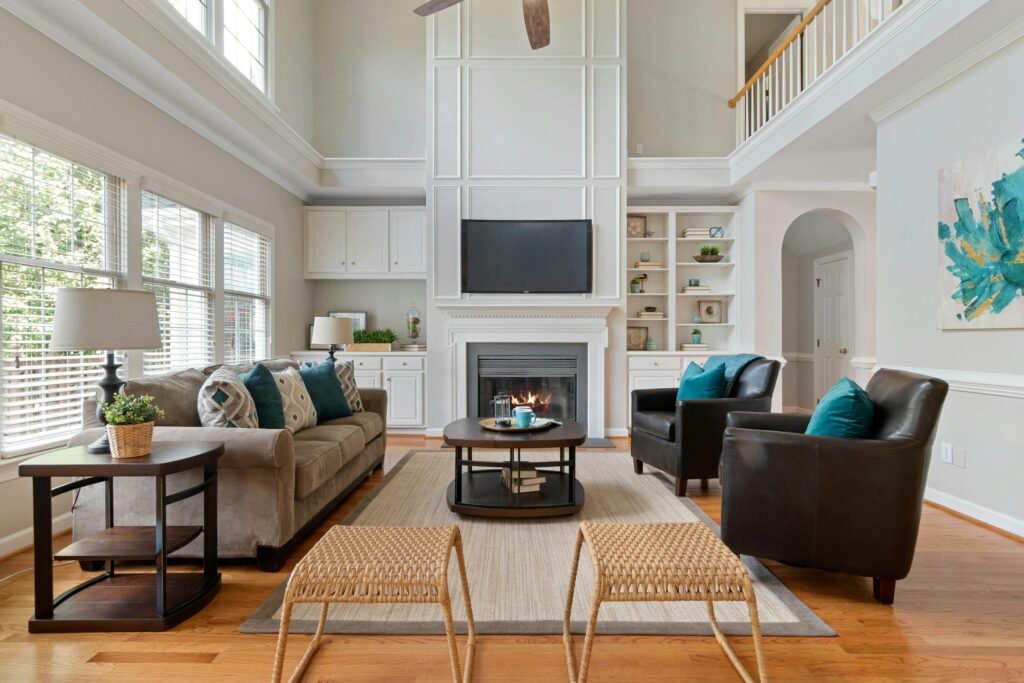
Coastal furniture is not precious. It’s not formal. The furniture in a room trying to feel like a beach retreat should look like something you could sit on in shorts after a swim — comfortable, forgiving, not the kind of thing where you’d worry about the cushions.
In practical terms: a slipcovered sofa in a washable fabric is the coastal living room sofa. It looks relaxed and intentional at the same time, and the cover comes off when life happens to it. IKEA’s SÖDERHAMN and Pottery Barn’s PB Comfort are the two I recommend at different price points — both have a low, comfortable profile that works in coastal rooms.
Coffee tables should be either natural wood (driftwood or light-finish teak, acacia, or pine) or rattan/woven — something with warmth and texture rather than a glass top. Low to the ground, large enough to actually be useful, and without the kind of design complexity that makes a room feel like it’s trying too hard.
A rattan or cane armchair is the coastal accent chair. One of them in a room is enough — it does a lot of visual work without taking over. The Amber Interiors style rattan chair has been copied by essentially every furniture company at every price point, from $60 at IKEA (SINNERLIG, when it’s in stock) to $400+ from specialty retailers.
The configuration that makes a coastal living room feel spacious: keep large furniture pieces away from walls. A sofa floating slightly off the wall with a console table or a low bookshelf behind it reads as more designed and creates the illusion of more space than a sofa pushed against a wall.
Artwork — Big, Simple, and Not a Seascape If You Can Help It
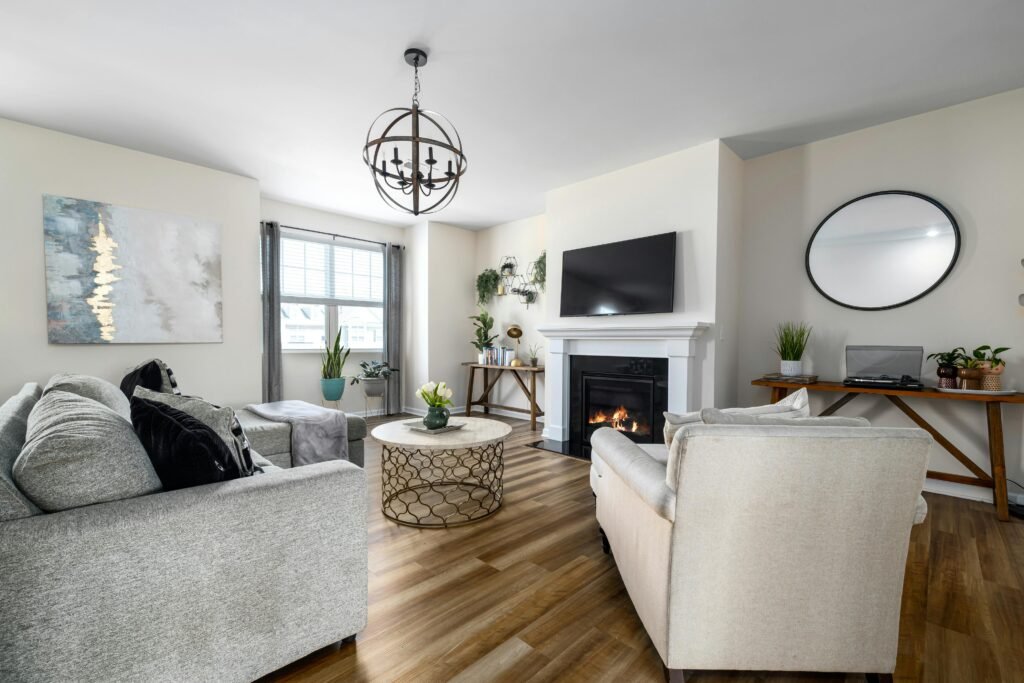
Coastal artwork in a contemporary room should not be a lighthouse, a sailboat, or a detailed seascape — unless the piece is genuinely good art that happens to be those things. The decorative versions of nautical art that end up in coastal rooms are the coastal equivalent of the anchor pillow: too literal, too obviously trying.
What works instead: large abstract pieces in blues, whites, and warm neutrals. Abstract art that suggests water or sky without depicting it. Black and white photography of natural landscapes. A large, simple botanical print. A canvas painted in layers of the room’s accent color. The goal is art that makes you feel calm and connected to nature, not art that reminds you that you’re near the coast.
Size matters in coastal rooms more than most: one large piece (24×36 inches minimum, ideally larger for the main wall) does more than three medium pieces. Coastal spaces have a generosity to them — they feel open and expansive — and the artwork should match that scale.
For budget-conscious options: Minted, Desenio, and Society6 all have large-format prints at accessible prices. A large print in a quality frame from IKEA’s RIBBA or HOVSTA range costs $20–40 and looks significantly more expensive than it is. The frame quality matters more than people realize — the same print in a cheap frame versus a good frame reads completely differently on the wall.
Plants — The Ones That Earn Their Place
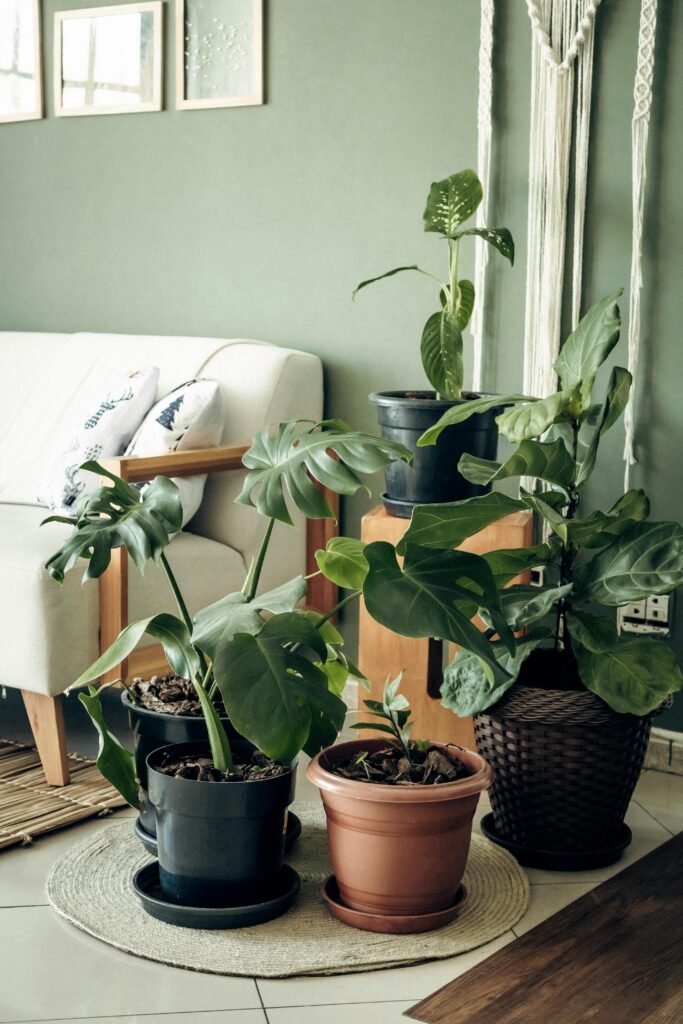
Plants in a coastal room should feel like the living room has spilled slightly into the outdoors, not like a collection of houseplants that happen to be in a room. Two or three plants placed with intention do this; fifteen scattered plants in mismatched pots do not.
The plants that work best in coastal living rooms: large-scale statement plants in corners (fiddle leaf fig, bird of paradise, or a large rubber plant — anything that reads like tropical foliage rather than a succulent collection), and smaller trailing plants on shelves (pothos, heartleaf philodendron). The fiddle leaf fig has been a cliché for a while, but it looks genuinely good in coastal rooms because it reads as lush and tropical without looking fussy.
The pots matter as much as the plants: terracotta in a light color, white ceramic, or woven rattan pot covers. Plastic nursery pots sitting in a room undermine everything else you’ve done with the space.
One plant I’d steer away from in coastal rooms: succulents. They’re dry-climate plants that don’t visually belong in a space that’s trying to feel lush and oceanic, and they’re often used in little arrangements that look cluttered rather than natural.
Nautical Accents — Edited Down to One or Two
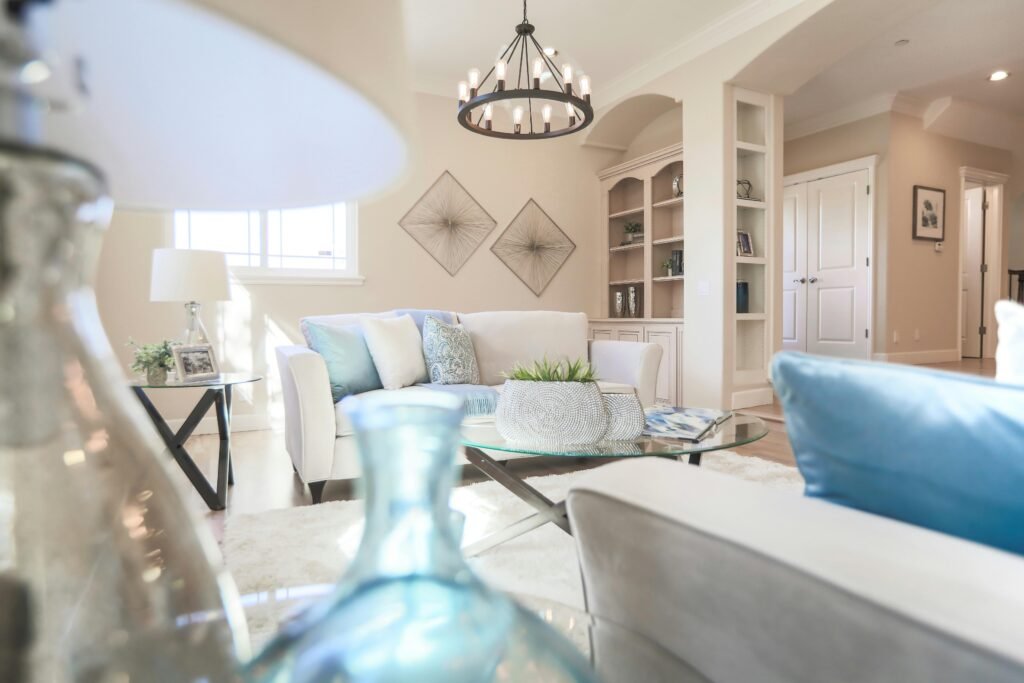
Nautical accents belong in a contemporary coastal room in the same way that a single good piece of jewelry belongs in an outfit: one or two, well chosen, adding character without dominating. The anchor motif, the rope, the nautical map, the little model sailboat — any of these can work if you choose one (not all of them) and it’s genuinely good looking rather than decorative filler.
The nautical accents that hold up: a vintage or vintage-looking naval or maritime map framed properly and hung as artwork. A glass float or two in an interesting color arranged on a shelf. A rope basket used as a planter or blanket storage. Objects that have their own visual quality and happen to be coastal in origin.
The ones to skip: anything with the word “ANCHOR” on it, novelty items from coastal gift shops, themed throw pillows that are too literal. These objects reduce a room’s personality rather than adding to it — they tell guests what you were going for rather than showing them.
The practical edit: walk through your current nautical items and keep only the one you’d be happy to see every day for the next five years. That’s usually the test that separates a genuinely good object from a decorating impulse.
The Rug — Bigger Than You Think, Simpler Than You Expect
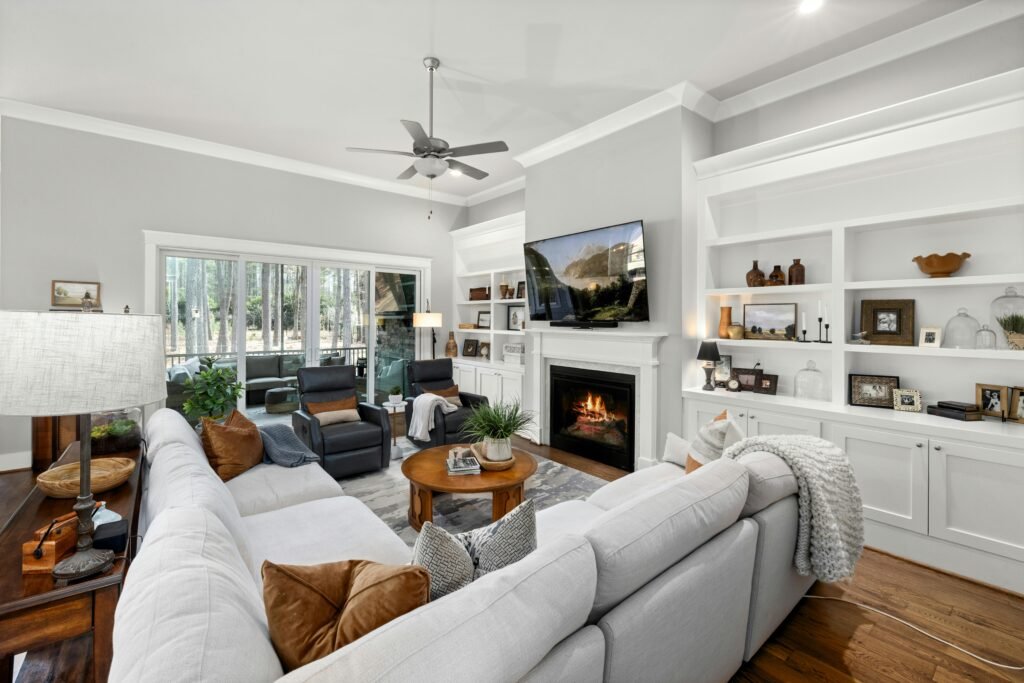
The area rug in a coastal living room does two things: it defines the seating area and it introduces the most texture per square foot of any single element in the room. Both of these require it to be large enough to fit under the front legs of all the seating (this is the rule — all front legs on the rug, or all four legs if the rug is large enough), and simple enough to read as a foundation rather than a focal point.
The two rug types that work best: natural fiber (jute, seagrass, sisal — expect to pay $80–200 for a quality 8×10), and flatweave or low-pile in a simple coastal pattern (thin stripes, gentle texture, no large graphic print). The natural fiber rug is the classic coastal choice and it works; the one honest caveat is that jute and seagrass are rough underfoot and can be hard to vacuum. Polypropylene rugs that mimic jute look slightly less authentic but are easier to live with, especially in rooms that get heavy use.
Rug sizing mistake that’s easy to make: buying one that’s too small. In a living room, the 5×8 rug that looks okay in the store almost always looks like a bath mat once the furniture is around it. If you’re between sizes, go bigger.
Open Shelving and Personal Display
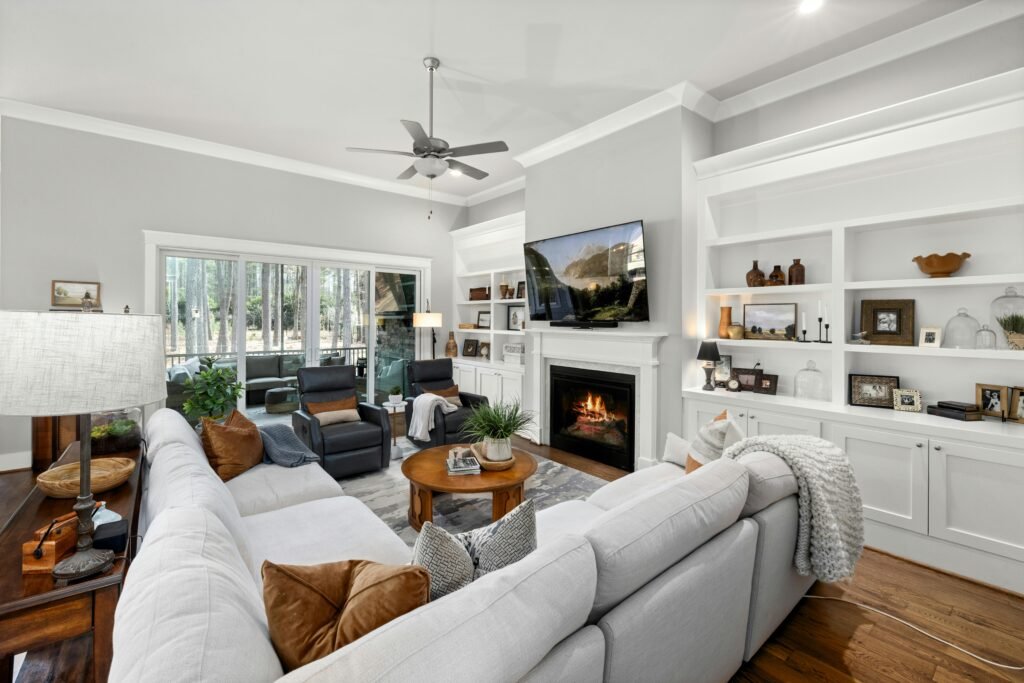
Shelving in a coastal living room is where the room gets its personality — the specific books, the objects brought back from places you’ve been, the things that are yours rather than generically coastal. Done well, it looks curated and intentional. Done wrong, it looks like everything in the room without a dedicated spot ended up on the shelves.
The approach that works: edit aggressively. A shelf in a coastal room should have books (spines facing out or turned in for a more uniform look), one or two plants, and one or two objects worth looking at. Empty space on a shelf is not wasted — it’s what makes everything else look intentional.
Objects that earn their place on a coastal shelf: something found (a piece of sea glass in a small dish, a beautiful shell that isn’t in a jar with fourteen other shells), something made (a ceramic bowl in a coastal color, a piece of pottery), something that means something to you (a small piece from a trip, a photograph in a simple frame). The shelf should feel like it was edited by someone, not assembled from a product list.
Floating shelves in a simple wood tone work better than white painted shelves in coastal rooms — the warmth of the wood material connects to the natural texture palette of the rest of the room.
Multi-Functional Furniture — Because Coastal Rooms Are Actually Lived In
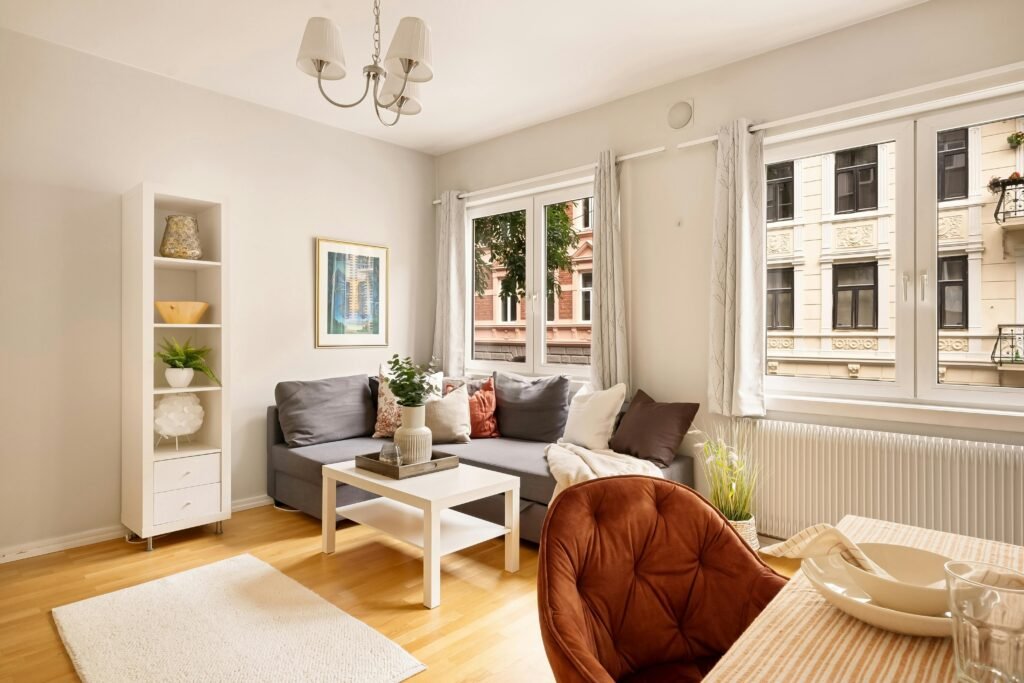
A coastal living room that looks beautiful in photos but has nowhere to put the throw blankets, nowhere to put drinks without a coaster, and nowhere to sit other than the one sofa is not a room that works. Coastal living is relaxed living, and relaxed living requires practicality.
The multi-functional pieces worth prioritizing: a storage ottoman instead of a solid coffee table (stores extra blankets, works as a footrest, works as extra seating — a tray on top keeps it functional as a surface), side tables with a lower shelf rather than a solid base (the lower shelf holds books, remotes, and anything that would otherwise be on the floor), and in smaller spaces, a console table behind the sofa that doubles as a work surface and display area.
Built-in storage isn’t always possible, but a freestanding media unit with closed cabinet storage below the television is the piece that keeps a coastal living room looking calm rather than lived-in-in-the-wrong-way. The stuff that doesn’t have visual charm goes behind the closed doors. The stuff that does goes on the open shelves.
A Reading Corner — The Most Important Square Footage in the Room
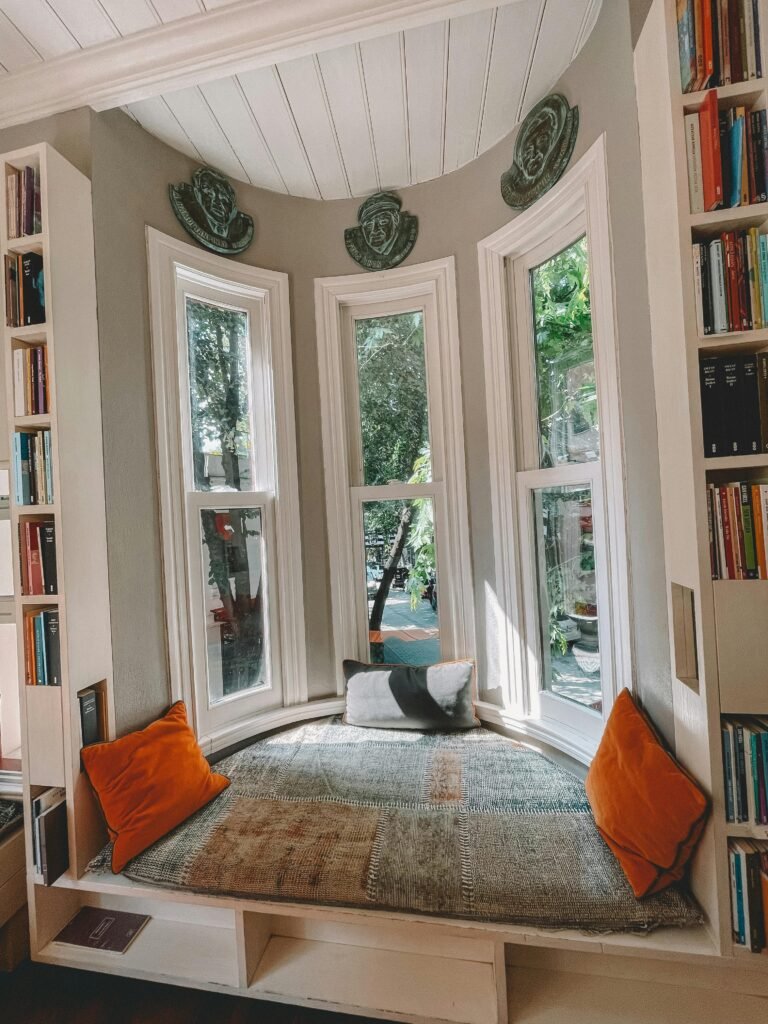
Every good coastal living room has a place that’s clearly for sitting still and doing nothing urgent. This is the reading corner, and it doesn’t require a lot of space: a comfortable chair (the rattan chair works here, or a small upholstered chair in a warm fabric), a small side table just large enough for a drink and a book, a floor lamp or a reading lamp positioned to provide actual reading light, and a throw blanket.
That’s it. The corner doesn’t need to be architecturally special — it just needs to be clearly designated for rest rather than for looking good in a photo. A corner with a chair and a lamp says: someone sits here. That quality, in a living room, is worth more than any decorating element.
The light position matters: the lamp should be slightly behind and to the side of the chair, at approximately eye level when seated. A lamp that’s too far away, too low, or directly overhead makes reading uncomfortable. A good floor lamp ($60–120) positioned correctly makes the corner a genuinely pleasant place to spend an hour.
The Details That Are Worth Thinking About
What’s the actual budget for a coastal living room refresh? A meaningful change — new rug, new throw pillows and blanket, a rattan pendant light, and two or three plants in proper pots — can be done for $300–500. A more significant transformation that includes new or slipcovered furniture brings the cost to $1,500–3,000 depending on what you’re starting with. The highest-ROI purchases in a coastal room are the rug (defines everything), the lighting (changes the evening atmosphere entirely), and the throw pillows (lowest cost, fastest visual change).
How do you prevent a coastal room from looking like a theme restaurant? Edit the explicitly nautical elements down to one or two, choose artwork that’s abstract or natural rather than nautical, and let the palette and textures do the work rather than the props. A room doesn’t need a single anchor in it to feel coastal — it needs light, natural materials, and a sense of ease.
Can coastal decorating work in a landlocked apartment? Completely. Coastal is an atmosphere, not a geography. The same palette, textures, and furniture choices that feel right near water feel right in any space that’s trying to be calm and livable. The one adjustment: without natural light from large windows, invest more in warm artificial lighting to compensate.
What’s the single most common mistake in coastal living rooms? Too many small decorative objects. The coastal vibe comes from openness — from space and light and air. A room filled with little shells, little anchors, little lanterns, little candles, and little baskets looks busy and cluttered, which is the opposite of what coastal is trying to achieve. One good object at a larger scale is better than ten small objects at the same scale.
The Room That Feels Like It’s Near the Water
The thing my friend eventually figured out — after the rope mirror came down and the anchor pillows found their way to a donation box — was that the coastal living room she wanted wasn’t about the stuff. It was about the light coming in the window at four in the afternoon, the texture of the rug underfoot, the chair in the corner that had a good lamp next to it and a book on the table beside it.
She painted the walls White Dove. She bought a jute rug. She replaced the overhead fixture with a rattan pendant. She kept one piece of good art above the sofa.
The room feels like the beach now. It doesn’t have anything in it that looks like the beach.
That’s the distinction worth making — and making it is the whole job.
What’s the piece of your living room you keep looking at that doesn’t quite fit? Sometimes that’s where the redesign should start. Drop it in the comments.
— Emily