10 Living Room Ideas That Make Your Space Feel Intentional (Not Just Furnished)
Most living rooms are furnished but not actually designed. There’s a sofa, a TV, maybe a rug underneath. Everything matches in a vague, inoffensive way. The room works — but it doesn’t feel like anything in particular.
The difference between a living room that’s just furnished and one that genuinely feels like yours usually comes down to a handful of specific decisions. The right focal point. The right amount of breathing room. One thing in the room that has real personality. That’s it.
Here are 10 living room ideas I’ve been thinking about a lot lately — each one pulled from a real space that’s doing something worth paying attention to.
1. Make a Small Living Room Work Harder
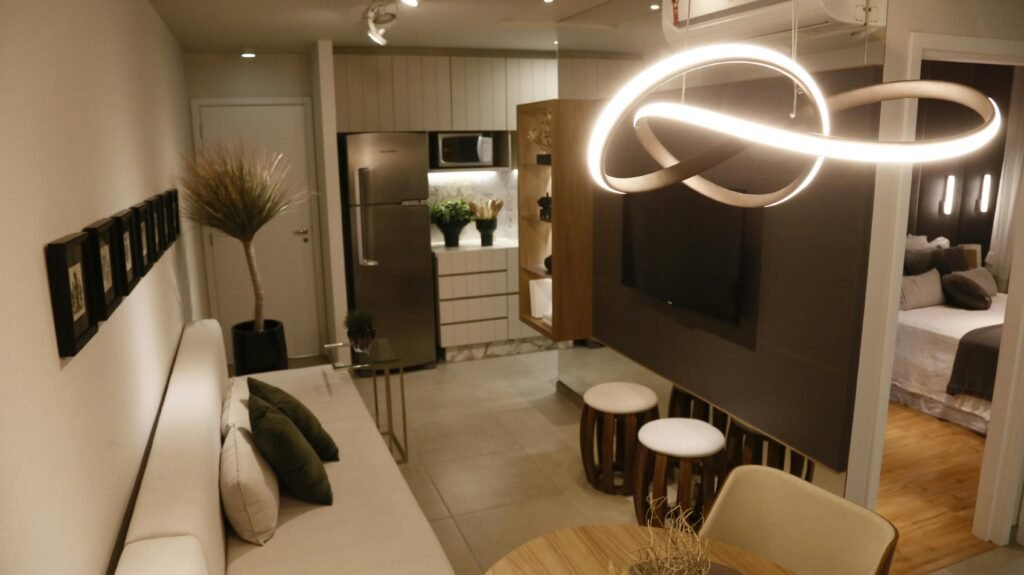
Small living rooms get treated like a problem to solve. More often, they’re an opportunity to be deliberate in a way that larger rooms never force you to be.
This compact apartment living room is proof. Every element earns its place: a white sofa keeps the space feeling open, dark green cushions add depth without heaviness, and wooden barrel stools double as side tables and sculpture. The dried grass plant in the corner adds height without bulk. And that sculptural infinity pendant light — curving and glowing overhead — gives the whole room a focal point that a small space absolutely needs.
Here’s the thing most people get wrong with small living rooms: they go smaller with everything, thinking it’ll make the space feel bigger. It usually doesn’t. One statement piece — a bold light, a large piece of art, a plant taller than you expected — actually makes a small room feel more considered. Sized-down everything just makes it feel cramped and timid.
If your living room is compact, decide on one moment of drama. Let everything else support it quietly.
2. Style Your Coffee Table Like You Mean It
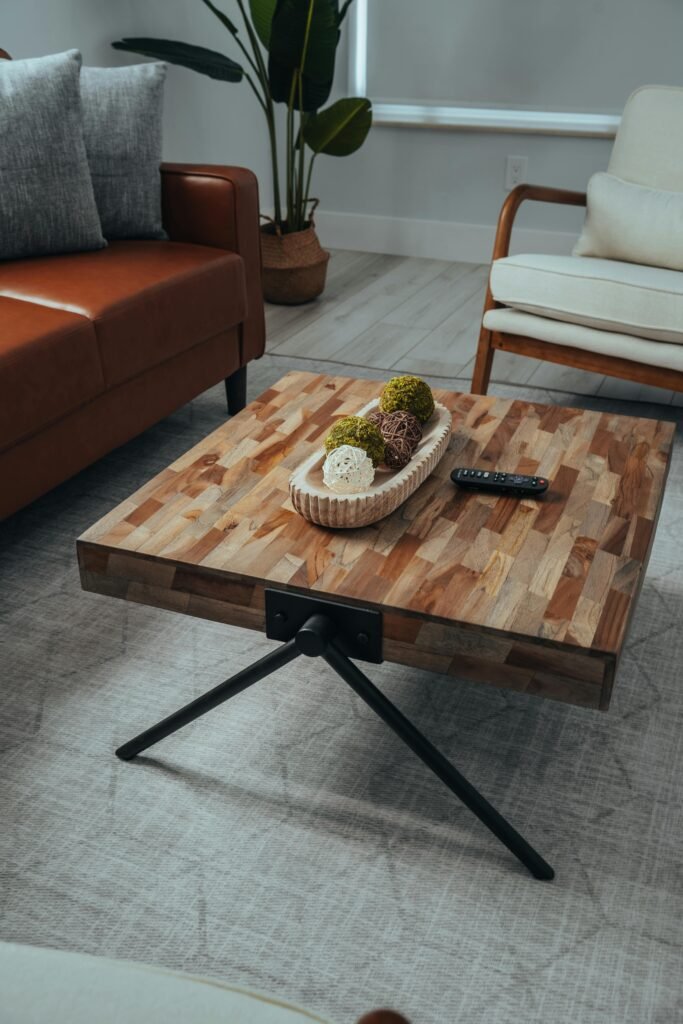
The coffee table is the most styled surface in your living room — and also the one most people get wrong. Too many random objects. No tray to contain them. Or the opposite: nothing at all, just a bare surface with a remote control.
This coffee table is doing it right. A chunky patchwork wood top on a simple black tripod base — the table itself has personality before anything goes on it. Then one carved wooden tray with three objects inside: a couple of moss balls and a wicker sphere. That’s it. The tray is the key. It says “this was arranged” rather than “things ended up here.”
The formula I keep coming back to: one tray + one natural texture object + one living element (a small plant, a vase with a stem). Three things, contained, intentional. And always leave some of the table surface empty — negative space is part of the styling.
The rug underneath matters too. A grey flatweave that extends well beyond the table’s footprint keeps everything grounded. If your rug ends at the table legs, it’s too small.
3. Build a Plant Corner That Transforms the Room
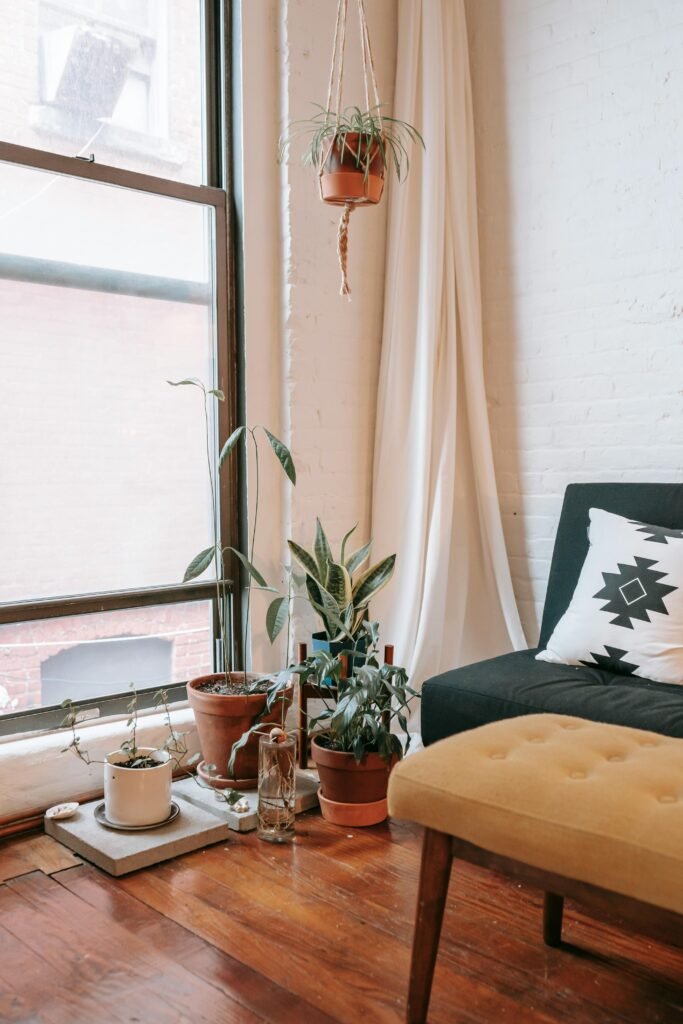
A single plant on a shelf is nice. A whole corner devoted to plants is something else entirely.
This window corner with its cluster of terracotta pots — a snake plant, a trailing philodendron, a spider plant in a macramé hanger above — creates a living, breathing moment in the room that no piece of furniture could replicate. The exposed brick wall behind it, the sheer curtains letting in soft light, the warm wood floors below. Everything in this corner is working together to create a feeling. And that feeling is: alive.
The trick to a plant corner that looks intentional rather than chaotic is the pots. When you commit to terracotta throughout — even in different sizes — the collection reads as a design decision rather than a plant hoard. Mix in one hanging plant at varying heights and suddenly it has structure.
You don’t need ten plants to start. Three on the floor near a window, one hanging above — that’s enough to create the moment. Add from there as your collection grows. And honestly, watching it grow is half the point.
4. Let Your Curtains Set the Tone for the Whole Room
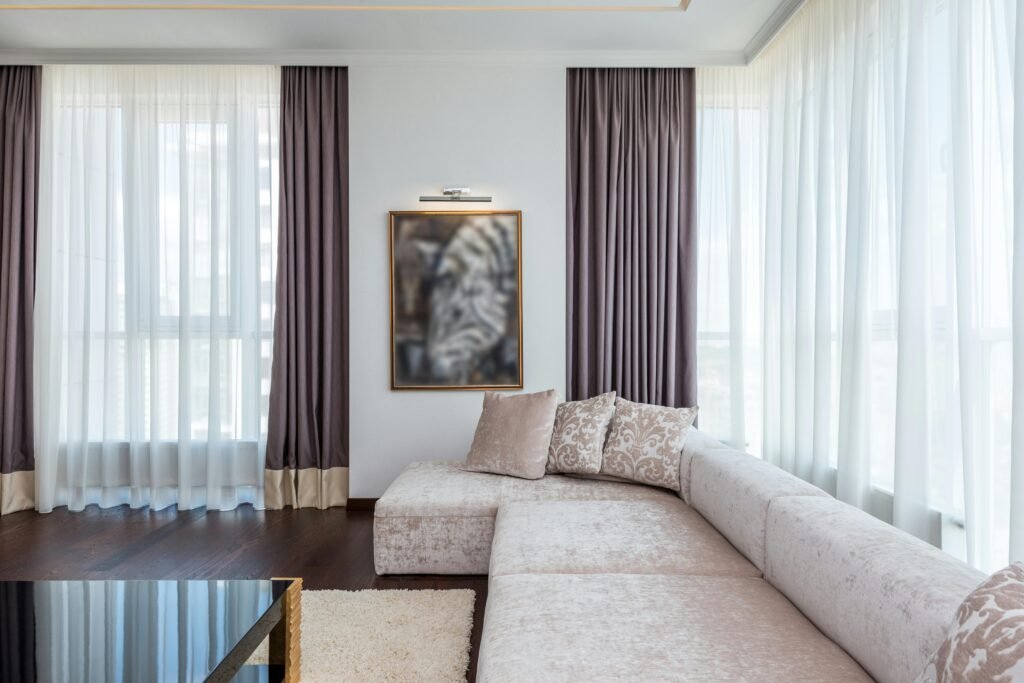
Curtains do something that most other decor elements don’t — they define the mood of the room from the moment you walk in. Before you sit down, before you notice the furniture, you notice what the light is doing. And the curtains control the light.
This living room gets it exactly right. Sheer white panels layered behind taupe velvet drapes, hung floor to ceiling, soften everything inside the room. The blush sectional could have felt harsh against white walls. Instead it reads as warm and deliberate because the curtains wrap the whole space in that same soft, dusty palette. The gold-framed art with its picture light adds the one moment of brightness.
The rules here apply to any living room: hang your curtains at ceiling height, not at window height. Use a sheer layer under a heavier panel so you can control light without blocking it entirely. And match your curtain color to the room’s undertone — warm rooms need warm curtains, cool rooms need cool ones. This is not the place to go matchy-matchy, but it is the place to go harmonious.
5. Don’t Be Afraid of a Bold Rug
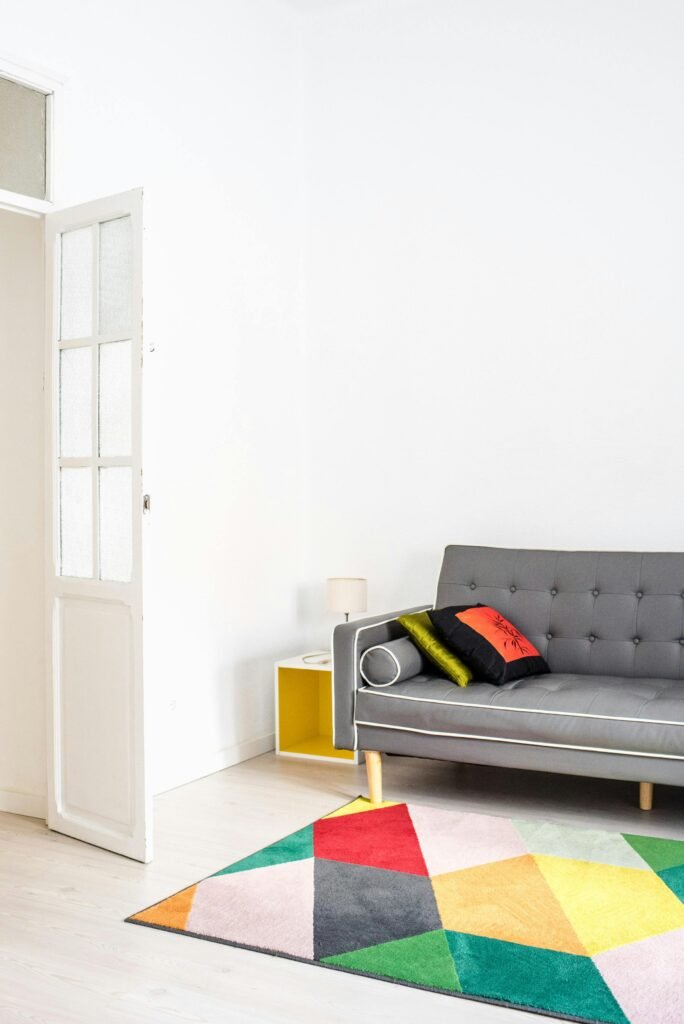
Here is a room that could have been completely forgettable — white walls, grey sofa, pale floors — and instead is genuinely fun to look at. One decision made the difference: that rug.
A bold geometric rug in full color — red, teal, yellow, green, pink — anchors this minimal room and gives it an identity. The grey sofa becomes the right choice precisely because the rug is doing all the visual work. The yellow cube side table echoes the rug’s yellow without matching it. Everything feels alive without being cluttered.
This is the living room idea most people are afraid to try. They worry the rug will clash. They worry it’ll be too much. But here’s what I’ve learned: in a room with neutral walls and neutral furniture, a bold rug is almost always the right move. It’s the one piece you can change if you tire of it — and until you do, it makes the whole room interesting.
The rule: the bolder the rug, the quieter everything else should be. Let it lead. Follow it.
6. Go Dramatic With a Statement Accent Wall
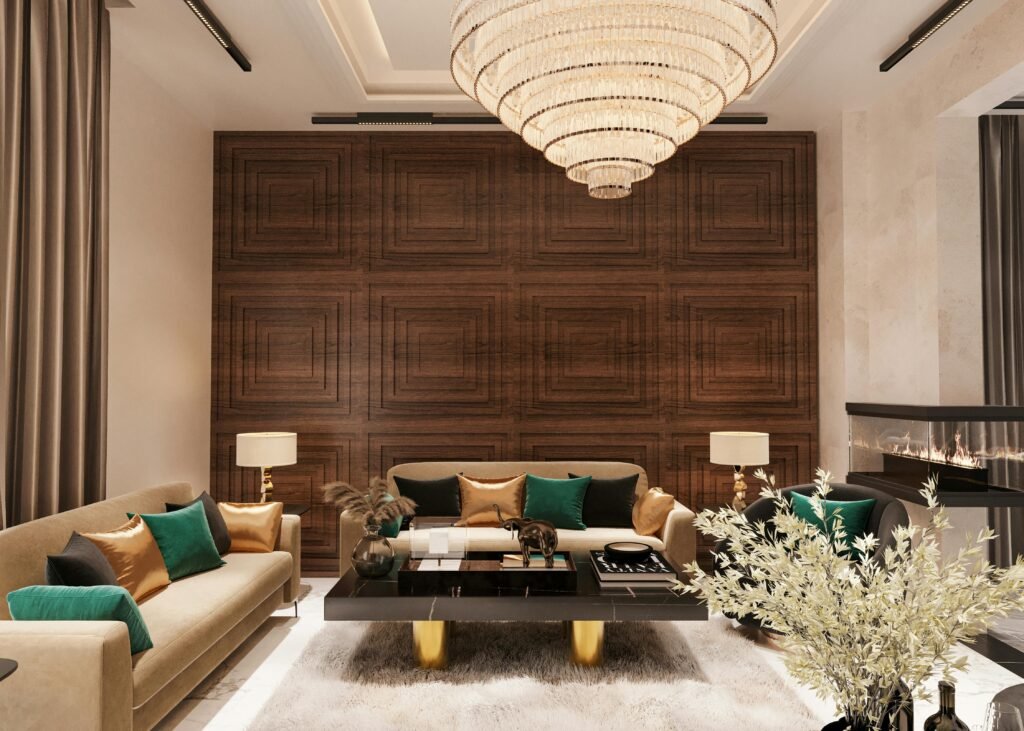
An accent wall doesn’t have to mean a different paint color. It can mean this — a full wall of dark walnut wood paneling in a bold grid pattern that turns an entire surface into a piece of architecture.
Everything in this room is anchored to that wall. The cream sofas are chosen to contrast it. The emerald and gold cushions pick up the warmth in the wood. The massive crystal chandelier draws the eye upward and rewards the room’s high ceilings. The fireplace tucks in at the side. It’s a lot — and it works because every decision is made in relationship to that wall.
You don’t need a renovation budget to take the principle home. A deeply colored paint on one wall, a large piece of art that spans most of it, or a collection of panels in one consistent material all achieve the same effect at different price points. The idea is to give your living room one wall that does something. Not all four. One.
The wall you choose matters: it should be the one you face when you walk in, or the one your sofa is positioned against. Make that wall earn it.
7. Create a Reading Nook Worth Sitting In
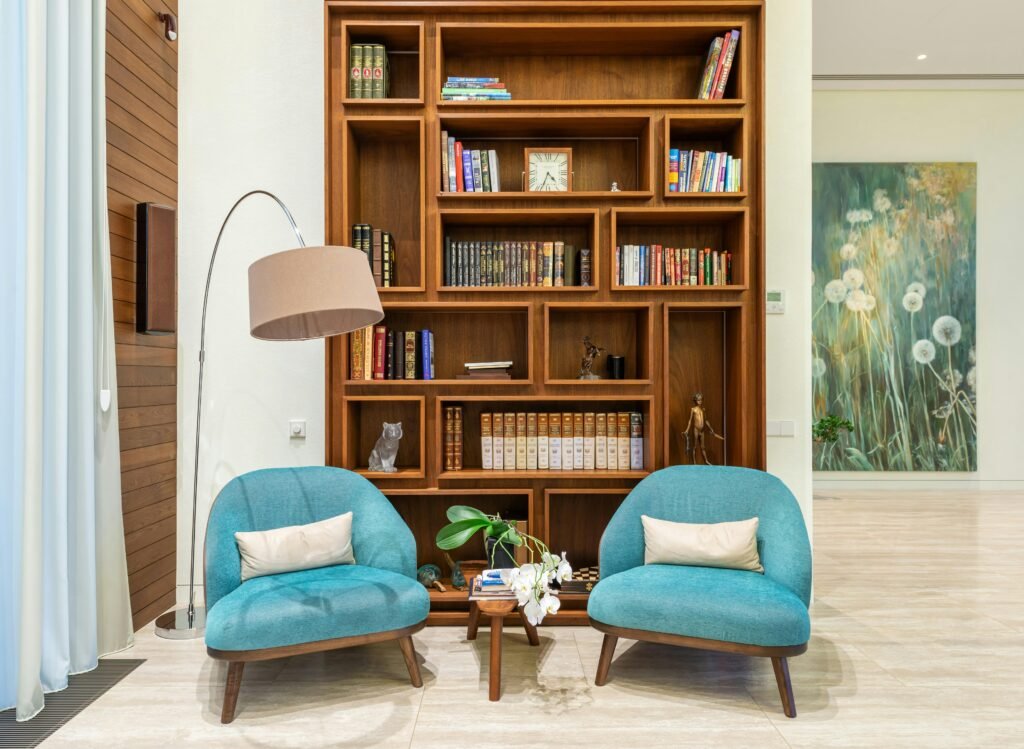
A reading nook is not just a chair near a bookshelf. It’s a destination — a place in your living room that has its own identity and pulls you toward it.
This one does everything right. Two rounded teal armchairs facing each other, creating a conversation rather than a solitary retreat. A large warm-wood bookshelf behind them, filled with books but also objects — a clock, small sculptures, a mix of heights. The arc floor lamp positioned to light both chairs. An orchid on the small table between them. There is nothing in this arrangement that doesn’t belong.
The teal chairs are the bold call here, and they’re right. Against the warm wood of the shelving and the light floors, they give the nook a distinct color identity that says: this space is different from the rest of the room. That separation is what makes a reading nook feel like a proper place rather than just two chairs you happened to put near some books.
Even without built-in shelving, you can recreate this. A large freestanding bookcase, two chairs that face each other at a slight angle, one good lamp. The conversation-facing arrangement is the key. It turns a reading corner into a place people actually want to sit.
8. Arrange Your Seating Around a Clear Focal Point
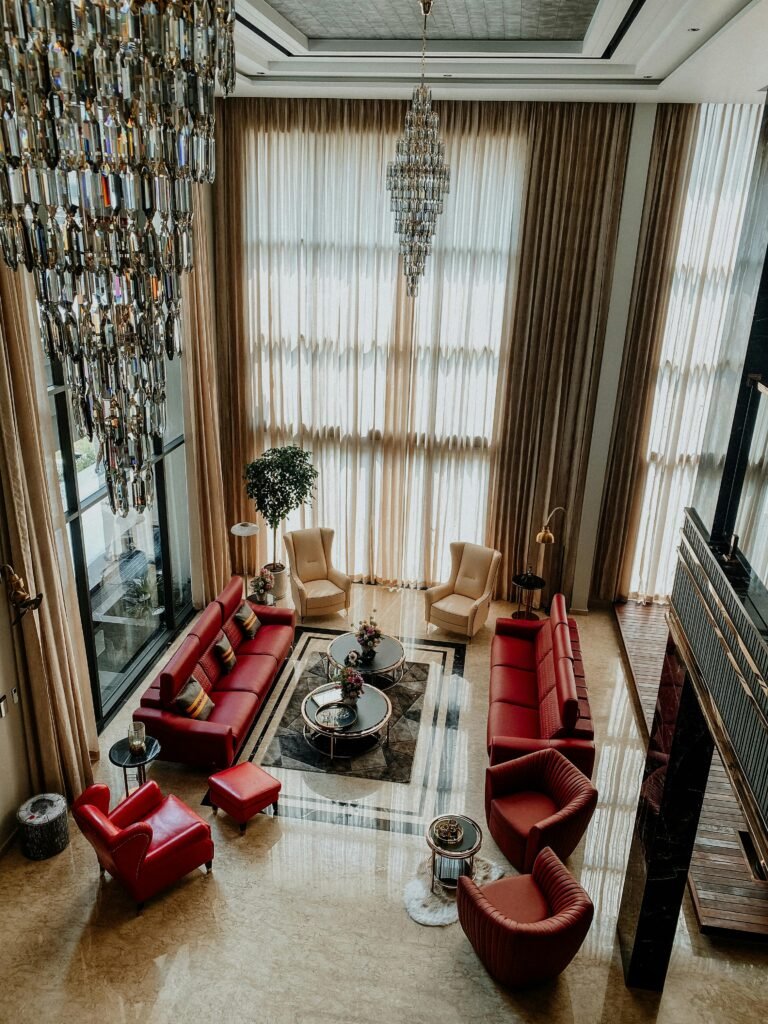
Furniture arrangement is one of those things that looks easy until you’re standing in your living room pushing a sofa back and forth for the fourth time. This aerial view of a grand living room is useful precisely because it shows the logic clearly from above.
Everything here is arranged around a central focal point — the two round coffee tables on the area rug — and the seating radiates outward from that center in a symmetrical pattern. Red leather sofas on both sides, cream wingback chairs at the corners, the rug defining the zone. The chandeliers reinforce the vertical axis. The result is a room that has clear structure even at a large scale.
In a regular living room, the same principle applies with simpler geometry. Define your focal point first — fireplace, TV wall, or large window — and point your seating toward it. Make sure all the main pieces of seating are within conversation distance of each other (roughly 8–10 feet apart). Leave a clear path around the seating arrangement. And always use a rug to define the zone — floating furniture on bare floor without a rug underneath looks unfinished regardless of how nice the furniture is.
9. Embrace Minimalism — Less Really Is More
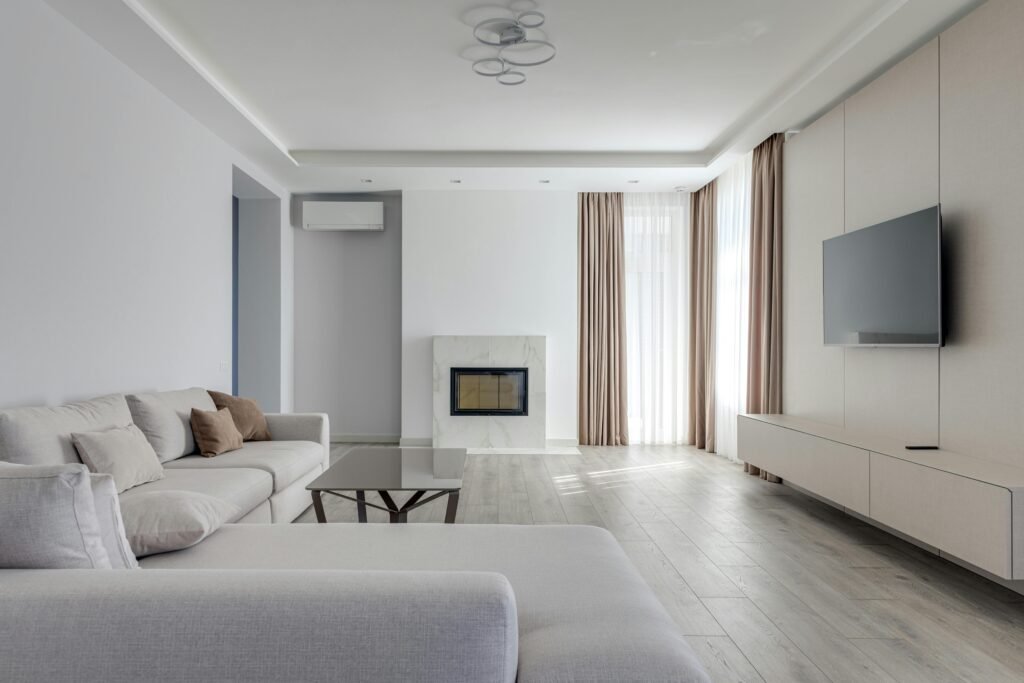
There is a version of minimalism that feels cold and punishing — like a room waiting to be lived in. And then there’s this: a room with so little visual noise that everything in it feels deliberate and calm.
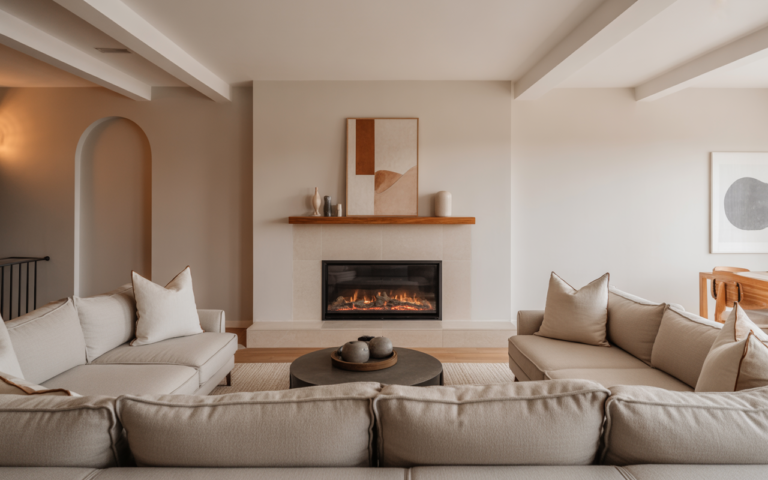
The fireplace is the focal point. The sofa — large, cream, comfortable — faces it. The built-in storage on the right keeps everything out of sight. The circular ceiling light adds subtle interest without competing. Two brown cushions on the sofa provide the only real warmth against all that white and grey. That’s it. Nothing extra.
What I find interesting about a room like this is how much confidence it requires. Most of us keep adding — another pillow, another object on the shelf, another piece on the wall — because empty space feels unfinished. But there’s a point where less is genuinely more, and this room has found it.
If you want to try a more minimal living room, the first step is editing rather than decorating. Take things out before you put things in. See how the room breathes. Then add back only what the room actually needs. You’ll probably add back less than you think.
10. Make Your Fireplace the Heart of the Room
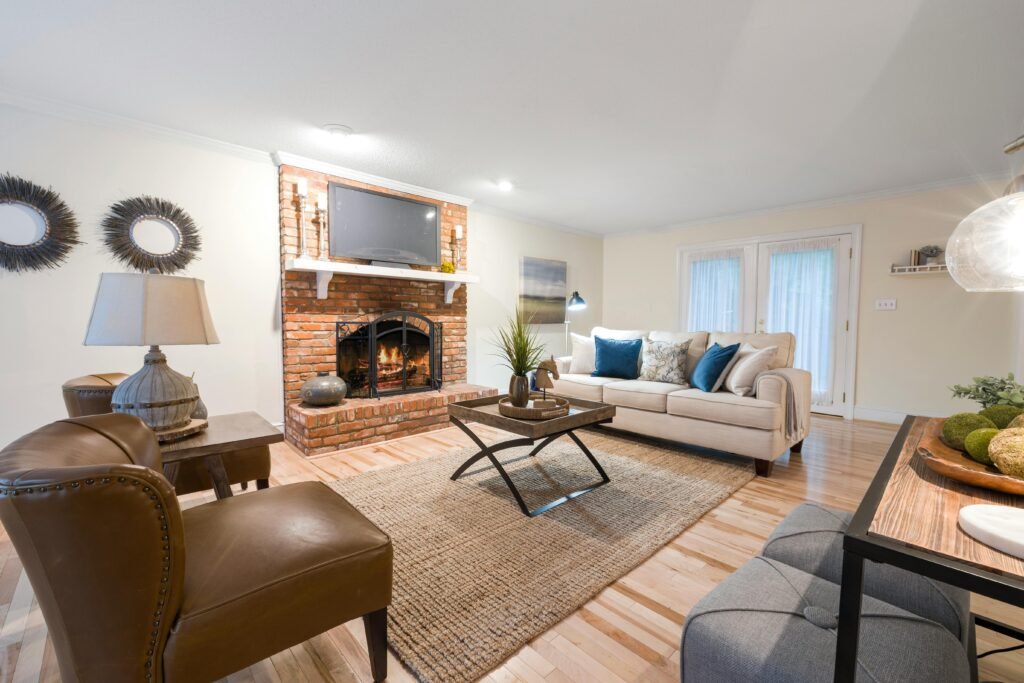
A fireplace is the original focal point of any living room — the thing every other piece of furniture orients toward. And yet a lot of living rooms treat the fireplace as background. A surface to put things on. A wall feature that happens to have a firebox in it.
This room doesn’t make that mistake. The exposed brick fireplace is the clear center of everything. The cream sofa faces it directly. The leather armchair angles toward it. The jute rug defines the zone in front of it. The TV above the mantel works because the mantel itself — with its flanking candle holders — frames the whole arrangement and gives it symmetry.
The starburst mirrors on the side wall are a detail worth stealing. Two of them, same style, same size, at the same height. They add visual interest to an otherwise plain wall without pulling focus from the fireplace. That supporting role — something interesting that doesn’t compete — is exactly what a living room’s secondary walls should do.
If your living room has a fireplace, let it be the boss. Orient your furniture toward it. Style the mantel with intention. Light it whenever you can — even a short evening fire changes the whole mood of the room in a way that no light fixture has ever managed to replicate.
The Living Room You Want Is One Decision Away
Every room on this list started with one clear idea — one thing the space was going to do well. A statement light. A plant corner. A bold rug. A wall that means something. You don’t need all ten ideas at once. You need to find the one that your space is missing.
Look at your living room right now and ask: what’s the one thing that would make it feel intentional instead of just furnished? Start there. Everything else will follow.
I’m currently rearranging my own living room around the fireplace — something I should have done two years ago. Turns out the sofa was just pointed at the wrong wall the whole time.
— Emily