10 Entryway Decor Ideas That Make a Real First Impression (Without Spending a Fortune)
My first apartment had an entryway that was essentially a 4-foot stretch of hallway between the front door and the living room. That was it. No closet, no natural light, no room for anything more than a pile of shoes. For almost a year I treated it as a passthrough — somewhere to throw my keys and ignore.
Then I spent one Saturday afternoon on it. One slim console table, one small mirror, one hook on the wall. About $80 total. And suddenly it felt like a proper entry into a home rather than a corridor into a slightly nicer corridor.
That’s what I keep coming back to with entryways: they set the tone for everything else. Walk into a cluttered entry and the whole apartment feels off. Walk into something intentional — even something small and simple — and the rest of the home reads better as a result. These 10 ideas are what I’ve used, tested, and kept.
Make a Narrow Hallway Work With a Slim Console Table
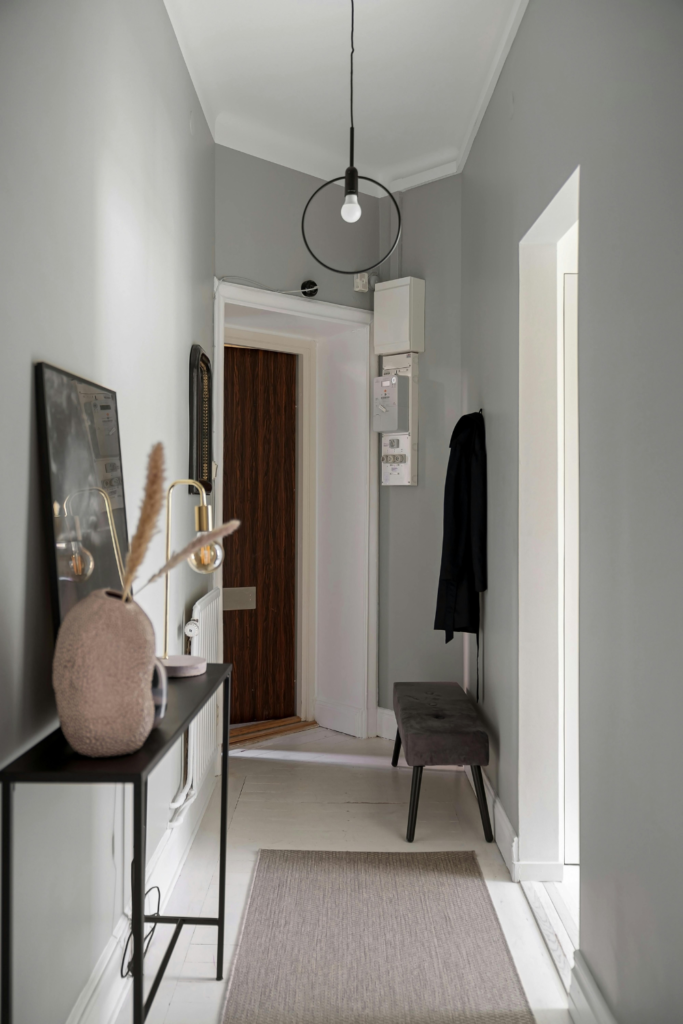
The narrow hallway is the entryway problem most people give up on. It’s tight, it’s dark, and every piece of furniture feels like it’s eating into the already limited space. The solution isn’t to leave it empty — it’s to choose furniture that’s proportioned for the scale.
A slim console table — 10 to 12 inches deep, no more — gives you a surface for styling without protruding into the walkway. The IKEA LIXHULT or a basic metal-frame console (both around $40–80) work perfectly. Style the top simply: one vase, one lamp, one leaned frame. Three objects maximum. Any more and the space reads as cluttered rather than curated.
What didn’t work for me: I tried a regular-depth console table (about 16 inches) in a hallway similar to this one and it made the corridor feel like an obstacle course. Every time someone walked through with a bag, they caught the edge. The 10-inch version eliminated the problem completely.
The runner rug in this hallway is doing exactly the right thing — it defines the zone, adds warmth to the white floor, and draws the eye toward the door. A runner at least 24 inches wide and as long as your hallway allows costs $30–60 at most home goods stores and is one of the most impactful additions you can make to a narrow entry.
Go Dark on One Wall and Make a Statement With Art
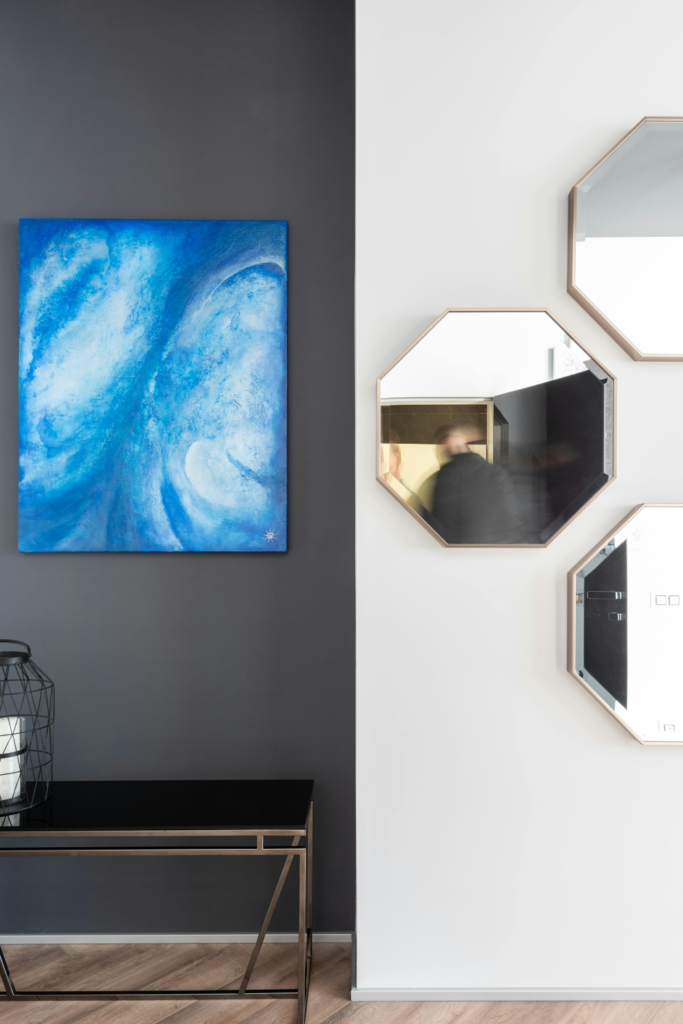
The entryway is the one room where a bold wall color makes immediate sense — visitors see it the second they walk in, it creates an impression before they even step fully inside, and because the square footage is small, you’re not committing to painting an entire room.
This combination is particularly strong: a deep charcoal accent wall on one side, large-scale artwork that punches against it, and then the adjacent white wall handled with a cluster of statement mirrors. The two walls work together rather than competing — the dark wall gives the art a gallery-like backdrop, and the mirrors on the white wall bounce light back into the space.
The cluster of three octagonal mirrors here is something I’ve been recommending for two years. Three mirrors of the same style and size, arranged in a vertical cluster, read as one intentional installation rather than three separate pieces. You can find octagonal or geometric mirrors at $15–35 each — the three together cost less than one large statement mirror and create significantly more visual interest.
For the dark wall: Sherwin-Williams Tricorn Black or Benjamin Moore’s Wrought Iron both work beautifully in small, naturally-lit entryways. One quart is usually enough for a single accent wall and costs around $18–22.
Style Floating Shelves With Plants and Real Objects
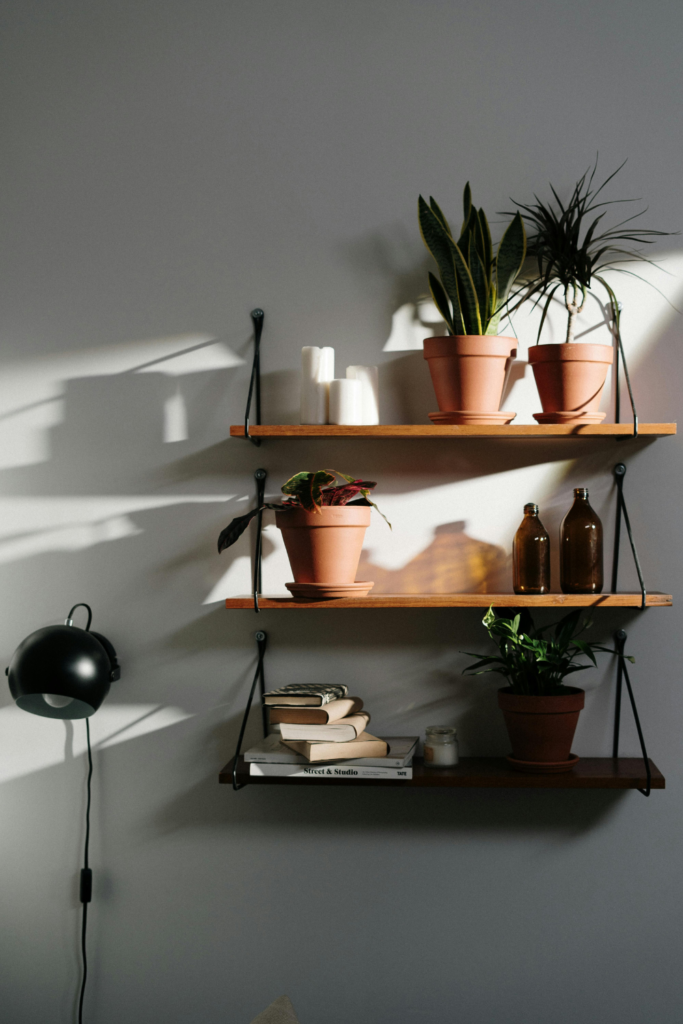
Floating shelves in an entryway solve a problem most people don’t think about until they run out of surface space: where do you put things that don’t have a home? A stack of books, a small plant, your keys in a ceramic dish. Shelves give these objects a place without requiring floor space.
The styling here is exactly right — terracotta pots, natural plants, amber glass bottles, a stack of books. It’s the kind of combination that reads as collected over time rather than arranged in an afternoon, which is the effect you’re always going for. The key is the terracotta consistency: when all your pots match in material (even if they vary in size), the shelf looks intentional regardless of what’s on it.
Three shelves spaced roughly 10–12 inches apart give you visual rhythm without feeling crowded. Each shelf should have no more than 4–5 objects, with at least one plant and one book or decorative object. The black iron bracket style shown here — the kind with a rod and tension wire — costs about $12–18 per bracket at hardware stores and adds an industrial touch that works with almost any wall color.
If you want more ideas on how to style shelves with plants throughout your home, the same principles apply in a small bedroom — one plant, some breathing room, and a mix of heights.
Build a Gallery Wall on Your Staircase
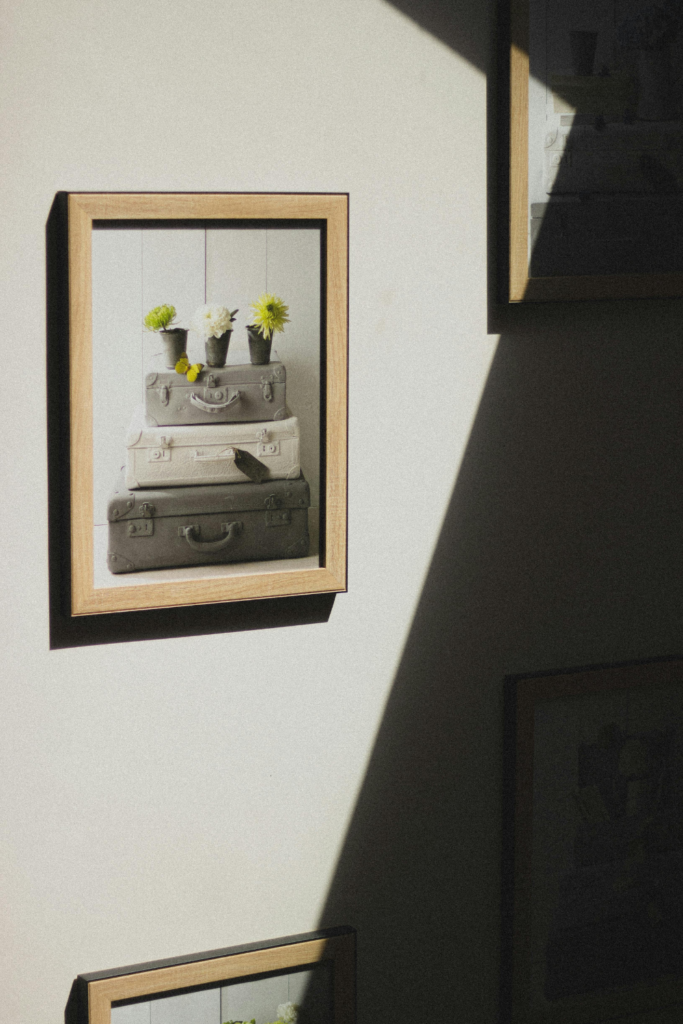
Staircase walls are some of the most underused real estate in a home. They’re large, they’re visible from the entryway, and they ascend at an angle that’s almost perfectly designed for a gallery wall. Most people leave them completely blank.
The gallery wall going up a staircase works best when the frames follow the angle of the stairs — each frame steps up with the wall rather than hanging at the same height. Use frames in the same finish (natural wood here, which reads warm and organic) but mix the sizes: one larger print, two medium, a few smaller ones. Keep the content cohesive — vintage botanical prints, photography from the same era, illustrations in a similar style.
I made the mistake of mixing frame finishes on a staircase gallery wall once — black frames, gold frames, and natural wood all on the same wall. It looked like I’d raided three different stores and combined everything without editing. Committing to one frame finish is the single rule that keeps a gallery wall from feeling chaotic.
A set of 6–8 prints in matching natural wood frames runs about $60–90 total if you print at a copy shop and buy basic frames. The arrangement takes an afternoon and a level, and the result holds up for years.
Lean a Large Mirror Against the Wall Instead of Hanging It
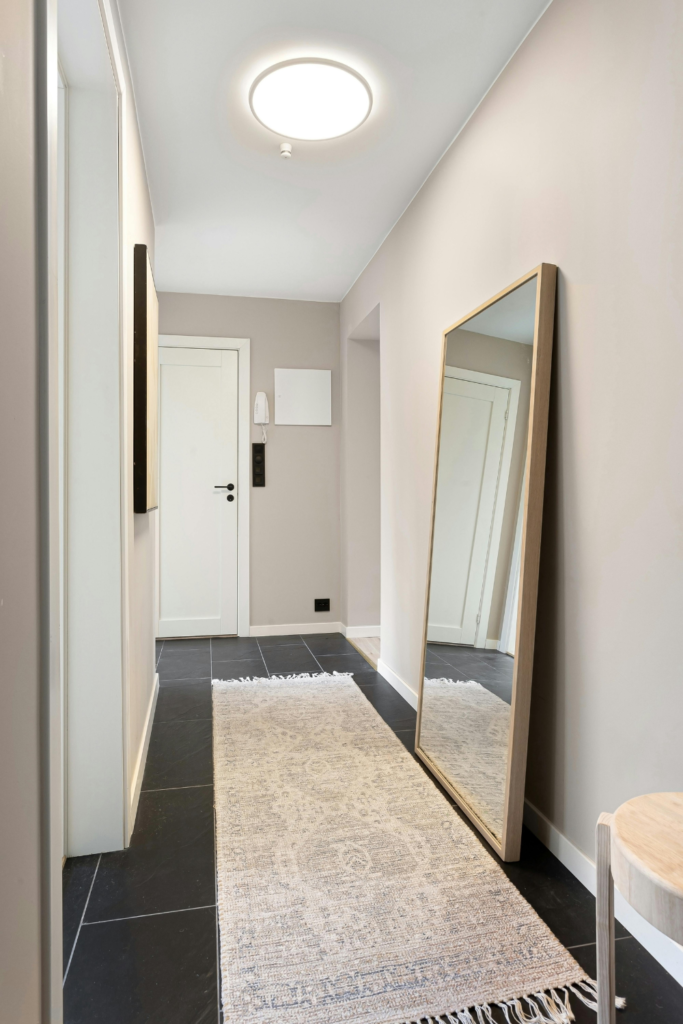
A leaning mirror is one of those ideas that feels a little lazy until you see it in person — and then it looks more intentional than a hung mirror ever does. The lean gives it a relaxed, considered quality that a straight-hung mirror doesn’t have.
The rules: the mirror needs to be large enough to be a statement. A 48×72 inch full-length mirror is the sweet spot — tall enough to read as furniture rather than an accessory, wide enough to reflect meaningful light. Natural wood frame or simple metal frame both work. Lean it against the longest unbroken wall in your entryway, slightly angled forward so it reflects the space rather than just the ceiling.
The runner rug in this hallway — a cream vintage-style flatweave — does something that’s easy to miss: it runs parallel to the mirror and creates a visual lane that makes the hallway feel wider than it is. That parallel relationship between rug and mirror is something worth replicating in any narrow entry.
A large leaning mirror in this style costs $80–150 at most furniture stores. It requires no wall damage, which matters enormously if you’re renting. And when you move, it comes with you without leaving a hole.
Use Large Statement Plants as Your Main Entryway Feature
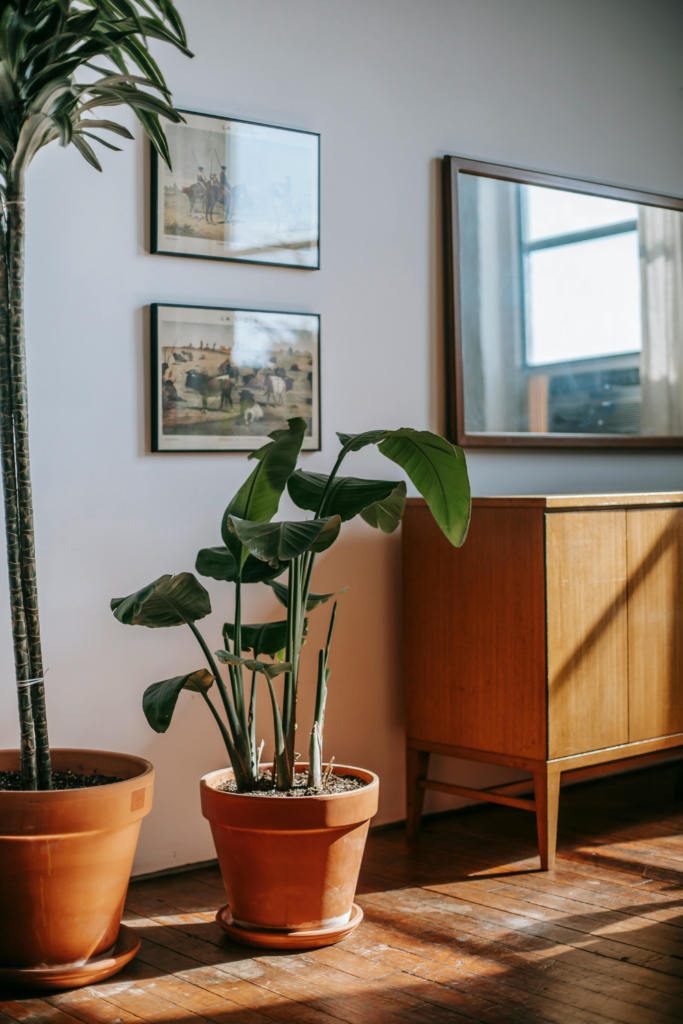
This is the entryway for people who would rather buy plants than furniture — and honestly, I understand completely. A large statement plant in a generous terracotta pot does what a console table does, but better: it fills vertical space, adds warmth, and makes the room feel alive in a way that no piece of furniture ever manages.
The bird of paradise is the gold standard for this use. It grows tall, has dramatic broad leaves, and does reasonably well in indirect light — which is what most entryways have. In a 14-inch terracotta pot it runs about $45–65 at most nurseries. A palm or a dracaena at similar scale works for lower-light entries.
Two plants of different heights together — as in this image — is more interesting than one large plant alone. The varying heights create visual movement, and the terracotta pots tie them together as a pair without making them look identical.
The sideboard behind the plants here is also worth noting. A mid-century credenza — either a real vintage piece or something like IKEA’s HAVSTA or the BRIMNES series — gives you closed storage while adding warmth through the wood grain. Vintage sideboards at thrift stores and Facebook Marketplace run $40–120 depending on condition. They’re some of the best value furniture you can find secondhand.
Add a Storage Bench Under the Stairs
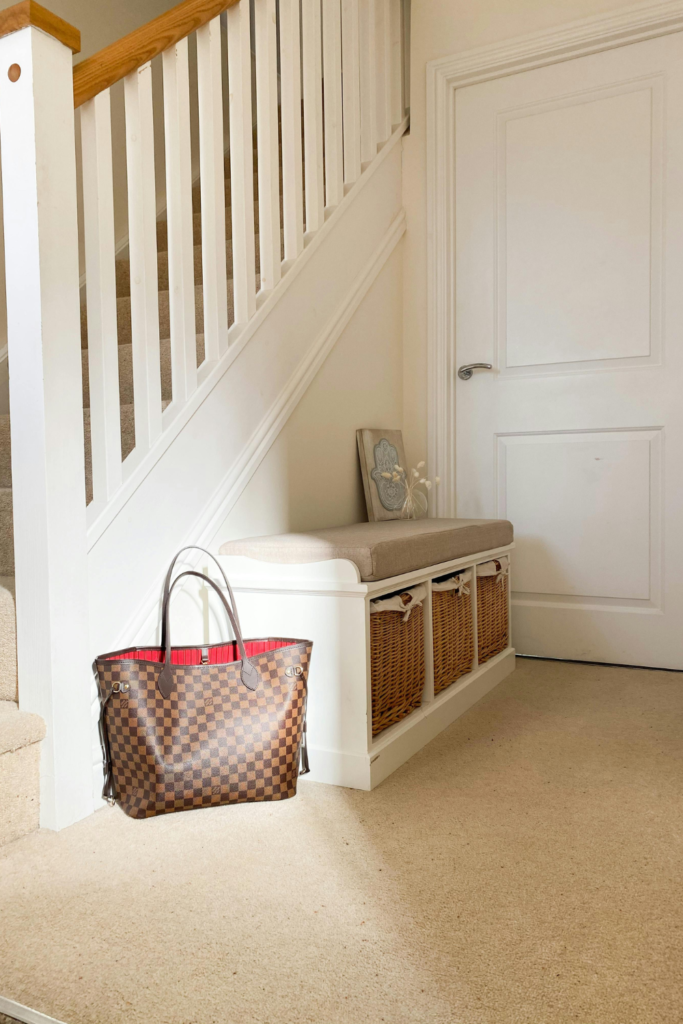
An entryway without seating is an entryway that creates a daily inconvenience — you’re standing on one foot trying to pull on a shoe while everything else topples. A bench solves this, and a bench with storage underneath it solves two problems at once.
The under-stair location in this image is a perfect use of otherwise dead space. But even without a staircase nook, a bench with wicker basket storage fits naturally along any entryway wall. The wicker baskets are the key detail — they contain shoes, scarves, bags, and miscellaneous clutter without looking like storage. They look like a styling decision.
IKEA’s HEMNES bench with storage comes in around $129 and is probably the most reproduced piece of entryway furniture in home decor. For a similar look at a lower price, a plain painted wooden bench ($40–60 at discount stores) with two or three wicker baskets tucked underneath ($8–12 each) achieves the same effect for about $65–85 total.
What I tried that didn’t work: I put a storage ottoman in my entryway thinking it would double as seating and hidden storage. It was too low for comfortable sitting, too bulky for the space, and the lid never stayed shut neatly. A proper bench is purpose-built for this use — the ottoman was a compromise that compromised everything.
Install Wall Hooks and a Bench for the Most Functional Entryway Possible
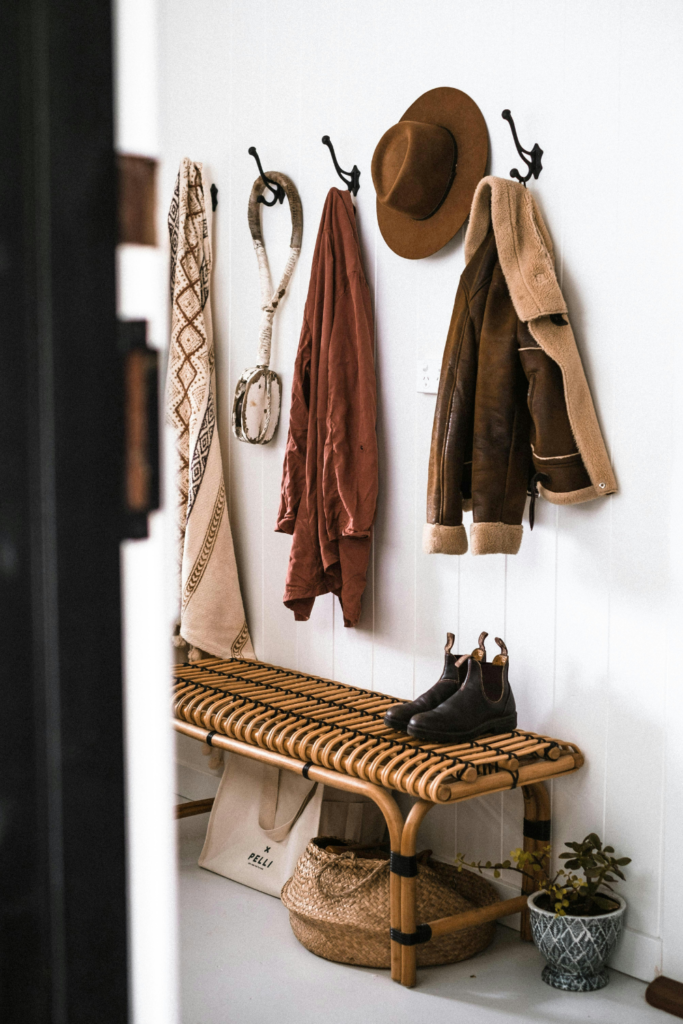
Here’s the thing about entryways: they’re not just decor. They’re the room that handles your daily life — where coats land, where bags get dropped, where shoes get kicked off. If the styling doesn’t work with how you actually live, it won’t stay looking good for more than a week.
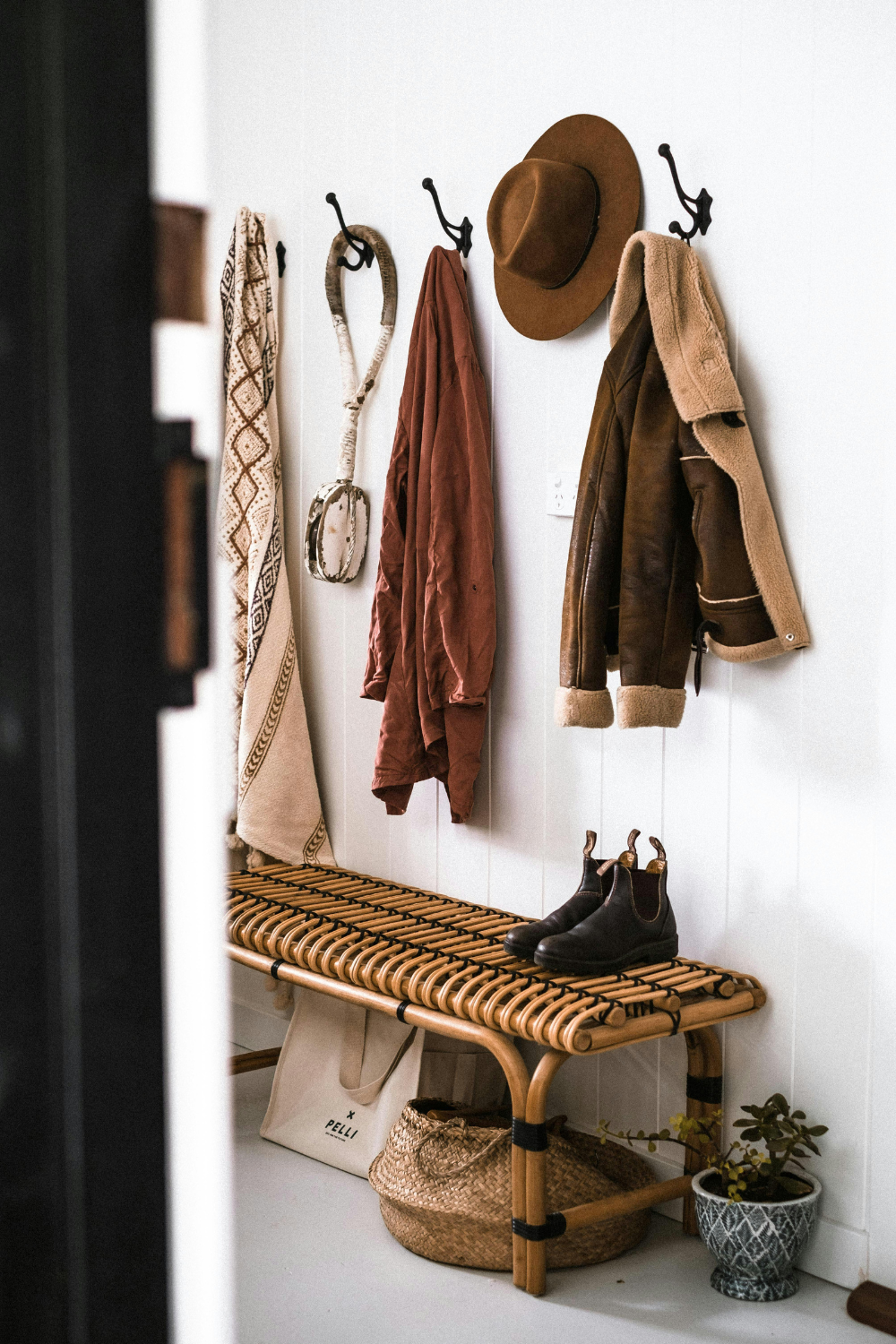
Wall hooks are the most honest entryway solution. Five black cast iron double hooks, spaced about 6–8 inches apart, hold everything a household produces — coats, hats, bags, scarves — and they do it visibly and accessibly. No fumbling with a closet. No pile growing on a chair. The rattan bench below gives you somewhere to sit while putting on shoes and a surface for what doesn’t go on a hook.
Cast iron double hooks run about $4–8 each at hardware stores — five of them costs less than $40. The rattan or bamboo bench ($55–90 depending on size) adds warmth and texture that a plain wooden bench doesn’t quite manage. Together this whole setup — hooks, bench, small basket and plant — costs well under $150 and is more functional than any expensive entryway cabinet I’ve ever owned.
The white shiplap paneling on the wall is a renter-friendly version this same look: peel-and-stick shiplap panels in white cost $25–40 for a 4×8 section and can be removed without wall damage. They add the same texture and the hooks mount directly into them.
Hang One Statement Mirror and Let It Do All the Work
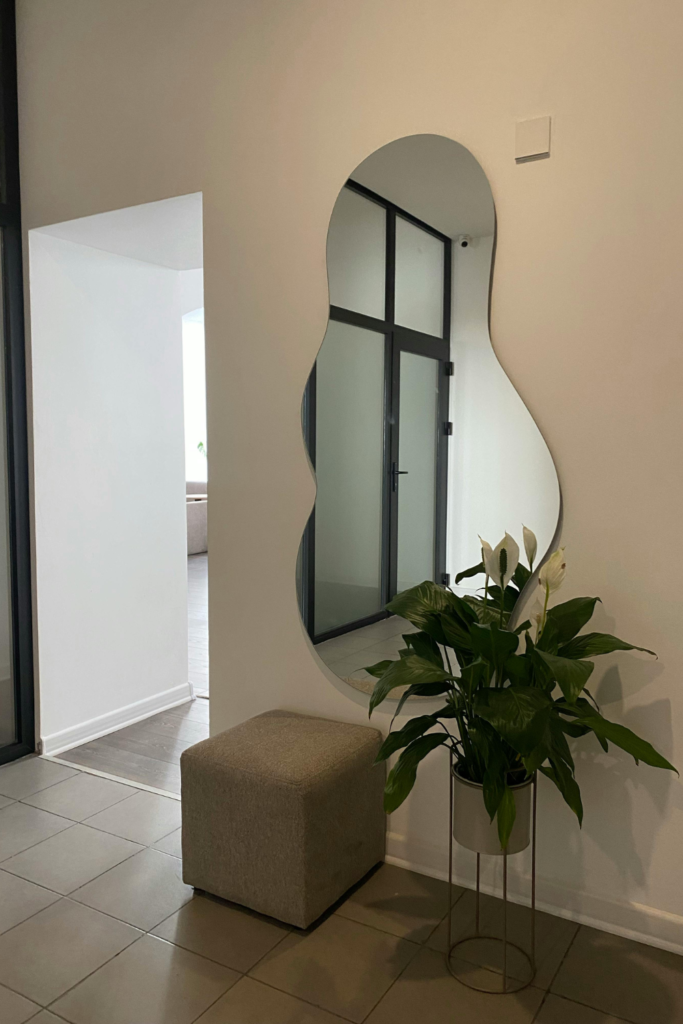
Sometimes the most effective entryway is the one that does the least. One large mirror. One plant. One small seat. Nothing else competing for attention.
The organic-shaped mirror — the wavy, irregular silhouette that’s been everywhere in the last two years — works particularly well in an entryway because it reads as art as much as a functional mirror. When you walk past it, you check yourself in it. When you don’t, it looks like a sculpture on the wall. That dual function is rare in home decor.
Frameless mirrors in this shape run $80–200 depending on size at most contemporary home decor retailers. The key is scale — go larger than you think you need. A 40×60 inch organic mirror is a statement. A 24×36 inch version is an accessory. They look completely different on a wall.
The peace lily on the tall gold plant stand in this image is a pairing I’d steal immediately. Peace lilies tolerate low light better than almost any flowering plant, the gold stand adds just enough warmth to the white entry, and the combination costs about $35–50 total. If you enjoy this minimal, contemporary aesthetic in other rooms, the 2026 home decor trends guide covers exactly how this direction is playing out across the full home.
Keep It Simple With a Console Table, a Mirror, and One Plant
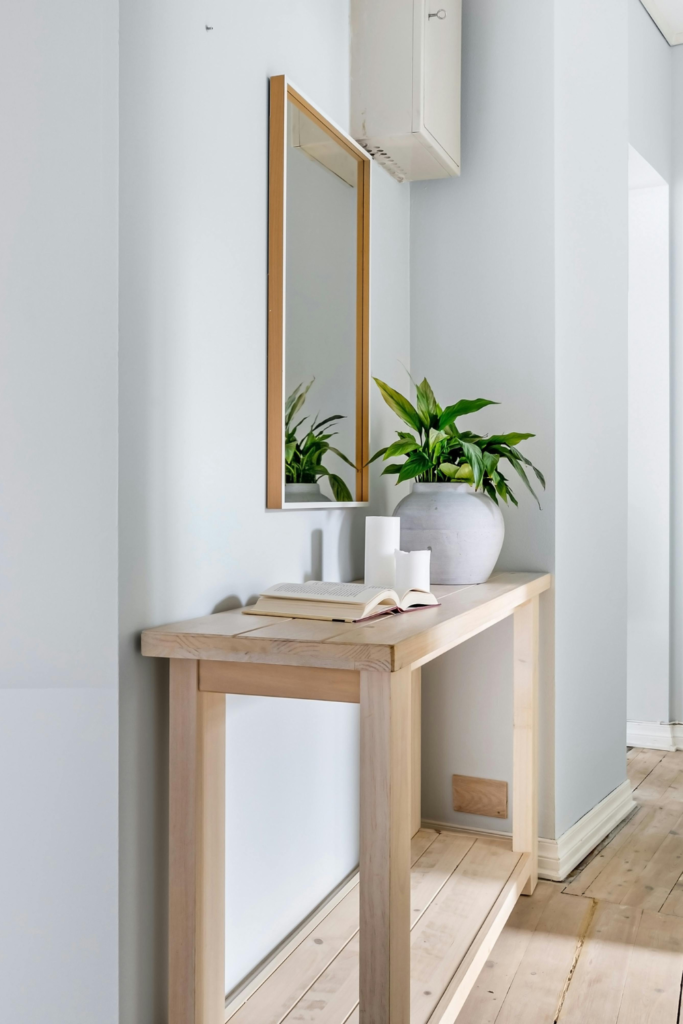
And sometimes the answer is just this. A console table. A mirror above it. A plant in a nice pot. Nothing else.
This combination works in almost any entryway, in almost any style, at almost any budget. The Scandinavian version here — pale oak, soft blue-grey walls, clean lines — reads quietly confident. No drama, no statement pieces, no layering of trends. Just a well-chosen table in the right place, styled with three objects that happen to be exactly right for the space.
The console table here is important: it’s very narrow (probably 8–10 inches deep) and the right height (around 32–34 inches, which is standard console height). That combination means it functions as a surface without taking anything from the room. IKEA’s HALLBORD hall table is about $99 and comes close to this look. A solid wood version from a thrift store, sanded and left natural, would be even better.
Above it: a small gold-framed mirror, roughly 18×24 inches — just large enough to check your reflection before you leave. Below the mirror: one plant in a round grey ceramic pot (a pothos or peace lily), two white candles of different heights, one open book. That’s five objects including the mirror, and the space looks complete.
This is the starting point I’d recommend to anyone who doesn’t know where to begin with their entryway. Do this first. See how it feels. Then add from there — or don’t, because this might be exactly enough. For more ideas on how this same calm, Scandi-influenced aesthetic works throughout the home, the cozy Scandinavian living room guide is worth reading next.
Questions I Get Asked a Lot About Entryway Decor
My entryway is basically just a doormat and a wall — where do I even start? Start with one hook and one small shelf or console table. That’s it. A single hook for your coat and bag eliminates the pile-on-the-floor problem immediately. A small surface — even a 10-inch-deep floating shelf — gives you somewhere to put keys and a small plant. Those two things alone change how the entry feels. Everything else comes later.
Can I add a mirror to a small entryway without it looking awkward? Yes — and a mirror actually makes a small entryway feel larger. The trick is going bigger than you’d instinctively choose. A small mirror in a small entry looks like an afterthought. A large mirror (even one you lean against the wall) makes the space feel like a real room. Aim for at least 24×36 inches, ideally bigger.
What’s the best flooring for a high-traffic entryway? If you can’t change the flooring, a flatweave or low-pile runner rug is the most practical addition you can make. It protects what’s underneath, adds warmth, and defines the zone. Avoid high-pile rugs in entryways — they collect debris, trip people, and don’t clean as easily. A cotton flatweave or a woven jute-blend runner runs $25–60 and lasts for years.
How do I make a rental entryway look good without making permanent changes? Three things that require no wall damage: a leaning mirror, a freestanding hook rack (the kind with a base, not wall-mounted), and a slim console table. Command hooks work for lightweight items — a single coat, a hat. For heavier coats, a freestanding coat rack at $35–60 is the answer. Everything else is styling — rugs, plants, objects on the console — and all of it moves with you.
How many things should I actually put in my entryway? Less than you think. An entryway that’s styled with 8–10 objects feels cluttered in a small space. The goal is 3–5 things on any given surface, and those things should earn their place: one plant (functional/beautiful), one mirror (functional/beautiful), one lighting element, one storage solution. Start there and add only when something is genuinely missing.
The Entryway Sets the Tone for Everything Else
It’s the room most people spend the least time decorating — and the room that visitors see first, that you see every time you leave and every time you come home. That’s a significant amount of daily interaction with a room that most of us treat as an afterthought.
You don’t need a full makeover. Pick one idea from this list that fits your space and your budget, and do that this weekend. The hook rack. The leaning mirror. The console table with a plant. Any of them will change how the entry feels — and by extension, how the whole home feels when you walk in.
My current entryway project: I’ve been eyeing a vintage credenza for the hallway for months. If I find the right one, I’ll share the before and after here.
— Emily
Which of these ideas are you most likely to try? Tell me in the comments — especially if you’re working with a really narrow hallway. I’d love to know what you’re dealing with.
