Black Fireplace Ideas: The Decision, the Materials, and Everything That Comes After
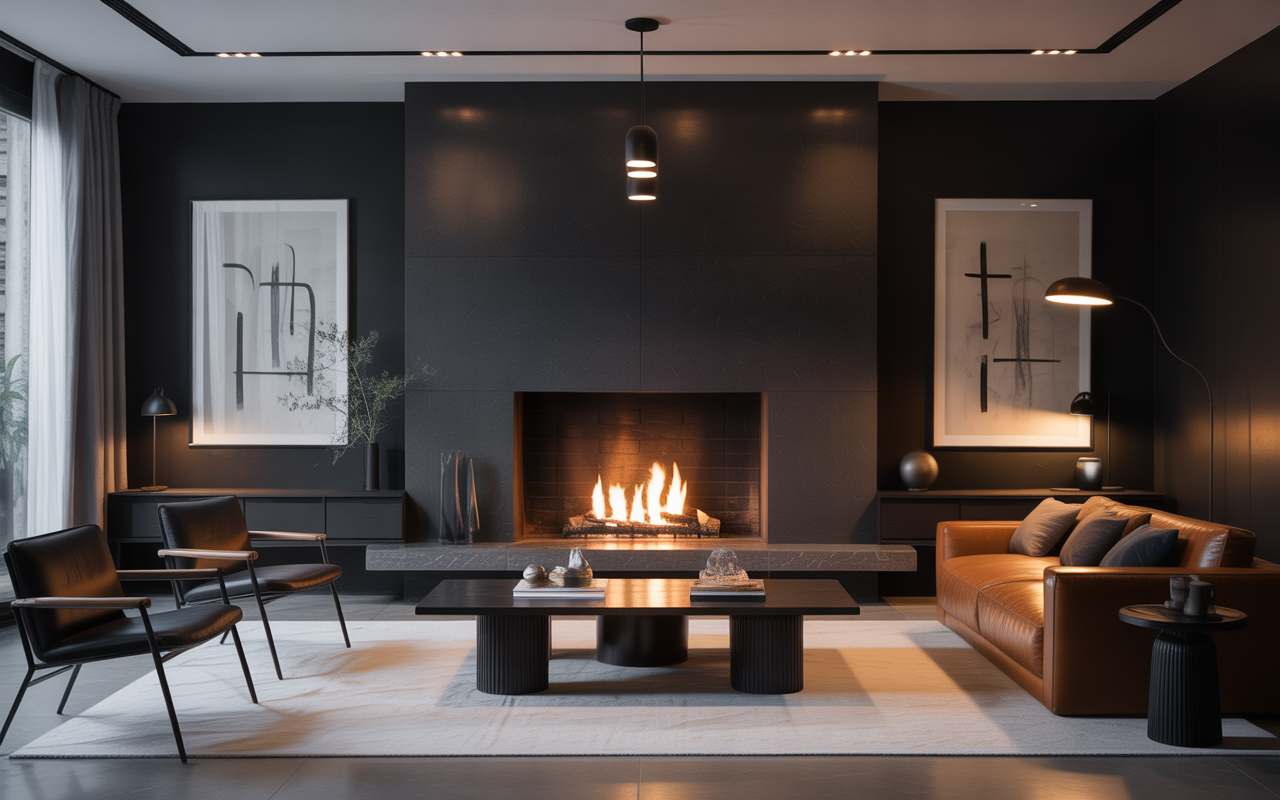
A black fireplace is not a decorating choice. It’s an architectural statement — the largest, most prominent feature in the room rendered in the strongest neutral there is. When it works, it works completely: the room has a gravitational center, everything else orbits it with clarity, and the fire itself, when it’s lit, glows against the dark surround with a warmth that a light-colored fireplace can’t quite match.
When it doesn’t work, it’s because someone made the fireplace black without thinking through what the rest of the room would need to do around it. A black fireplace in a room that’s also full of dark furniture and low light doesn’t read as bold — it reads as heavy. And a black fireplace in a room full of competing statement pieces reads as one more thing trying to be the loudest.
Getting a black fireplace right starts with understanding what kind you’re dealing with, because “black fireplace” covers several genuinely different things — a painted brick surround that cost $40 in paint and an afternoon, a professional black tile surround that cost $3,000 in renovation work, a modern linear gas fireplace that cost $8,000 installed. The ideas that apply to one don’t necessarily apply to another. Here’s how to navigate all of them.
The Material Decision — What Kind of Black Are You Choosing?

The black in a black fireplace comes from one of several materials, each with a different texture, finish, cost, and visual character. Getting the material right matters as much as the color.
Painted brick is the most accessible: high-temperature paint rated for fireplaces ($40–80 for the paint, more if you hire a painter) transforms a dated brick surround into something modern in a day. The result is matte and slightly textural — the brick pattern reads through the paint, which gives the surface more visual interest than a perfectly smooth finish. It’s the right choice if the brick is structurally sound and the bones of the fireplace are good; it’s the wrong choice if the brick has seen better days and the visual interest of the painted texture would highlight rather than hide that.
Black tile — whether glossy, matte, or textured — is a professional renovation decision. Glossy black tiles reflect light and make the surround feel more contemporary and almost lacquered. Matte black tile reads as more understated and works across a wider range of room styles. Textured or dimensional tile adds depth that flat tile doesn’t have. The cost depends heavily on the tile and the installation, but expect $500–3,000+ for a full surround replacement depending on size and complexity.
Natural black stone — slate, honed black granite, or soapstone — is the premium option that earns the investment by having a visual quality that painted or manufactured materials can’t replicate. Natural stone has variation in tone and texture across its surface that catches light differently depending on the hour. It looks like what it is, which in a home context is always better than looking like something it isn’t.
Painted shiplap falls between the painted brick and the tile in character — the horizontal planks of shiplap painted matte black create a surface that’s warmer and more textural than flat painted drywall, with a slight rustic quality that works especially well in rooms that lean toward the warm and cozy rather than the sleek and modern.
The modern black frame fireplace — a zero-clearance or linear insert in a black powder-coat or black steel finish — is a product rather than a finish, and it reads differently from a surround treatment: more architectural, more contemporary, a deliberate object inserted into the room rather than a surface treatment applied to an existing feature. More on this type specifically in the next section.
The Modern Black Frame Fireplace — The Fireplace as Object
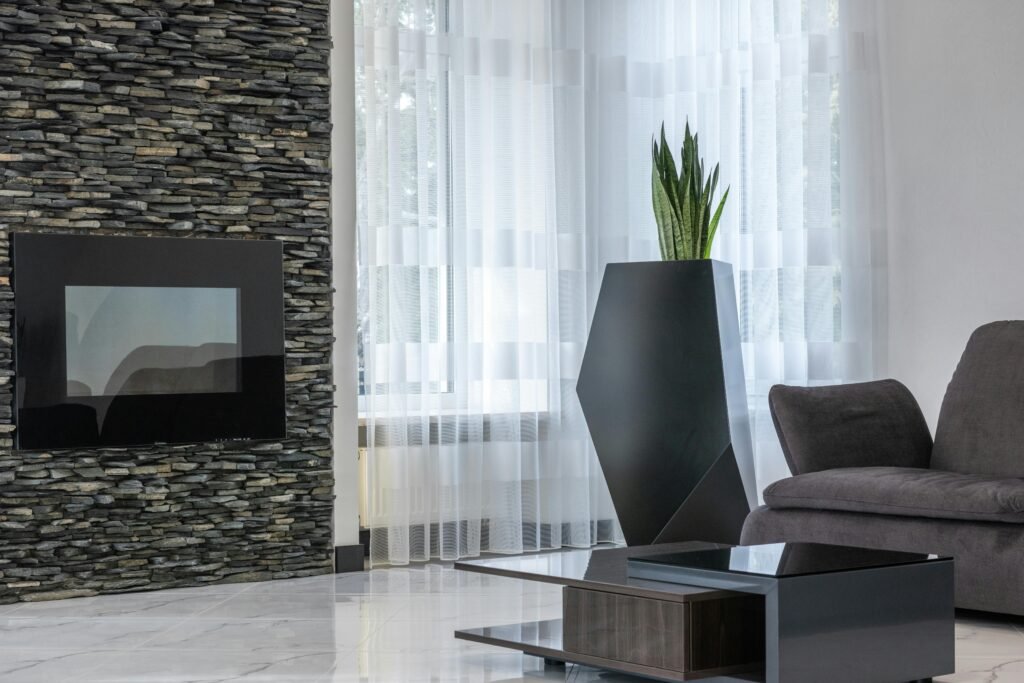
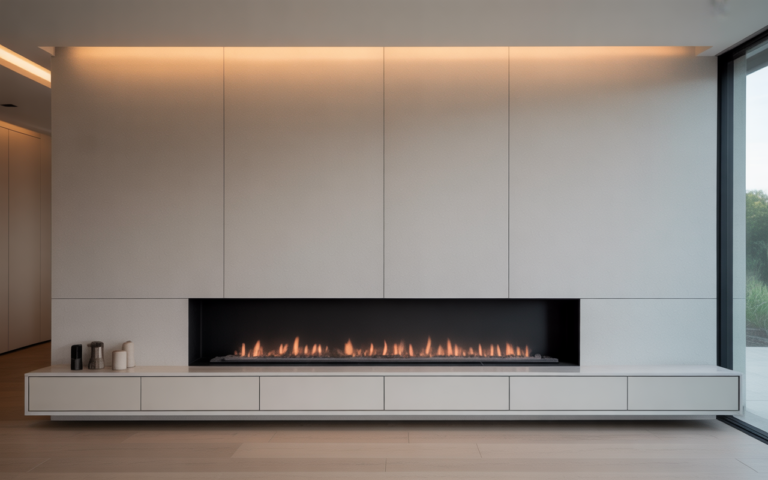
A modern black frame or linear fireplace — gas or electric, with a black steel or powder-coated housing — is a product designed to be a room’s architectural focal point. It doesn’t pretend to be a traditional fireplace. It’s a contemporary object, usually rectangular and low-profile or tall and narrow, that brings fire into a space that wasn’t built around a traditional masonry firebox.
These fireplaces work especially well in rooms that are already committed to a contemporary design language: clean lines, neutral palette, furniture with visible legs and simple profiles. In that context, a black steel frame fireplace against a white or concrete-gray wall is a complete and coherent statement — the fireplace as sculpture.
The proportions matter significantly. A linear fireplace that’s too wide for the wall it’s on overwhelms the room. One that’s too narrow looks like a television mounted in the wrong place. The general guide: the fireplace opening should be no wider than the sofa or the primary seating arrangement in front of it. A fireplace that’s exactly as wide as the sofa creates a satisfying visual alignment; one that’s significantly wider or narrower breaks it.
Installation costs for a modern gas insert with a black steel surround run $3,000–10,000+ depending on gas line access, framing requirements, and the specific unit. Electric linear fireplaces are significantly less expensive and require no gas line — a quality electric linear fireplace with a black surround runs $800–2,500 and can be installed without professional help in many cases.
Updating an Existing Fireplace — The Insert Approach
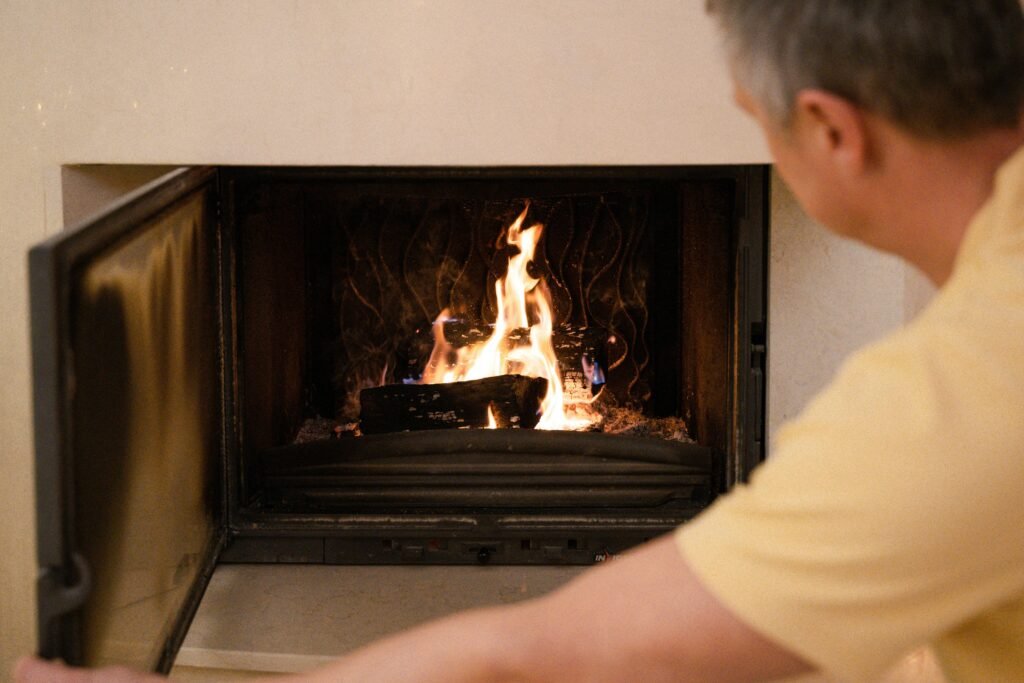
A fireplace insert is the most cost-effective way to update an existing fireplace that functions but looks dated. An insert — whether gas, electric, or wood-burning — fits into the existing firebox opening and provides a new face for the fireplace without requiring demolition of the surround or the mantelpiece.
Black inserts in a simple, contemporary design update a traditional fireplace’s interior while leaving the surround and mantel intact to be worked with separately. This matters because the insert itself is visible only from the front, and a black interior behind a brick or stone surround can look odd if the two elements don’t relate. The better approach when using a black insert: update the surround and mantel finish to relate to the insert’s tone, even if you don’t replace them entirely. A painted surround in a warm charcoal or matte black, or new tile that works with the insert’s color, completes the update in a way that an insert alone doesn’t.
The practical considerations for inserts: a gas insert requires a gas line (either existing or newly run) and professional installation; an electric insert does not. Both require that the firebox opening is within the dimensional range the insert is designed for — measure before purchasing. Quality gas fireplace inserts with a black finish start around $1,500–2,500 plus installation; electric inserts of similar quality start around $500–1,500.
Built-In Shelving — When the Fireplace Becomes a Wall
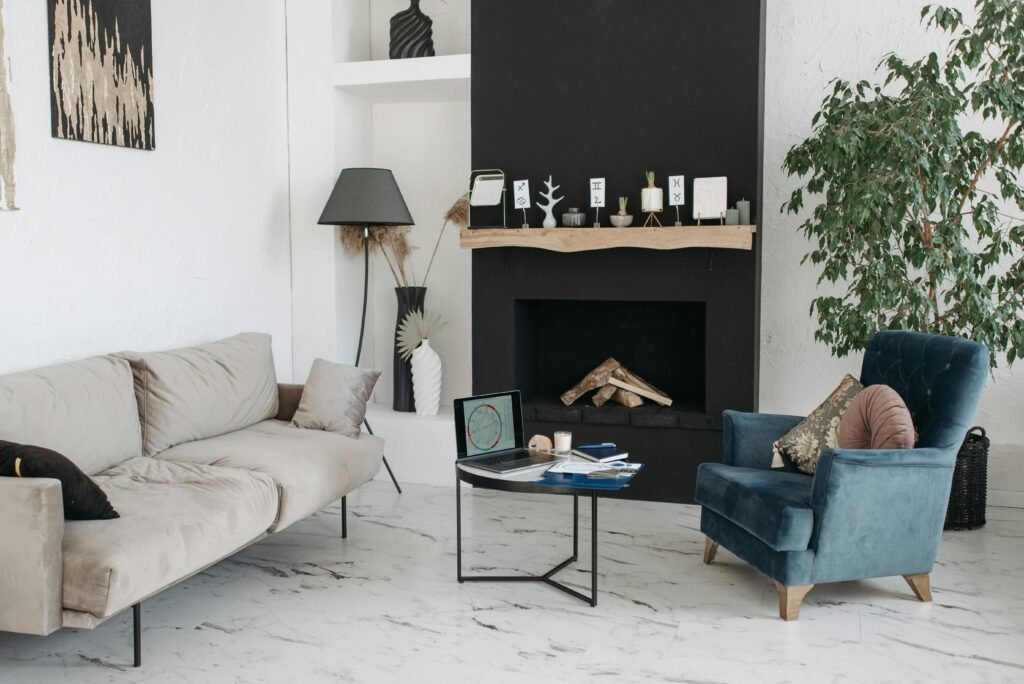
A black fireplace flanked by built-in shelving is a different kind of fireplace decision — it’s not just the fireplace you’re designing, it’s an entire wall composition. The fireplace becomes the anchor of a built-in unit that extends to either side, incorporating shelving, cabinet storage, or both, and the whole assembly reads as one architectural feature rather than a fireplace with some shelves nearby.
This approach works best when the wall is wide enough to accommodate the fireplace plus meaningful flanking shelving — at least two feet on each side, ideally more. A narrow room where the fireplace already takes up most of the wall doesn’t benefit from built-ins that feel squeezed; it benefits from treating the fireplace as the only feature on the wall and leaving what flanks it clear.
The black finish decision for built-ins flanking a black fireplace: the shelving doesn’t need to be black to work with a black fireplace. In fact, painting the shelving white or a warm off-white — so the black fireplace reads as distinct within a lighter surround — often produces a more interesting composition than painting everything black and losing the definition between the fireplace and the shelving. The books, plants, and objects on light shelves read much more clearly against the light background; the black fireplace box anchors the center of the composition; the whole wall has hierarchy.
Built-in shelving around a fireplace is a carpentry project — either professional ($3,000–8,000+ for custom built-ins, depending on size and complexity) or DIY with IKEA cabinet hacking and floating shelves (significantly less, and genuinely achievable for an intermediate DIYer).
The Wall Above — What a Black Fireplace Needs Overhead
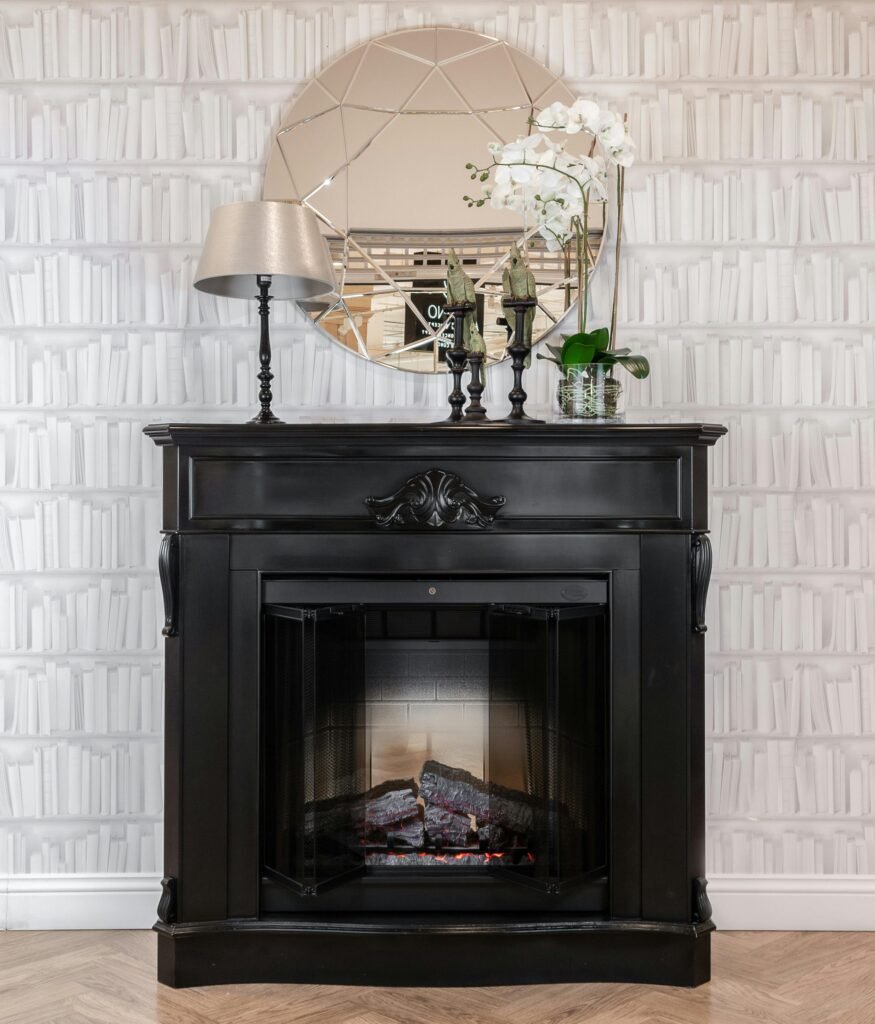
A black fireplace creates a specific challenge for the wall above it: the surround is already dark and visually strong, which means whatever goes above it needs to be confident enough to coexist with that strength rather than being swallowed by it.
Three approaches work consistently. The first: a large mirror in a simple frame — not ornate, not too thin — hung at the right height above the mantel. The mirror’s reflective surface creates light in the dark surround’s vicinity, and the scale (it should be nearly as wide as the fireplace opening, or wider) anchors the wall while opening it up. A large mirror above a black fireplace is one of the most reliable and beautiful combinations in contemporary interior design.
The second: large, confident artwork. The piece needs to be large enough to not disappear against the visual weight of the black below it. An abstract piece in warm tones — cream, sienna, warm gray, deep blue — relates to the fireplace’s dark tone without fighting it. Pale, delicate artwork above a black fireplace often gets lost; the artwork needs visual weight to match the fireplace’s.
The third: a floating shelf above the mantel, at the height and depth needed to display a few strong objects, with the wall above the shelf left intentionally clear. This works when the objects on the shelf are genuinely interesting and when the space has enough height that the exposed wall above the shelf reads as intentional breathing room rather than empty space waiting for something.
What doesn’t work: small decorative signs, collections of small framed photos that don’t aggregate to a scale that holds up against the fireplace, and the pattern of putting many small things on the mantel because the wall above felt too bare — which is usually a sign that the wall above needs a larger single element rather than more things on the shelf below.
Black and Warm Wood — The Pairing That Works Best
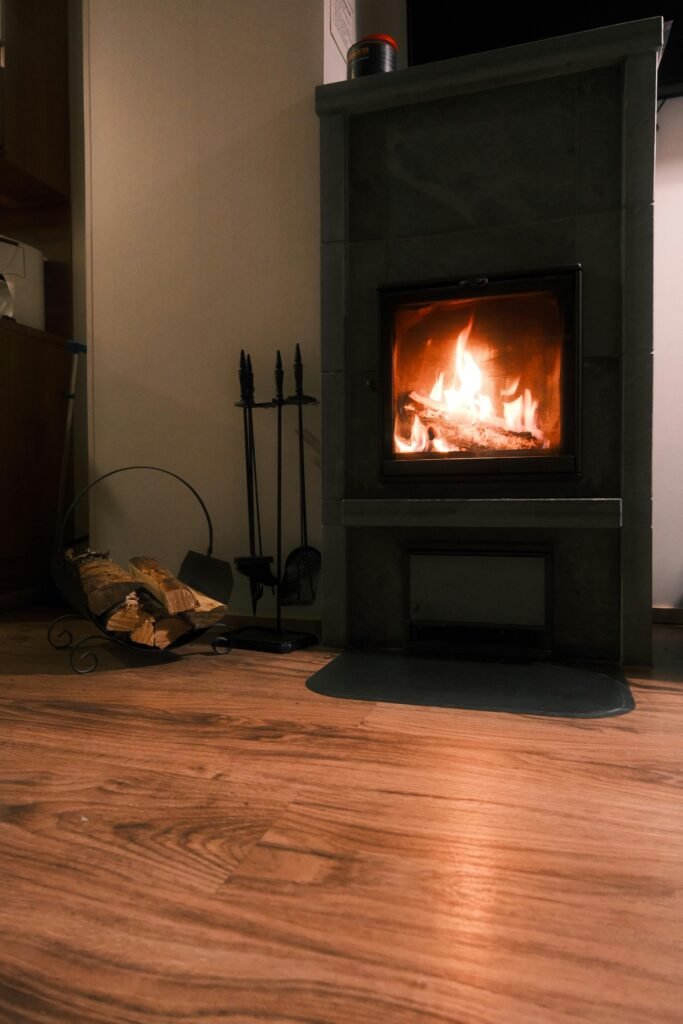
A black fireplace in a room full of cold, hard surfaces — polished concrete, metal, glass, white walls — can feel austere and uninhabitable regardless of how well-designed each element is individually. The antidote is almost always wood: a reclaimed wood mantel above the black surround, light oak or walnut floors, wooden furniture with visible grain, a wood-beamed ceiling if the architecture offers one.
The wood doesn’t warm the fireplace itself — the fire does that — but it warms the fireplace’s relationship to the room, giving the eye somewhere to rest that’s organic and human-scaled rather than hard and industrial. A light-finish wood mantel on a black tile surround is one of the most reliable fireplace combinations there is: the contrast is strong but the warmth of the wood keeps it from feeling severe.
The tone of wood matters significantly with a black fireplace. Very dark woods — ebony, very dark walnut, blackened oak — don’t provide enough contrast to read as a distinct pairing; they merge with the black and the combined effect is heavy. Light-to-medium woods — white oak, natural maple, pine, lighter walnut — provide the contrast that makes both elements visible and beautiful. The lighter the wood, the more the black fireplace recedes slightly and the wood leads; the darker the wood, the more the two elements compete.
Reclaimed wood mantels specifically — rough-hewn beams repurposed as mantelpieces — have become almost a cliché above black fireplaces, which is a sign that they work rather than a reason to avoid them. A genuine reclaimed beam with visible grain and history, mounted simply above a clean black surround, remains one of the most beautiful fireplace arrangements available.
Lighting — How to Illuminate a Dark Fireplace
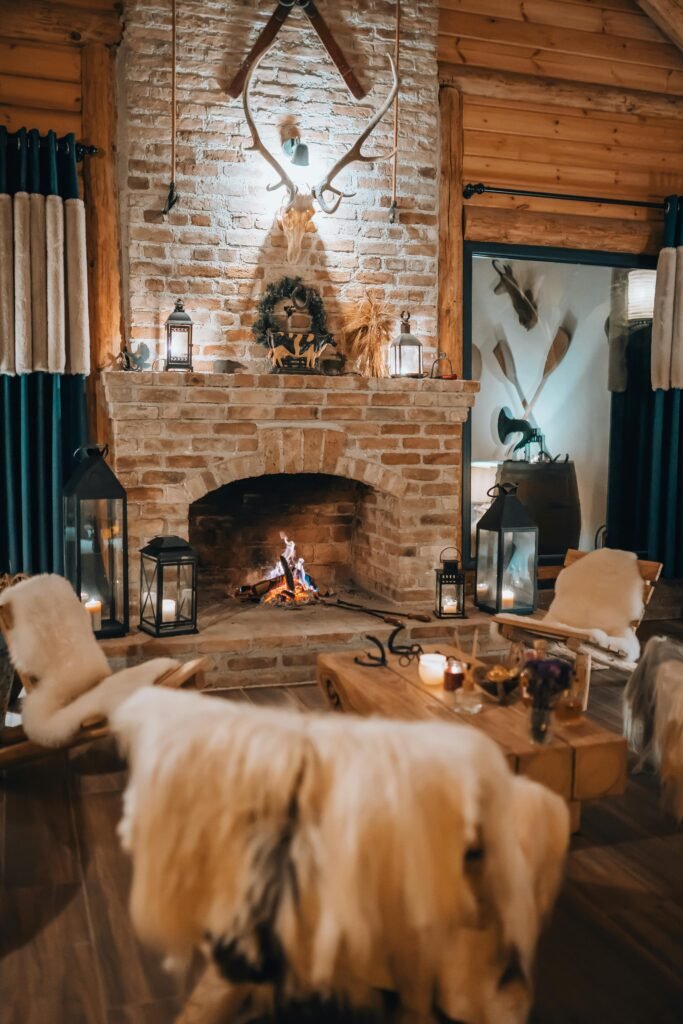
A black fireplace in a room with only overhead lighting will look dark and heavy most of the time, because overhead lighting illuminates the floor and the top surfaces of furniture and does relatively little for the mid-height architectural features where the fireplace lives. The fireplace needs its own lighting logic.
Flanking sconces — a pair mounted at roughly eye height on either side of the fireplace, roughly at mantel level or slightly above — are the classic solution. They illuminate the surround from the sides, create a warm glow that relates to the fire’s own light, and anchor the fireplace within its wall in the way that flanking light sources always do. The sconce style should be simple enough not to compete with the fireplace: a straightforward arm sconce in black metal or brushed brass, without ornate detail, in a scale proportionate to the wall.
Floor lamps positioned at the ends of the sofa facing the fireplace illuminate the room from a warm height and direct attention toward the fireplace from the seating position. Table lamps on flanking furniture do the same.
The specific light quality: warm white (2700K), always. A black fireplace under cool-toned light looks cold and industrial; under warm light it looks rich and sophisticated. This is one of the most impactful changes you can make to an existing black fireplace room that isn’t working — change the bulbs before changing anything else.
When the fire is lit: no overhead lights. The fire provides the focal light; supplemental lamps provide enough ambient light to see by. This is the moment the black fireplace was designed for, and overhead lighting competes with rather than supports it.
Color in a Room with a Black Fireplace
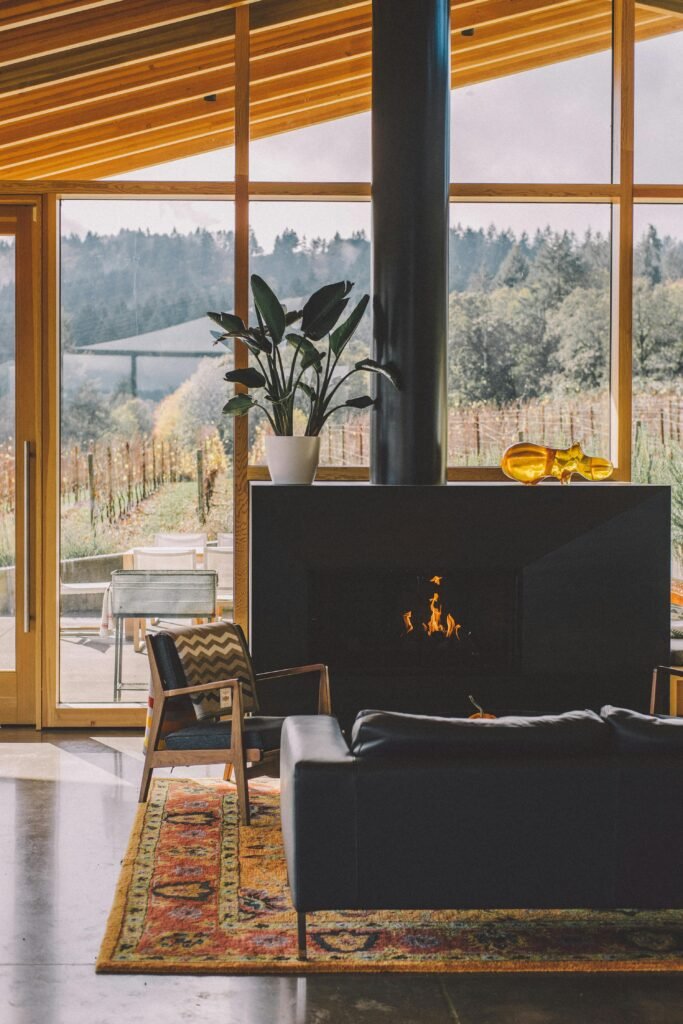
A black fireplace is a strong dark anchor in the room, and the rest of the color palette has two coherent directions to go: lean into the contrast (light walls, light furniture, the black fireplace as the one dark statement), or complement with depth (warm deep wall colors that relate tonally to the black without matching it).
The high-contrast approach — white or very light walls, light-upholstered furniture, the black fireplace as the sole dark anchor — is the most common and most frequently photographed black fireplace arrangement, and it works because the contrast is genuinely striking. The fireplace reads clearly and confidently; the light room makes it pop. The risk is that it can feel stark if the room doesn’t have enough warmth introduced through textiles, wood, and plants.
The deep-tone approach — a warm dark wall color like a deep navy, forest green, or terracotta alongside the black fireplace — creates a moodier, more enveloping room where the fireplace is part of a rich, layered environment rather than a contrast statement. This works particularly well in smaller rooms where the depth of color creates intimacy rather than claustrophobia, and in rooms with good natural light that keeps the dark palette from feeling heavy during the day.
What to avoid: a room where there’s no relationship between the black fireplace and the surrounding color palette — where the fireplace feels like it was placed in the room without consideration of what the walls and furniture were doing. The black fireplace needs to be either clearly contrasting (intentionally the darkest element) or clearly integrated (part of a cohesive dark palette). A black fireplace in a room of warm medium tones — tan walls, medium-wood furniture, rust accents — often feels like it arrived from a different design sensibility and makes the room restless rather than resolved.
The Mantle Arrangement for a Black Fireplace
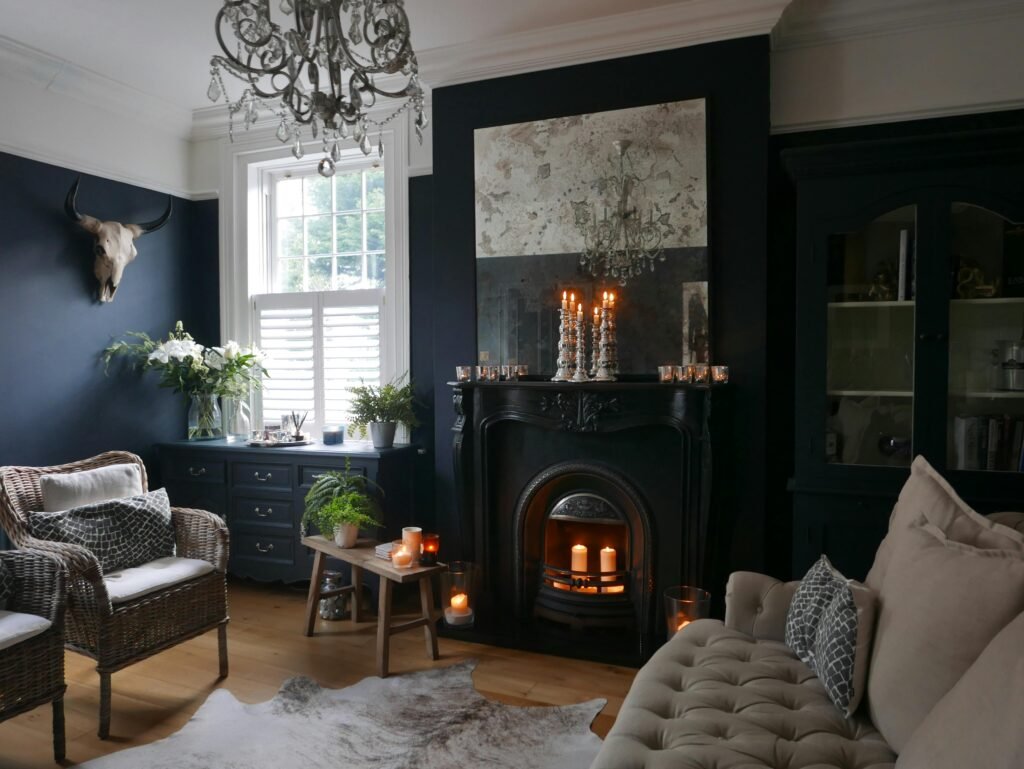
Everything that applies to mantle styling in general (see: the rule of odds, height variation, one focal point, negative space) applies here, with one additional consideration: the black surround is a strong visual element that will either support or compete with the mantle arrangement, depending on what’s displayed.
Objects with visual weight — tall candlesticks, a substantial piece of pottery, a vase of generous greenery — hold up against the dark surround. Delicate or intricate small objects get partially absorbed by it. This isn’t a reason to avoid small objects entirely, but it is a reason to make sure the arrangement has at least one or two pieces with enough scale to register against the dark background.
Colors that work well on the mantle of a black fireplace: warm whites and creams, natural wood tones, warm metals (brass, unlacquered bronze, warm gold — not chrome or cold silver), the green of plants. These colors have enough warmth and contrast to read clearly against the black. Cool pale grays and muted silvers can get lost.
The specific arrangement that almost always works on a black fireplace mantle: a warm-toned vase or jug of greenery slightly off-center, a cluster of candles in varying heights in warm metal holders on the opposite side, and one or two personal objects of genuine visual interest filling the middle. Nothing symmetrical, nothing too small to read from across the room, nothing that competes with the surround rather than resting comfortably above it.
What to Know Before You Commit
Is painting a brick fireplace black reversible? Technically yes, but in practice it’s very difficult to fully remove paint from brick. A painted brick fireplace should be considered a long-term change rather than a temporary experiment. Paint it with confidence or don’t paint it — the in-between attitude produces rooms where you spend years second-guessing the decision.
Does a black fireplace make a room feel smaller? In a room with poor natural light and dark walls, a black fireplace can contribute to a heavy feeling. In a room with good natural light and lighter walls and furniture, a black fireplace reads as a strong design choice that makes the room feel more architectural rather than smaller. The light in the room matters more than the darkness of the fireplace.
What if I want to lighten the fireplace later? Tile and stone surrounds can be replaced. Painted brick can be lightewashed or painted a lighter color, though the result varies depending on the original brick color and the paint used. A modern black frame fireplace insert can often be replaced with a different-finish insert without structural changes. Knowing your exit options before you commit to a material is worth the research time.
What’s the most common black fireplace mistake? Choosing a black fireplace and then decorating the rest of the room as if the fireplace isn’t black — using the same furniture, the same colors, the same mantle arrangement that was there before — and wondering why the room doesn’t feel resolved. A black fireplace is an architectural anchor that requires the room to respond to it. Give it the contrast, the lighting, and the mantle arrangement it needs to do its job.
The Room That Knows What It’s Doing
A black fireplace in the right room is one of the most confident design choices available to a homeowner. It says: this is the center, and everything else is arranged around it. When the fire is lit, the room has a quality that’s ancient and immediate at the same time — the dark surround concentrating the eye on the flame, the warm light reaching across the room, the whole arrangement making a case for why people have always built fires in the center of their homes and gathered around them.
The room earns that quality by responding to the fireplace rather than ignoring it. Light walls or warm deep ones. Wood somewhere in the room to soften the strength of the black. Proper lighting that makes the fire the hero rather than competing with it. A mantle arrangement with confidence and negative space.
It’s a strong choice. Make it with your eyes open, and it will be one of the best things in your home.
What room are you putting a black fireplace in — and what’s the wall color you’re considering? Drop it in the comments. The specific details always make for the best advice.
— Emily