Mantle Decor Ideas: How to Style the Most Compositional Surface in Your Home
The mantle is the hardest surface in the house to decorate well and the easiest to decorate badly. Stand in front of most mantles and you can tell immediately which one happened. The badly decorated mantle has too many things on it, nothing in particular to look at, and an arrangement that appears to have arrived gradually rather than been chosen. The well-styled mantle has a composition — a place where the eye lands first, a sense of hierarchy, and enough negative space that each object gets to be itself.
The difference between those two outcomes is less about what you put on the mantle and more about how you think about the surface. A mantle is not a shelf. A shelf holds things. A mantle is a stage — it’s at eye level, it has a wall above it that’s part of the composition, and whatever you put on it will be seen from across the room. That’s a different challenge than organizing a bookshelf, and it calls for a different approach.
Here’s how to build a mantle that works all year, across seasons, and in whatever style your room is asking for.
Start Above the Mantle — This Is the Most Important Decision
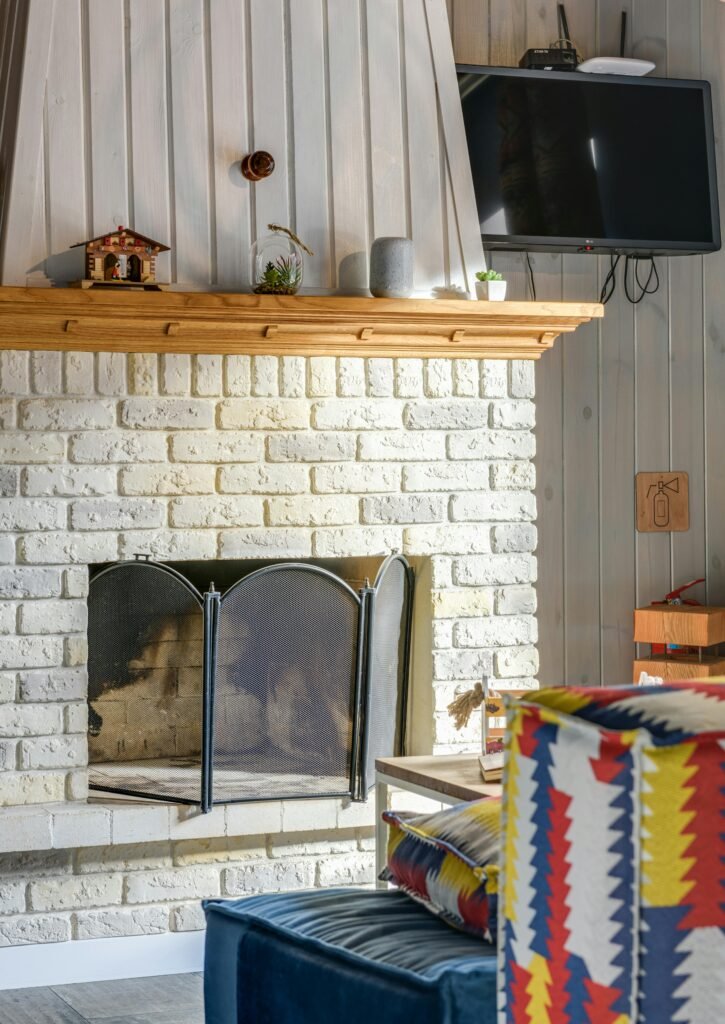
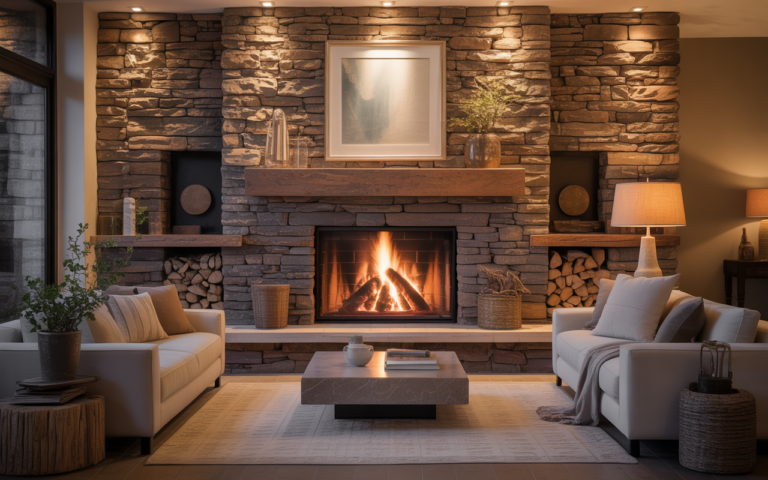
The wall above your mantle is where the whole composition begins. Whatever you put there — or choose not to put there — sets the scale and anchor for everything on the shelf below it. Most styling mistakes on a mantle happen because the above-mantle decision wasn’t made deliberately, and the shelf arrangement is trying to compensate for an empty or under-scaled wall.
Three options work. The first: a large mirror. A mirror above the mantle reflects light, makes the room feel larger, and provides a neutral but strong focal point that allows the shelf arrangement beneath it to change with the seasons without the whole composition falling apart. The mirror should be large — at least two-thirds the width of the mantle — and proportionate to the height of the wall above it. A small mirror floating in the center of a large wall looks tentative. A mirror that fills the space looks intentional.
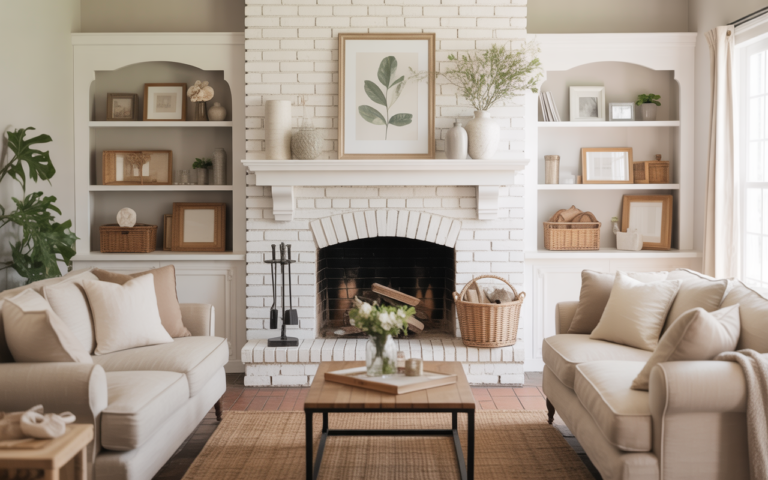
The second: a single large piece of art or a framed print. Same principle — large enough to anchor the space. This is the more personal choice, and the art becomes the personality of the whole arrangement. Everything on the shelf should relate to it, at least tonally.
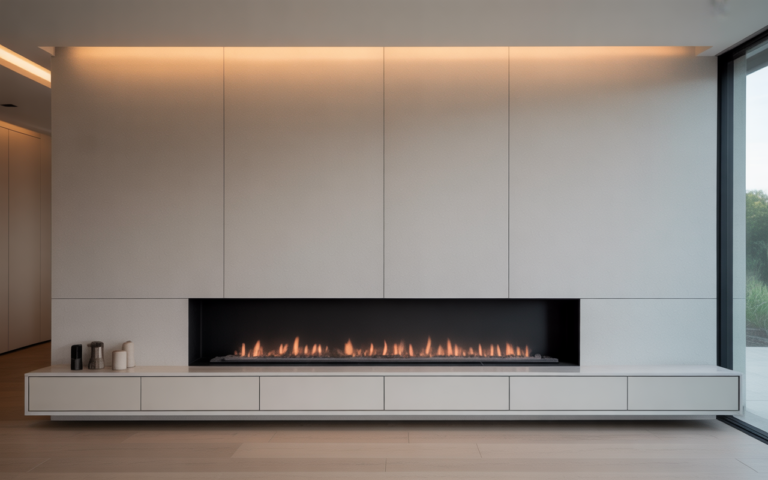
The third: nothing, with a very strong shelf arrangement. This works when the mantle itself is architecturally interesting — an ornate surround, a beautiful stone or tile, a color that stands out — or when the shelf arrangement is confident enough at scale to not need an anchor above it. It’s the hardest option to pull off because it requires the shelf composition to carry the whole wall.
What doesn’t work: a small decorative sign, a medium-sized print that doesn’t fill the space, or a clock that’s too small to register from across the room. Scale matters above a mantle more than anywhere else in the room.
Build for Height Variation — The Eye Needs Somewhere to Travel
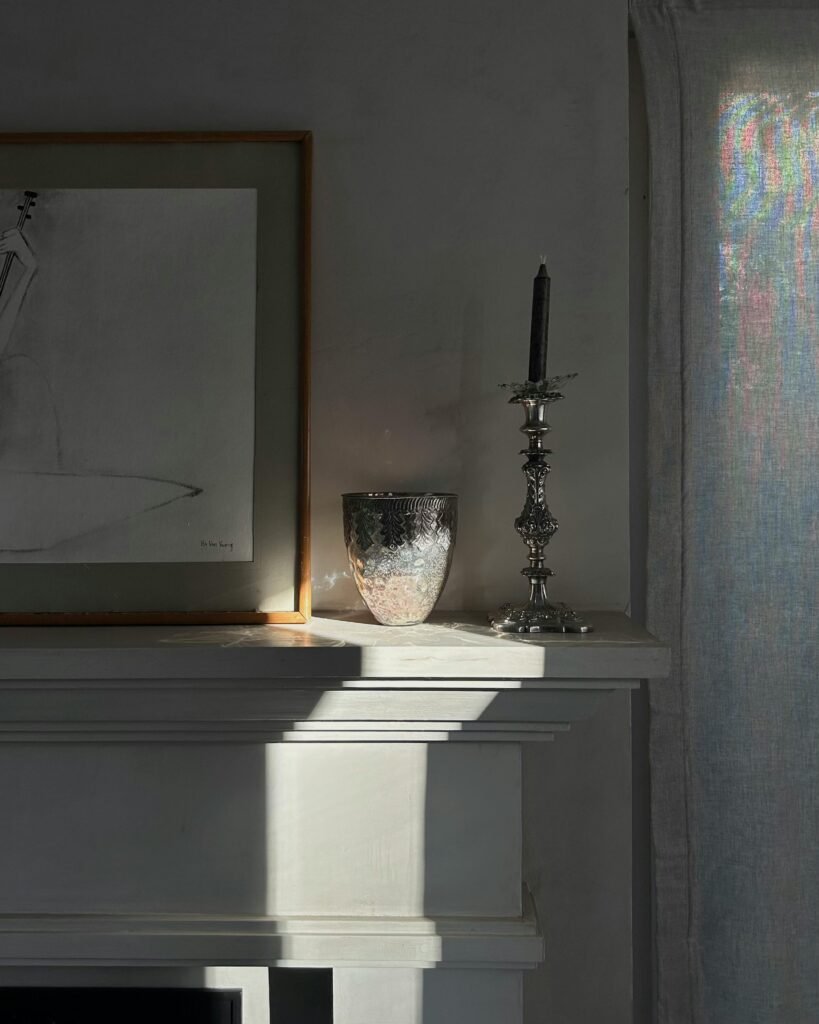
A mantle arrangement where every object is roughly the same height looks flat. A mantle arrangement with good height variation — something tall, something medium, something low — gives the eye a path to travel and the composition a sense of movement.
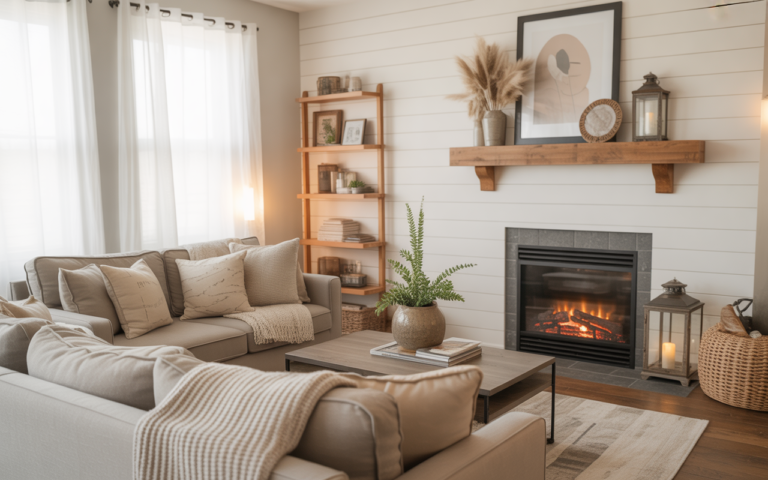
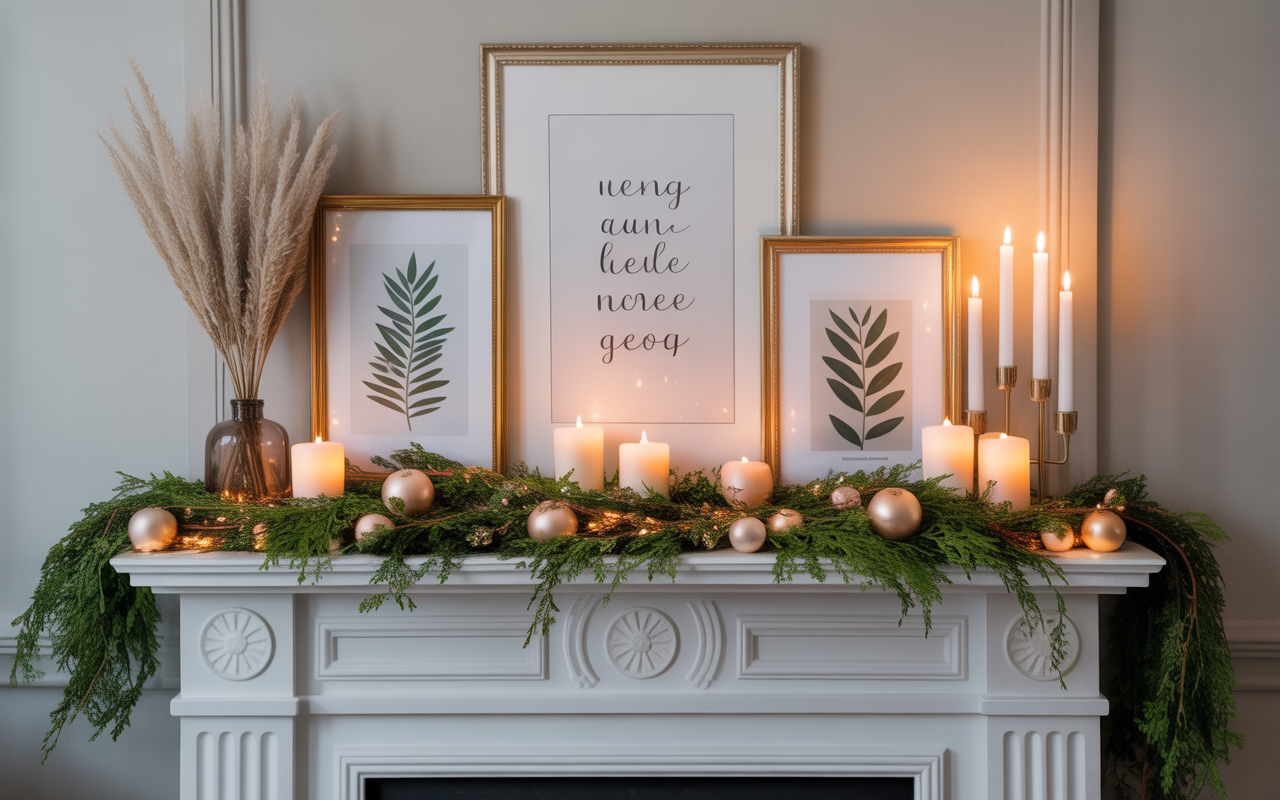
The practical approach: anchor one side (or the center) with the tallest element. This could be a tall vase with branches or greenery, a pair of candlesticks at the tallest setting, a sculpture, or a stack of books with an object on top. From there, step down in height toward the other side or toward the outer edges, with the lowest objects — a small plant, a candle in a low holder, a decorative bowl — at the ends or in the foreground.
The silhouette of a well-styled mantle, viewed from across the room, should be varied and interesting — not a flat line of objects at the same height, and not a steep pyramid (everything funneling to a central peak), but something asymmetrical and organic. Think of how a good flower arrangement has a deliberate varied profile; a mantle arrangement benefits from the same thinking.
One practical trick: when you’ve arranged the mantle, walk to the other side of the room and look at it from there. The profile you see from ten feet away is the composition that matters — not the up-close view you have while you’re arranging it.
The Rule of Odds — Groups of Three Work Better Than Pairs
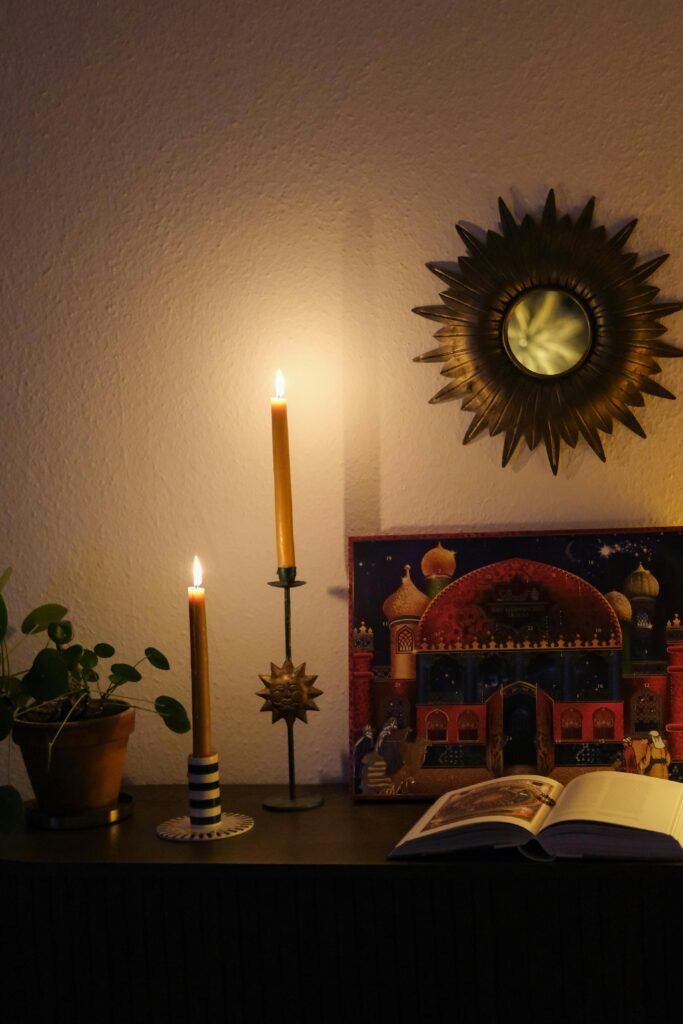
Pairs feel static. A pair of identical candlesticks, a pair of matching vases, a pair of framed photos of equal size — symmetrical arrangements like this read as formal and hotel-ish, which works in some contexts but usually not in a home that’s trying to feel warm and personal.
Groups of three — and, to a lesser extent, five and seven — feel dynamic and alive. Three candles of different heights. Three objects in a cluster: a tall one, a medium one, a small one. A vase of greenery plus two candles plus a small dish. These groupings have internal logic that the eye reads as interesting rather than predictable.
The exception: intentional symmetry can work beautifully on a mantle when it’s genuinely deliberate and the objects chosen for it are strong. A tall candlestick flanking each side of a large mirror, with a centered arrangement in the middle, is a classic mantle formula that works when executed with confidence and good objects. The problem is when the symmetry is accidental rather than chosen — objects ending up in pairs by default — which produces something that looks balanced without looking designed.
The middle-ground approach for most mantles: loose symmetry with variation. The left side and right side have similar visual weight, but the objects aren’t identical. A tall vase of greenery on the left balanced by a shorter cluster of three candles on the right. Similar weight, different elements, more interesting than exact mirroring.
A Focal Point on the Shelf — One Thing That Anchors Everything
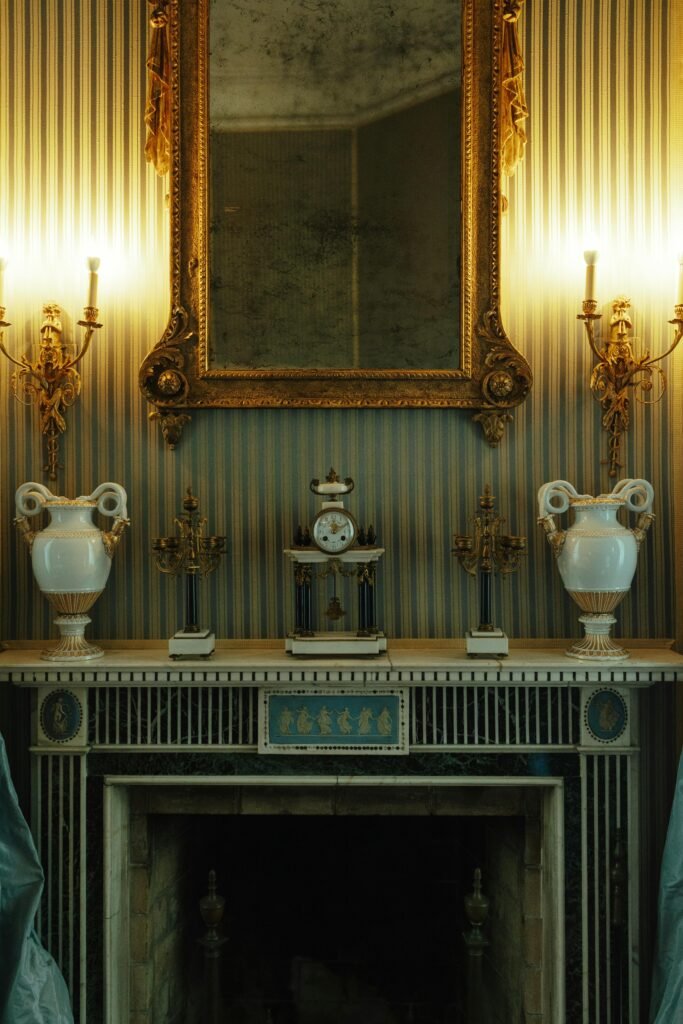
Every mantle arrangement needs one object that’s doing more work than the others — the piece the eye lands on first, the thing that gives the arrangement its personality. Without a focal point, the eye moves across the mantle in a restless sweep and doesn’t settle, and the whole arrangement feels like a collection rather than a composition.
The focal point can be almost anything that’s strong enough at scale: a beautiful piece of pottery in a color that contrasts with the wall, an interesting clock (more on this shortly), a sculpture, a stack of large books with something significant on top, a single oversized candle in a statement holder. What makes it a focal point is relative scale — it should be noticeably larger or more visually significant than the objects around it — and placement, usually slightly off-center toward one side or exactly at center with supporting objects flanking it.
The objects that don’t work as focal points: things that are interesting up close but don’t read from across the room (small figurines, delicate small frames, intricate decorative objects that require proximity to appreciate). A mantle focal point needs to communicate at a distance. If you have to walk up to see what it is, it’s not doing the job.
Greenery — Living or Not, Something Growing
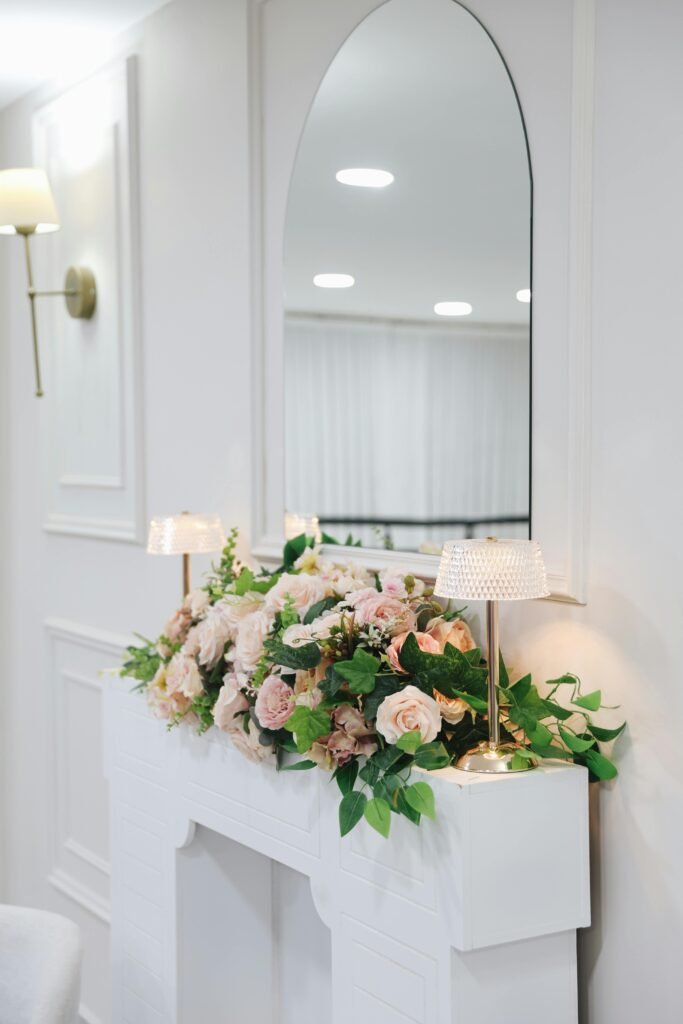
A mantle without anything alive — a plant, fresh or dried greenery, even a high-quality artificial stem — tends to feel static and finished in the wrong way. Something organic brings a quality to the arrangement that manufactured objects don’t have: the slight imperfection of natural form, the visual texture of leaves, the sense that the space is inhabited rather than staged.
The simplest version: a single vase of eucalyptus stems, which are available dried year-round, smell clean and faint, and hold their silver-green color for months without care. They’re $6–12 at Trader Joe’s or most grocery stores with a floral section, and they work in almost any style of room. A bunch of dried pampas grass in a tall vase does the same job with more presence and drama.
For seasonal rotation: spring calls for real or faux tulips and hyacinths, cherry blossom branches, or ranunculus in a vase. Summer works with garden cuttings — whatever’s overflowing outside brought in. Autumn is made for dried magnolia leaves, wheat stems, berry branches, and pine cones arranged in low bowls. Winter is where evergreen garland laid across the mantle shelf (with nothing else required above a certain point of the arrangement) earns every inch of the space.
The quality distinction that matters for faux greenery: the stems and the base of the plant, not just the leaves. Bad faux greenery is identifiable from the plastic stems and the way the leaves cluster in obviously manufactured configurations. Good faux greenery (IKEA has some surprisingly decent options; Pottery Barn and McGee & Co. have better ones at higher prices) fools the eye even from close range. It’s worth spending slightly more on one good faux stem than buying three cheap ones.
Candles — Height, Warmth, and the Right Placement
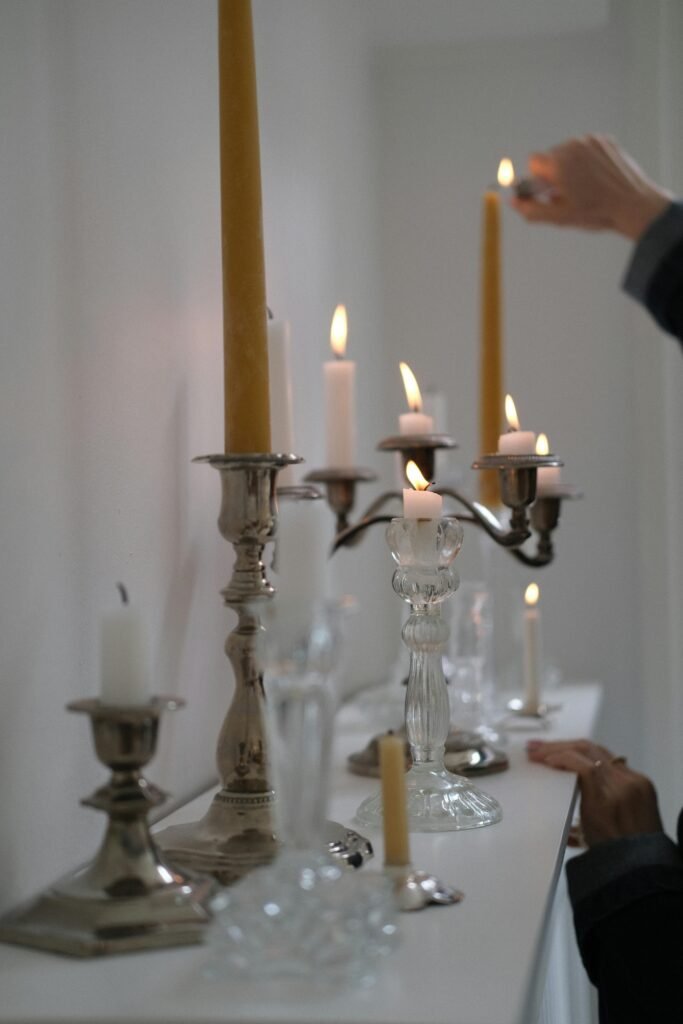
Candles on a mantle are the oldest mantle decoration there is, and they remain the most effective for the same reason they always were: the light they produce is warm, directional, and alive in a way that no other light source in the room can provide. From across the room, a cluster of lit candles on the mantle glows differently than any lamp, and the effect on the room’s atmosphere is immediate.
The arrangement approach: varying heights rather than matched pairs. Three candlesticks of different heights — tall, medium, short — clustered together on one side of the mantle, or distributed with the tallest at center and stepping down to the sides. The holders matter as much as the candles: ceramic, glass, metal, or stone holders in finishes that work with the room’s palette. Avoid plastic or obviously cheap holders — they undermine the warmth of the candle itself.
For the mantle specifically: taper candles in candlesticks give the height variation that pillar candles alone can’t provide. A combination of a tall taper in a candlestick and a chunky pillar candle in a low holder uses both forms and creates more visual range.
The practical question about lit candles on a mantle: never leave them unattended, obviously — but beyond that, consider whether your mantle arrangement is stable enough that a candle that burns down significantly won’t create a hazard. A pillar candle that’s burned down to within an inch of a nearby paper or dried plant is a problem. Battery-operated flicker candles in candlesticks solve this entirely and, for the mantle specifically where the candles are often more about visual effect than about being the primary light source in the room, they’re a reasonable and safe choice.
The Clock Question — Statement or Supporting
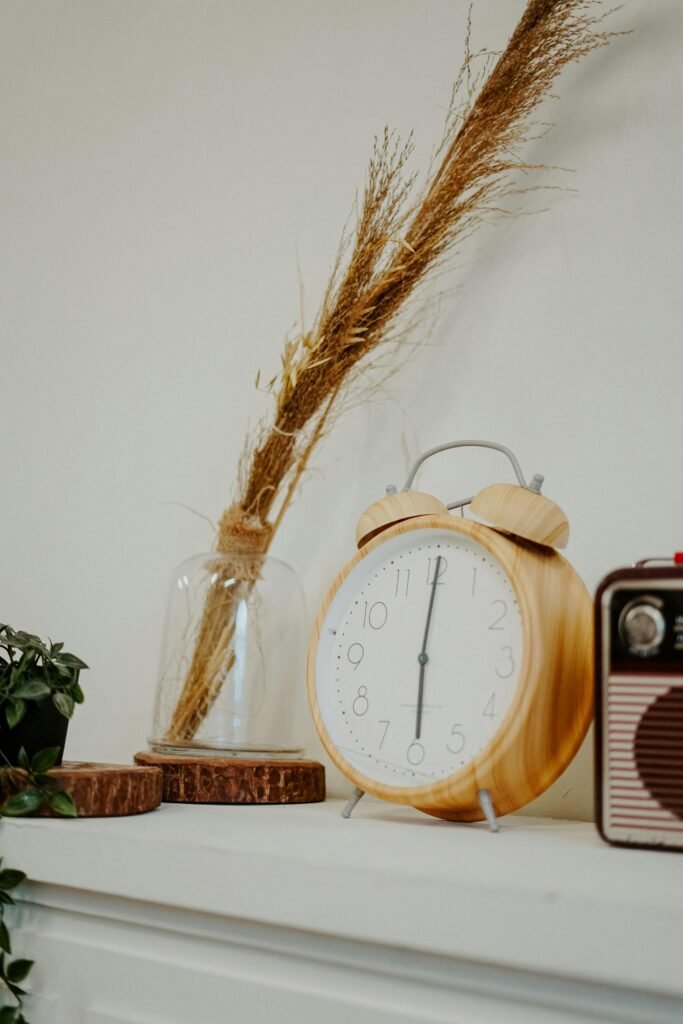
A clock on a mantle has a long tradition, and the right clock can do exactly what a mantle needs: a strong, functional object at the right scale that provides both a visual anchor and a practical purpose. The wrong clock — too small, too ornate without enough presence, or generically decorative — is just another object competing for attention.
A clock works as a focal point when it’s large enough to be seen from across the room and interesting enough in design to reward attention. Vintage or antique clocks — the kind with visible mechanisms or architectural cases — tend to work best because they have character that manufactured contemporary clocks often lack. A beautiful old clock in a mahogany or slate case is a reason to look at the mantle; a mass-produced decorative clock is usually not.
If a clock is in the arrangement but not the focal point, it needs to be genuinely subordinate — smaller, less visually dominant, sitting within a grouping rather than standing alone in the center. The mistake is placing a medium-sized clock in the center of the mantle where it should be the focal point but isn’t strong enough to do the job.
One place to find good mantle clocks: estate sales and antique shops, where genuine old clocks with interesting cases are often priced reasonably because they’re not fashionable in the way contemporary decorative items are. A real clock is almost always more interesting on a mantle than a decorative replica.
Personal Objects — The Things That Make It Yours
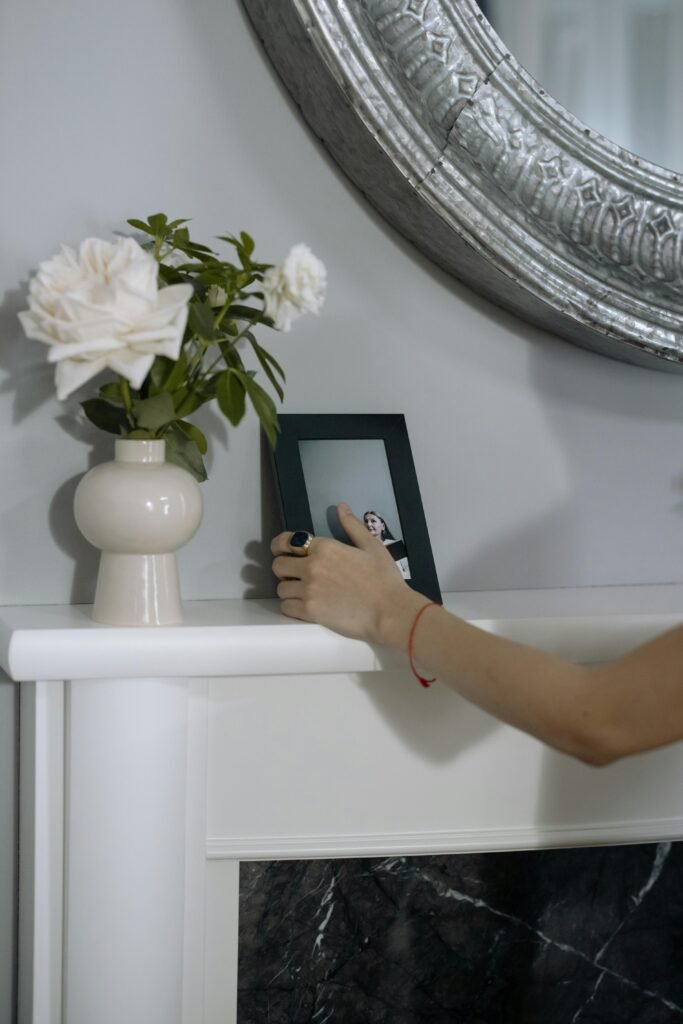
A mantle without anything personal looks like a showroom. Family photographs, a piece of pottery made by someone you know, a vintage object that tells a story, a piece of art you bought somewhere that mattered — these are the objects that turn a well-arranged mantle into a mantle that belongs to a specific person.
The styling challenge with personal objects is that they’re often the wrong size or shape for where they’d look best in the composition. A family photo in a 4×6 frame disappears on a mantle. The same photo in a substantial 8×10 or 11×14 frame — or three photos arranged as a small triptych in matching frames — becomes a presence.
The approach that works: treat personal objects as the starting point and build the arrangement around them rather than fitting them in after. If the thing you most want to display is a small ceramic bowl from a trip to Portugal, that bowl becomes the center of one grouping, and the other objects — a candle behind it, a small plant beside it, a book beneath it for height — support it. The bowl is the thing; everything else is the setting.
Vintage objects on a mantle earn their place by having visual quality that holds up from across the room. A genuinely interesting old clock, a beautiful antique vase, a piece of old pottery in an unusual color — these look better on a mantle than in a cabinet because the mantle is where you actually see things. The key question for any vintage piece you’re considering for the mantle: does it hold up at distance? If yes, it belongs there.
Seasonal Rotation — How to Change Everything by Changing Very Little

A mantle that looks good year-round doesn’t require a complete restyle four times a year. It requires a structure — focal point, height variation, greenery, candles, personal objects — that stays in place across seasons, with the greenery, the accent colors, and one or two seasonal additions doing the work of marking the time of year.
The practical system: keep the architecture of the arrangement constant. The large mirror or art above stays. The focal point object — a beautiful ceramic vase, a significant clock, a sculptural piece — stays. The candlesticks stay. What changes: the stems or branches in the vase (eucalyptus through fall and winter, cherry blossom in spring, garden cuttings in summer), the small accent objects (a few pine cones in November, a small nest with eggs in March, a seashell or two in July), and the colors of any textiles or candles in the arrangement.
This approach costs almost nothing to maintain across seasons because you’re replacing inexpensive naturals — a bunch of stems, a handful of objects from outside or a craft store — rather than buying a whole new set of decorations four times a year. A mason jar of collected acorns in October, a few bare branches in February, a small pot of hyacinths in April — these cost almost nothing and signal the season without requiring a complete overhaul.
The Edit — Taking Things Off Is the Most Important Step
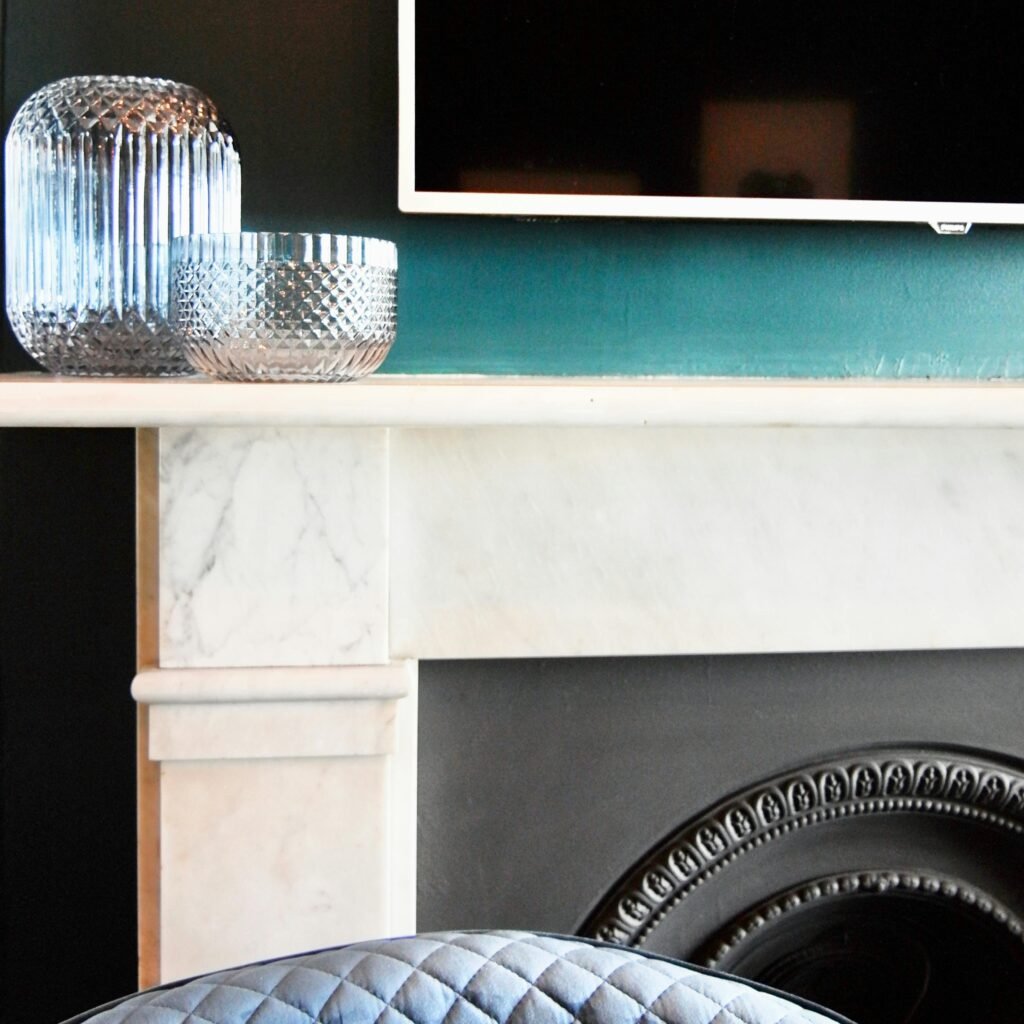
The single most common reason a mantle doesn’t work is that it has too much on it. Every surface in a home tends to accumulate objects over time — cards that arrived and were propped there, small gifts without another home, objects that seemed right when they were placed and never quite made it off — and the mantle accumulates faster than most because it’s a natural landing surface at eye level.
Editing a mantle means taking things off until only the things that genuinely earn their place remain. The test for each object: does it contribute something specific to the composition — height, color, personal meaning, visual interest from across the room — or is it there because it was there last time? If you moved it to the windowsill or the bookshelf and the mantle looked better without it, it doesn’t belong on the mantle.
Negative space on a mantle is not wasted space. It’s what allows the objects that remain to be seen and appreciated individually rather than experienced as a mass of stuff. A mantle with six strong objects and breathing room between them looks better than a mantle with twelve objects that have to crowd together to fit.
The practice of removing before adding: whenever you want to change or update the mantle, take everything off first. Stand in front of the empty mantle. Then add back only the things that clearly belong, one at a time, stepping back after each addition to evaluate the composition from across the room. This process consistently produces better arrangements than adding to what’s already there, because adding to existing arrangements is how mantles get over-decorated.
Questions Worth Asking Before You Start
What if my mantle is very narrow? A narrow mantle (under 6 inches deep) limits the range of objects you can use but doesn’t change the principles. Lean art against the wall rather than hanging it, so it sits on the shelf and creates depth the narrow ledge can’t provide on its own. Use taller, slimmer objects — taper candlesticks, single stems in narrow vases, flat books stacked vertically and leaned — rather than objects that need depth to sit stably.
Should my mantle match the rest of the room’s decor style? It should relate to it without being a literal repetition of it. A modern room with a mantle arrangement full of rustic antiques reads as confused; a modern room with one beautiful vintage piece among clean-lined contemporary objects reads as layered and personal. The mantle doesn’t need to match perfectly — in fact, a mantle that’s slightly more personal or slightly more curated than the rest of the room is often the best version of it.
How do I style a mantle with no fireplace? A floating shelf at mantle height, a built-in ledge, or even a deep windowsill can be treated with the same compositional approach. The absence of a firebox below actually makes it easier — you’re working with just the shelf and wall, without having to relate the arrangement to an architectural feature beneath it.
What’s the most common mantle mistake? Symmetry without intention and scale without proportion — putting a small object in the center that should be the focal point but isn’t large enough to carry the role, and flanking it with matching objects that produce a static, hotel-lobby arrangement. The fix is almost always to go larger with the center piece, loosen the symmetry, and add height variation.
The Mantle You Look Forward to Coming Home To
The best mantles have two qualities that are hard to define but instantly recognizable: they look like they were composed by someone, and they look like they belong to someone. The composition part is the craft — the focal point, the height variation, the editing. The belonging part is the personal objects, the seasonal greenery, the things that are specific to the life being lived in the house.
You can have both. You usually can’t buy them pre-packaged from a home goods store. They come from knowing which things you actually love and building an arrangement around those, rather than starting with a decorating scheme and filling it in.
Take everything off your mantle. Stand back. Add back the thing you love most. Then build from there.
What’s the one object on your mantle that you’d never take off? Drop it in the comments — those are always the most interesting answers.
— Emily